




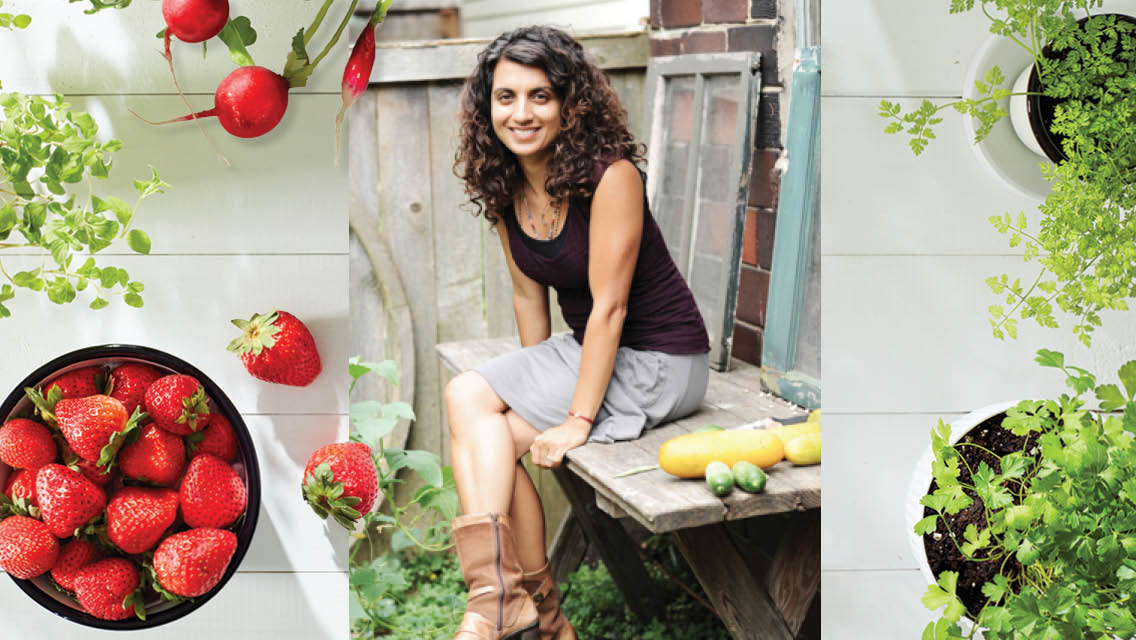
When Geeta Maker-Clark was 19, she knew she wanted to practice medicine, but beyond that she wasn’t so sure. Then she traveled to the Indian state of Rajasthan to learn more about her ancestral and agricultural roots. It was there that she met an elder healer who would shape her perspective for decades to come.
“She was very steady, grounded, and attuned to the people who came to her for guidance,” recalls Maker-Clark, MD, now an integrative physician and clinical professor at the University of Chicago Pritzker School of Medicine. “She was the wise elder of the community, never in any rush to make a judgment or a diagnosis, and very centered in deep listening with her whole being.”
After reflecting on Maker-Clark’s concerns about her future, the healer provided her with a clear framework: “She told me to not focus on fixing what’s broken but rather on nourishing what has been forgotten.”
Restoring forgotten connections — to ourselves, to nature, to one another — is now the centerpiece of Maker-Clark’s healing work.
“My approach to medicine is both integrative and ancestral,” she explains. “It’s a spiritual path that is connected to the earth, to nature, and to humanity. When I was in my training, I realized that the science that I loved in medical school and the traditional wisdom that I had been steeped in were not opposites. They were both very much part of a larger paradigm of ancient wisdom that I could see very clearly.”
She believes one of the simplest ways we can recover our sense of connection and belonging is through food. That might mean learning where our food is sourced, discovering our ancestral food traditions, or growing some edible plants. Even a pot of herbs on a windowsill is enough to slow us down and remind us that we and our food belong to the same connective web.
“Almost everyone has some relationship in their childhood with an herb or plant, whether it was grown in a pot in their house or in their family garden, or just a plant that was used often in their cuisine — maybe an herb or a seasoning,” says Maker-Clark. “I ask folks to think about what brings them some comfort and what they’re drawn to when they think of certain plants. Then I invite them to notice how their bodies are responding to that.
“We all have incredibly sophisticated physiologic systems that connect our body, mind, and spirit. Restoring and supporting those connections to ourselves, our communities, and the living world that sustains us — that’s what I’m interested in.”
We asked Maker-Clark, who is also codirector of the Culinary Medicine program at Pritzker, to talk with us about her philosophy of food and connection. This is some of what we learned.
Q&A
With Geeta Maker-Clark, MD
Experience Life | How do you understand food as medicine?
Geeta Maker-Clark | To me, food as medicine is literal, in that the nutrients we take in through food are the foundation of our cellular growth and integrity. Food influences inflammation, immunity, our risk of disease, even our mood.
On a deeper level, food as medicine is profoundly personal. Food is also about care and culture. It’s a carrier of memory. And the ways we cook and share food influence how we feel nourished. I often tell people that even if you’re not eating the most perfect nutrient-dense meal, if you’re eating it amongst people who you love, or with great joy and connection, that’s also medicine.
EL | You’ve noted that in wisdom traditions like Ayurveda and Traditional Chinese Medicine, there’s no “one true way” to eat. Can you say more?
GMC | There is a trend toward all of us conforming to one pattern of eating. Right now, it’s a push toward eating lots of protein. I think these global prescriptions are problematic, because the idea that there’s one perfect diet for everyone is a modern illusion.
Real nourishment is responsive to your own needs. It’s flexible and adaptable. Both Ayurveda and Traditional Chinese Medicine are rooted in an understanding that health is contextual. What’s healing for one person in one season might be unbalancing for another. There is never just one way to eat well.
Ayurveda teaches us to align with cycles, with nature’s rhythms, with our own constitution, and even with the seasons of our own lives. What we need to eat as a younger person might be different from what we need when we’re moving into another chapter of our life.
EL | You teach a class called Food Is Power to middle-school students in Chicago. What do they learn from you?
GMC | We teach on everything from vitamins and minerals to food justice. I want students to learn that they have power in their food choices — that they don’t have to just listen to people telling them what to eat, or to eat whatever is given to them.
One lesson covers what’s called the “bliss point” in processed foods. So, if they choose, let’s say, a bag of Doritos, we teach that it isn’t a lack of willpower if they end up finishing the entire large bag. It’s because the food was created by a food scientist who crafted a flavor that makes it very difficult to stop eating it. They learn that these processed foods have been crafted for them to eat and finish, and that they don’t contain the things that they need to stay full and feel focused for the whole day.
To me, that knowledge is what the class is about. I’m saying, “We are giving you the power of this knowledge, and what you do with it is always going to be your choice.”
EL | How can we learn to approach food as medicine in our daily lives?
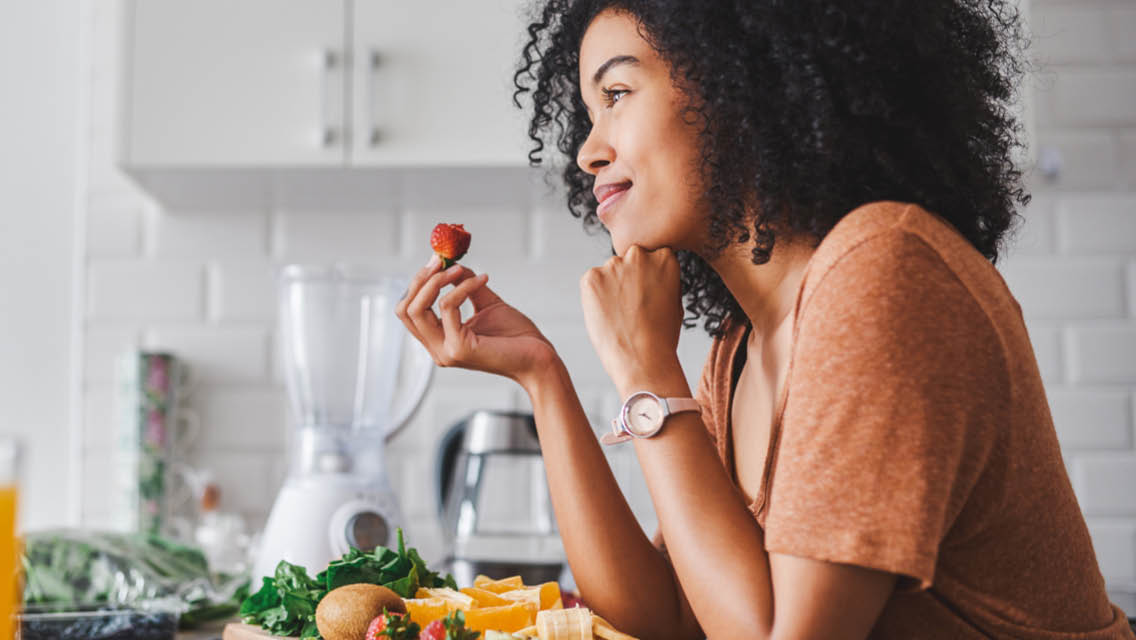
GMC | I think slowing down with your food is a good place to begin. When we slow down and eat mindfully, we can remember that every meal is information for the body, an opportunity to nourish ourselves. Food has become somewhat transactional. We’re eating quickly, eating on the go, to keep ourselves fueled up so we can move on to the rest of our day. But in all our ancestral cultures, eating was a time that you slowed down. You sat down. You took time for blessings, and you enjoyed either the company of yourself or the company of others.
EL | For those of us who have a hard time slowing down, are there any practices you recommend?
GMC | Before you take the first bite, pause for one slow inhale and exhale. This activates the “rest and digest” response and primes your body for eating. You don’t have to eat the whole meal slowly. Just savor the first three bites — notice texture, warmth, aroma, and taste. This can shift your pace for the rest of the meal.
Another ordinary ritual I love is making tea, because it’s so simple to boil water, and it also takes a little bit of time. So, while you’re waiting for the water to boil, stop and ask yourself, What do I really need right now from this? Do I need grounding? Do I need calm? Do I need warmth, physical or emotional? And then you can decide what kind of tea you might like (try one of these recipes to make teatime more delicious).
That ritual — boiling the water, checking in with yourself, smelling the tea, pausing to breathe — is all part of the medicine.
EL | Your book, Medicine for All People: Science and Ancient Wisdom for Revolutionary Healing, is due to be published in August 2026. It focuses on the many everyday forms of medicine available to us. What are some of them?
GMC | Practices like dancing, being in nature, making simple food, being of service, and having a regular gratitude ritual help us remember who we really are. These are the medicines of the spirit and for this moment, when so many of us are feeling disconnected from ourselves and from one another. Ancestral wisdom teaches us to always return to reciprocity and to relationships, and to remember that healing is always a collective pursuit, not an individual one.
We already carry the wisdom we need to heal. We don’t need to seek it anywhere else. We have it. It is free and accessible and part of our inheritance. We just need to remember it and nourish it every day.
This article originally appeared as “Food as Medicine” in the March/April 2026 issue of Experience Life.

This Post Has 0 Comments