



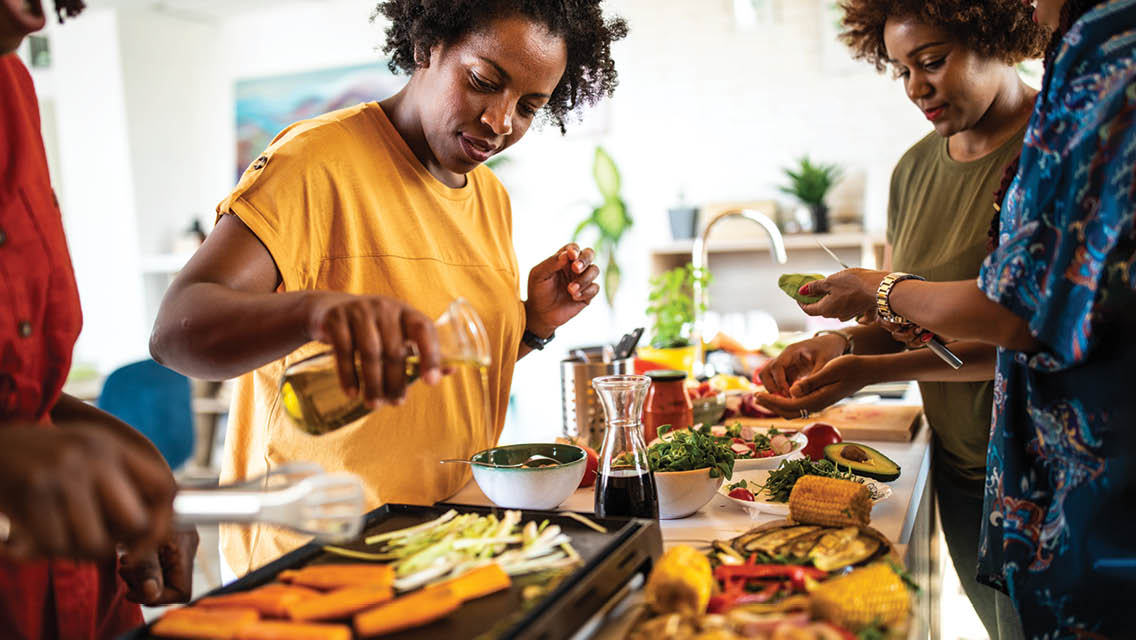
When Joanna Wing left her city life in St. Paul, Minn., for a home in the suburbs, people told her that she wasn’t going to have any fun because it wasn’t “cool there.” But, she decided to start the North Suburban Supper Club. In addition to creating a convivial space to unwind, enjoy food, and bond with friends, Wing says, her supper club has improved her kitchen skills: “It teaches you how to time the food, which turns out to be important as we get older, our kids go every which way, and we have 20 minutes to make dinner.”
Sharing a meal prepared in your own kitchen is often far less expensive than dining at a restaurant, and it’s a healthy habit to cultivate. A growing body of evidence links more frequent restaurant dining to an increased risk for heart disease, type 2 diabetes, and depression.
“We’re simply not going to stem the tide of increasing chronic disease . . . until Americans start eating at home,” says longevity researcher Dan Buettner, author of The Blue Zones: Lessons for Living Longer From the People Who’ve Lived the Longest, whose latest book, The Blue Zones Kitchen One Pot Meals, aims to make it easier to do that.
Even if you aren’t inclined to cook for yourself, cooking for the people you care about can inspire you to get into the kitchen and try stuff.
“Cooking for others is an act of generosity,” explains cookbook author Amy Riolo. “It doesn’t even have to be elaborate, but when we do it, we enjoy cooking more and we tend to make more-nourishing food.”
These tips can help you increase your confidence in the kitchen:
- Have a realistic plan. If you lack experience, don’t try to make a soufflé before you’ve learned to scramble an egg. Get a few simple recipes under your belt and initially aim to make dinner a couple nights a week.
- Keep dinner simple. Don’t wait to become a better cook before you start sharing food (though sharing food may eventually help make you a better cook). If what you know how to make now is lentil soup, then invite friends over for lentil soup. Ask someone else to bring the salad.
- Take some risks. If you’re already a comfortable cook, let gatherings be a springboard to expand your repertoire. “My absolute favorite way to host a dinner party is to make a menu of recipes I’ve never cooked before,” says functional nutritionist Jesse Haas, MS, CNS, LN. “Yes, it might be terrible, but we’ll have fun.”
Let’s Eat Together!
The rewards of eating with family and friends extend far beyond the dinner table. Learn why it’s worth the effort to sit down and dine with others at “5 Surprising Reasons Why Eating With Others Is Good for Your Health,” from which this article was excerpted.



Comments (0)