



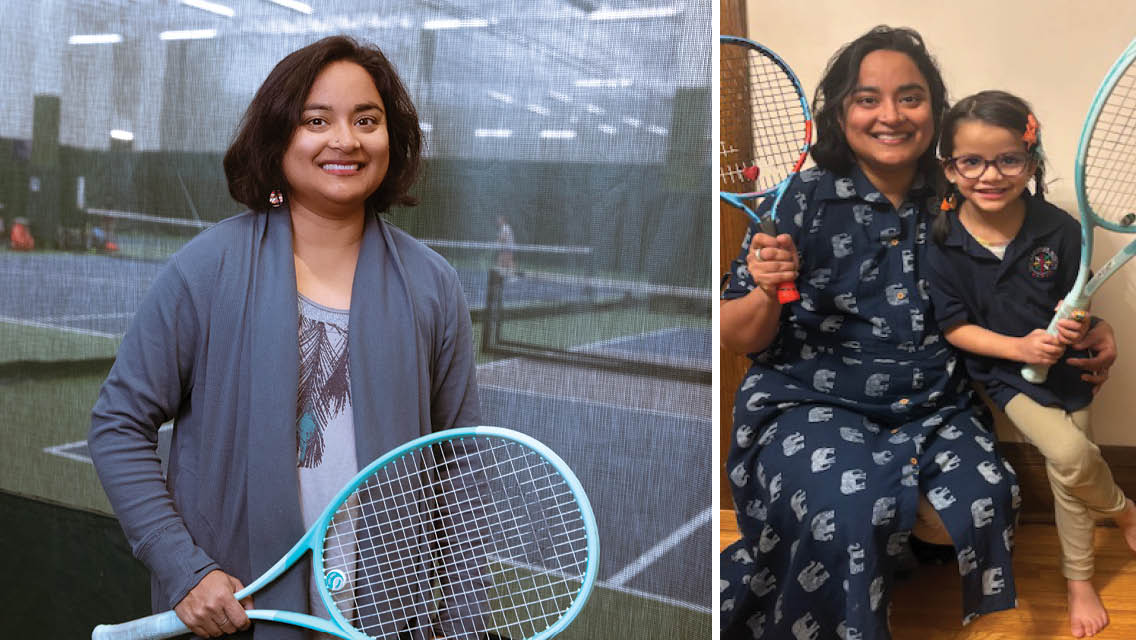
I remember the experience clearly: I was in junior high school in Wayne, Neb. It was sunny, hot, and dusty. My face was flushed, but not just from the heat. I was mortified. My gym class was dividing into teams for softball, and everyone had been chosen but me.
When my name was finally called, members of my team groaned. I was embarrassed by my lack of athletic ability — but, even more, I was scared because soon there would be softballs flying in my direction. And I would be expected to catch them or hit them, neither of which I could do.
I spent most of my life afraid of getting hit in the head. I didn’t play any ball sports, so I had no practice with them or understanding of the physics of how they worked. And if a ball was ever hurtling in my direction, I covered my head in terror and prayed that the person closest to me would catch it.
For decades I avoided my fear. But in early 2022 I decided to try a complimentary tennis class that came with my membership at Life Time, and my life changed.
Watching From the Sidelines
Fitness played a complicated role in my family of origin. My dad died when I was 13, and one of the memories I have is of him watching professional tennis matches. A frequent yeller, he’d get vocal, and he’d relish a powerful serve or particularly eloquent rally. I remember being intrigued and perplexed by the game.
Meanwhile, I ran track in junior high and high school. Other than the shot put, which I never tried, the sport was devoid of spherical objects. I was a sprinter, running the 100-, 200-, and 400-meter sprints and relays.
In the summer of 2000, my brother came to live near me in Minnesota for the summer. He was enthusiastic about tennis and played often. I couldn’t play with him because of my fear and because I didn’t know how. But I was intrigued. Some of my very dearest friends also played tennis, and I passively hoped that one day I’d be able to join them.
Sports and fitness remained a fixture in my life after I started a family. My husband played baseball and basketball and was devoted to his tae kwon do practice. My daughter participated in gymnastics, soccer, and competitive cheerleading. My son played soccer and baseball while I secretly cheered that I didn’t have to catch or throw the balls myself.
I went to yoga, strength training, HIIT, and stretch and balance classes at a locally owned gym where I was a member for 17 years. That gym closed in 2021 due to the pandemic, and we decided to become members at the Life Time in Fridley, Minn. We knew we’d frequent the Kids Academy with our youngest daughter.
Hitting the Ball
The Fridley club was enormous compared with our previous gym. We marveled at its multiple spaces for strength training, its group fitness studios, its swimming pools, and its tennis areas. The club even offered an introductory tennis lesson.
Despite my lifelong fear of balls, the lesson sounded fun, and it was a way for me to connect with my brother. It was also free. When things are free, I feel like there’s less pressure to perform at a certain level.
My tennis lesson was led by Malik Benyebka, a tall man with a kind face and a mean serve. We quickly determined that he was teaching my brother, too. I was thrilled by this information.
During that initial lesson with Malik, my fear was suspended for 30 minutes. We bounced the ball with our rackets. We gently passed it back and forth. The simplicity and casualness of the experience helped assuage my anxieties.
After our session, I knew that I’d like to learn more from Malik. I joined his drill class on Saturday mornings at 8 (talk about dedication!), where I learned how to hit and receive the ball.
In class, balls would fly in my direction but at a speed I could handle. The slower speed made them less formidable. I might not have been able to hit them, but I wasn’t afraid of them — which was a huge step for me. I also learned to watch the ball and anticipate where it would land.
A compassionate and caring teacher really helps when you’re trying to move past mental and physical obstacles. Malik is kind, fun, loving, funny, and thoughtful. He’s a responsive teacher and is always looking for the best way to teach a student a particular skill.
In class, Malik creates a playful atmosphere with music and camaraderie. He customizes feedback for each student, even in fast-paced drill classes. And I appreciate that he takes tennis seriously — but not too seriously.
Addressing My Inner Critic
It hasn’t all been rosy. Over time, I’ve discovered that behind my lifelong fear was an even greater fear. The more I played tennis, the more I noticed the times that I dreaded my drills. Sometimes I was afraid to play at all. I feared feeling inadequate and being unable to hit the ball or serve.
I discovered that both my bipolar disorder (diagnosed in 2003) and my perfectionism had infected my joyful tennis game. The critical voice in my head would tell me that I’d never improve, a destructive habit I picked up early in life.
I grew up in a family where it was common to compare. I was compared with my cousins, my brother, my friends. And it never helped me — not in junior high or in college or when starting out as a young stay-at-home mom. There was always someone smarter, prettier, or blessed with a better backhand, and seeing myself as less-than only made me more reluctant to participate.
My perfectionistic tendencies lead to unrealistic expectations and fuel the hyperactive critical voice in my head, and they become much worse when I am in a depressive space. These are the times I can easily talk myself out of going to my Saturday morning class.
I have benefited from meeting with numerous talk therapists in my life. They have helped me unpack that critical voice and develop strategies for reducing its power over my actions and inactions.
And my experience with tennis has helped quiet these cognitive distortions. The more tennis I play, the stronger I feel mentally and physically. Having Malik as a coach has taught me how to bring positive thoughts into my mind when it is flooded with negativity.
When I’m able to let go of some of the comparing, I can focus on my own game — my serves and my returns. Now I recognize that when my mindset is positive and centered on how I’m showing up, I’m a much more fun-loving and responsive tennis player.
And I’m not afraid of the ball.
Keeping Up the Practice
I’ve been attending the Saturday morning class for four years, and I take an additional drill class on Wednesdays. My tennis classes have helped me build community by introducing me to incredible people from all over the world.
I’ve also played tennis with my brother, and I hope to play soon with more of my friends. My 4-year-old daughter, Paloma, is taking tennis lessons in the Fridley program too, and I couldn’t be more delighted. Thanks to my experience with the Life Time tennis program, all I want to do now is play.
Piyali’s Top 3 Takeaways
1. Be willing to try new things. “When I finally gave tennis a shot, I found that it made me feel alive in a way that no physical activity had since before the pandemic,” Piyali says.
2. Create a sense of play. “Play is a great way to help you work through initial feelings of intimidation or fear,” she notes. “Furthermore, it creates a sense of safety, making mistakes less threatening.”
3. Have fun. “By choosing an activity you love, you can create more long-term health benefits.”
My Turnaround
For more real-life success stories of people who have embraced healthy behaviors and changed their lives, visit our My Turnaround department.
This article originally appeared as “Confidence on the Court.”




Comments (0)