



The pre-teen and teenage years are a pivotal time in a child’s life. They learn more about the world around them and often struggle to establish their own identity. As a parent, you want to set your child up for success, while also giving them the freedom to pursue their own interests.
During this crucial phase, Life Time can be a key partner as you help your child discover their passions while encouraging lifelong healthy habits that foster confidence and joy.
“When a child comes into a Life Time club, they’re exposed to so many different body types, ages, and sizes with each person grinding and working toward their goals,” says Becca Rigg, a group fitness coach at Life Time in Plymouth, Minn., and a mom of five kids. “They can see that health and fitness are accessible and learn how to make it part of their regular lifestyle.”
When kids reach the age of 12, they are eligible to use equipment and machines independently on the Life Time workout floor; at 13, they can download the Life Time app and access a digital world full of healthy-living topics, workouts, programs, and other wellness offerings, as well as reserve their spot at in-person fitness classes at their club.
To help you guide your child’s transition to using more Life Time amenities independently and safely, we asked Rigg, as well Kristine Fritz (senior director of classes at Life Time) and Shelly Forsberg (director of kids and aquatics business development for Life Time), to share some helpful tips.
1. Encourage your kid to lean into their Kids Academy experiences.
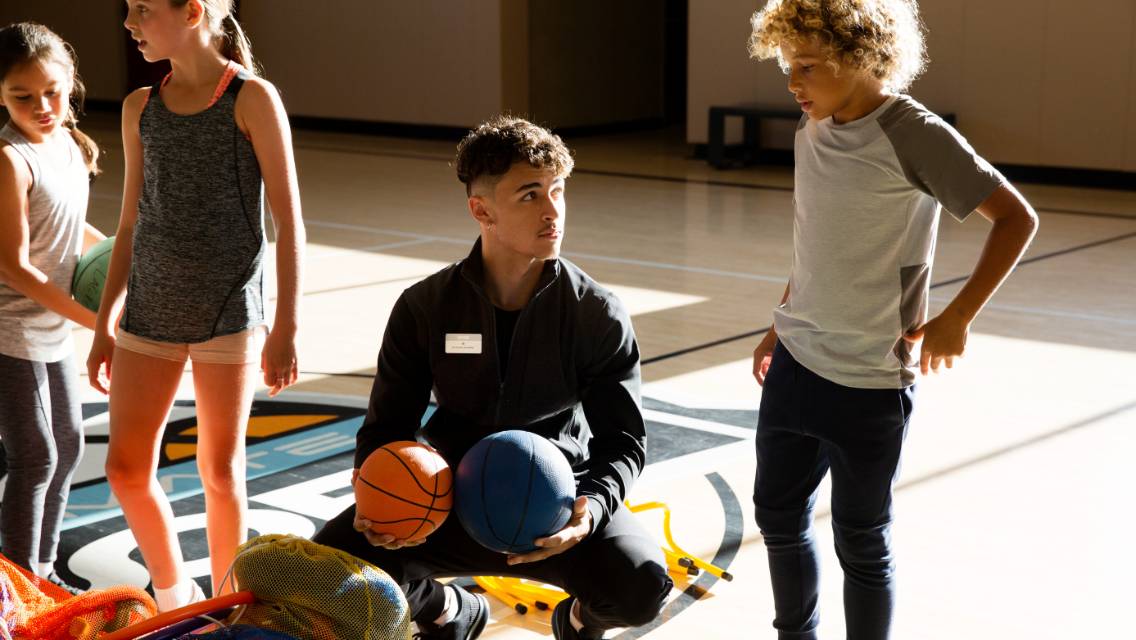
If your child is aging out of the Kids Academy, they already have a head start on the Life Time club experience. “They’re familiar with the club building and layout and can recognize team member faces — all aiding in their comfort level,” Forsberg says.
The Kids Academy also exposes kids to Life Time classes. “In our Kids Academy, we do our best to offer a different array of fitness-based programming that can tease what they’ll have access to when they age out of the academy,” she adds. “If a kid really enjoyed a yoga class from our Kids Studio offerings, then they can transition to an adult yoga class.”
From there, a child can find where their health and wellness passions intersect with their fitness goals, she explains. “This can help provide some more direction when kids start exploring more Life Time offerings.”
2. Leverage on-demand and live-stream classes on the Life Time app as a precursor for studio classes.
If your kid is nervous about attending an in-person class, the Life Time app can offer an intimidation-free foray into a class’s structure, cadence, and intensity level. “We have a lot of on-demand fitness classes — led by Life Time’s top instructors — that can give your kid a taste of what happens inside a class,” says Fritz. Her 13-year-old (which is the age when you can download the Life Time app and create a digital account) uses the app for her own workouts.
“There are also live-stream class options for your children. For example, if my daughter wanted to try out a class that involves lifting weights, she could try it out at home before reserving a spot in a class in the club,” she adds. “By using the app, kids can really familiarize themselves with the Life Time brand and classes, so they’ll be a little more comfortable when they transition to an in-person class.”
Life Time’s AI companion within the app, L•AI•C (pronounced “lay-see”), can also help answer your kid’s questions related to their health and even build workouts that match their goals. L•AI•C learns from information created by Life Time and its experts, including our fitness professionals who design a wide range of workouts. (Learn more: “Just Ask L•AI•C: Life Time’s Health and Wellness Companion.”)
3. Attend a class with your kid or suggest they bring a buddy.
At this age, your child might not want to go to a class on their own. “Speaking as an instructor, it’s very rare that I’m going to get a 13- or 14-year-old walking into class by themselves,” says Fritz, who teaches LIFT and MAXOUT classes at Life Time in Chanhassen, Minn. “It’s going to be more interesting and engaging if they can attend a class with a parent, guardian, or a friend — at that age, it’s all about being with their peers.”
But if your teen is attending for the first time by themselves, Fritz recommends that you encourage them to sign up for a class they’re particularly excited about. That level of excitement can help them overcome any nervousness. (Learn more: “The Ultimate Guide to Life Time Classes.”)
Fritz also suggests they arrive early if it’s their first time and let the instructor know they’re new to the class. “Our instructors are well equipped to help any member who’s walking through the door as a newbie, but they do need a buffer of time to connect with an individual and help them with any concerns, including setting up equipment,” she says.
Another benefit of studio classes for teens is the exposure to the foundational elements of fitness, says Rigg. “You’re often using lighter weights with basic movements, like hinge, press, squat, pull — this is helpful for when your kid eventually transitions to the workout floor with bigger weights and different modalities.
“When you’re in a class, you have an instructor you can look at for visual cueing and you’ve got people next to you doing the same movement — you have all these reinforcements of how to perform a movement,” she adds. “This is an invaluable environment for a kid learning about fitness.”
It’s all about belonging, says Fritz. “Ultimately, what kids are looking for at this stage of life is community, and that’s what’s so special about Life Time. We offer this immediate ability for anyone at any age to be a part of a community and to feel like they have a place and are valued.”
4. Sign your kid up for a Dynamic Personal Training session.
In addition to tagging along the first few times your child navigates the workout floor, parents might consider signing them up for at least one session with a Dynamic Personal Trainer — especially if they want to use strength or cardio machines. “For smaller bodies, a lot of adjustments have to be made for a movement to be safe and effective, which can be easily demonstrated by a Dynamic Personal Trainer,” Rigg says.
When she was a full-time Dynamic Personal Trainer, Rigg recalls being booked often by parents for a one-on-one session with their child. “When a kid had graduated from the Kids Academy, I would walk them through the workout floor and show them how to use the machines,” she says. “My favorite place to start would be at the TRX, since it’s versatile and can be easier to learn.”
A session can also offer a helpful introduction to gym etiquette, says Rigg. Kids can begin to learn and adopt good habits, such as not hoarding a machine or dumbbells, wiping down equipment after use, and showing respect for other members. A one-time complimentary Dynamic Personal Training session is available to all Life Time members — including junior members.
5. Promote a positive relationship with healthy living.
Encouraging kids to adopt a healthy lifestyle starts with exposing them to that way of life, which can then empower them to make healthy behaviors an essential part of their own lives, says Rigg. “At this age, your kid might start pushing back on a lot of things, but health and fitness is worth investing time and energy in, because the results can lead to so much confidence.”
It’s also important to help kids build a positive relationship with health, she adds. “It’s about building a habit versus seeking a result; it’s not about just building healthy, strong kids, it’s about building confident kids, which can bleed into every other aspect of their lives.”
Persistence and patience are key at this age. “I would say to parents, ‘Be patient and continue to keep pushing,’” she advises. “Find ways to get them involved with their own healthy-living goals and encourage them to keep showing up, because it’s worth it to see them make this a part of their lifestyle.”