




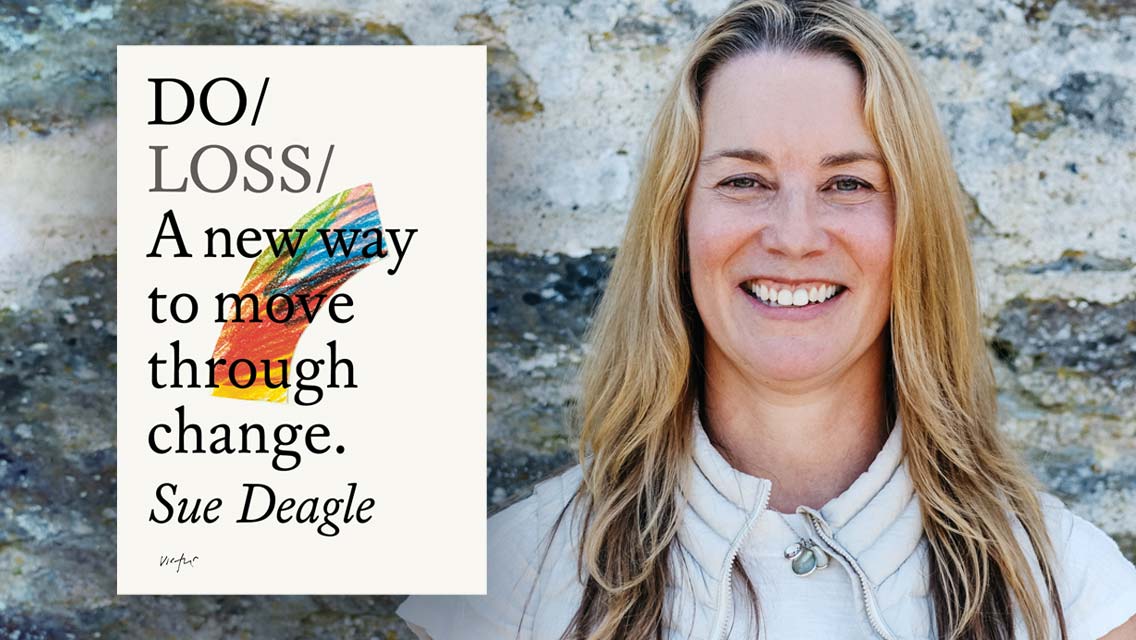
A few years back, I had this idea: I wanted to change the conversation around loss.
Because here’s what I noticed: We’re terrible at this. Whenever we’re facing a loss — whether it’s death, divorce, job loss, health changes, or any other major transition — we avoid discussing it with others. We hide from loss. We pretend it’s not happening. Then when it does hit, we’re completely unprepared.
We tell ourselves stories that don’t help. That loss makes us “less than.” That we should handle it alone. That talking about loss makes it worse. We’ve spent our lifetimes learning how to keep our losses hidden, convinced that falling apart means we are weak.
The stories we tell ourselves are doing us no favors.
Nearly 10 years ago, I experienced a catastrophic loss — the sudden death of my husband, Mike, which left me to care for our 11-year-old and 13-year-old alone. But today, I live a life that’s bigger than I ever imagined.
My book is about exactly what the title says: a new way to move through change. Instead of avoiding loss until it forces itself on us, we’re going to learn how to navigate it.
I’ve found that the concept of a playbook — most familiar from the worlds of business and sports — works remarkably well for navigating loss. Not as a script to follow, but as a flexible collection of tactics, techniques, methods, and strategies you can consider and apply during the different phases of your loss.
My own experience of loss revealed three phases that I call Cocoon, Adapt, and Emerge. In my playbook, I provide specific strategies for each. Some of these strategies you’ll embrace immediately. Others you’ll customize to fit your circumstances. Some you’ll dismiss entirely. That’s exactly how a playbook should work. Its power isn’t in following it precisely. It’s in the permission it gives you to choose what serves you, when it serves you, and how it serves you.
For this article, I’m going to dive deep into the Cocoon phase; for my step-by-step playbook for the Adapt and Emerge phases, you can check out my book.
The Cocoon Phase
How you know you’re here: It’s early days, and you’re still processing that this loss is real. You move erratically from one emotion to another. Time feels strange — some moments drag on forever, others disappear completely. Simple decisions feel exceptionally hard. The basics of life are challenging.
This is the phase where you need to pull back and focus on yourself. If you broke your leg, you wouldn’t expect yourself to run a marathon. You’d rest, limit activity, focus on healing. Loss requires the same kind of withdrawal. The clichéd journey of a butterfly gives us the visual here: This is the phase of caterpillar soup — the protected space where the messy, necessary work can happen.
This retreat is essential in the intense early period when the loss hits hardest. Those first hours, days, weeks, months when you’re still processing that your new reality is indeed your new reality. Pulling back keeps distractions to a minimum and provides the focus you need during this stage.
Here are six plays that can help you navigate the Cocoon phase.
1) Respect Your Emotions
Invite these unwanted guests to the party.
I spent 48 years avoiding unwanted emotions at all costs. I wouldn’t even listen to sad songs on the radio. Then Mike’s death obliterated my defenses. Thank goodness. Without processing emotions, there is no moving ahead.
When loss kicks tough emotions into high gear — anger, anxiety, despair, fear — our brains rebel. This isn’t weakness or failure on our part. Neuroscientist Lisa Feldman Barrett, PhD, explains that our brains are wired to predict and prepare for what might happen next, and when loss disrupts our world, our prediction systems go into overdrive trying to make sense of the threat. We try to run from both the loss and the overwhelming feelings that come with it. But working with our emotions, not against them, is the foundation for healing.
So, resist locking your emotions away. Filled with rage? Consumed by anxiety? Feeling hopeless? While this feels like chaos, it’s also a healthy dose of information. Facts that help you protect yourself, ask for support, or honor what you’ve been through.
This means letting yourself cry when you need to cry. Feeling angry without immediately trying to talk yourself out of it. Sitting with sadness instead of rushing to distraction. Punching a pillow. Walking it out. Jumping in the swimming pool and screaming underwater (been there, done that).
Your emotions aren’t problems to solve — they’re responses to process. Denying them only separates us from ourselves.
— Take Stock —
Reflect on the emotions that come up for you first after your losses.
2) Brace for the Chaos
Ride the rollercoaster even when you didn’t buy a ticket.
A few months after Mike died, a therapist handed me a piece of paper. It showed an expanded stages-of-grief diagram shaped like a “U”: denial, anger, bargaining, depression, and acceptance, plus a smorgasbord of other in-between stages — fear, shock, numbness — for extra effect. The message: You go down into the depths, then recover in a neat, orderly progression.
But then she showed me an identical drawing with an overlay: spaghetti-style squiggly lines all over the place, zigzagging everywhere, looping back, jumping ahead, creating a complete mess.
“This,” she said, “is what any major loss really looks like.” It was exactly how I felt. My emotions were everywhere — furious one minute, numb the next, then hit with a wave of unexpected gratitude, followed by crushing despair. Then a little awe sneaking in while touching that unfurling spring leaf.
When you’re processing a loss of any size, there’s no order to it, no tidy progression from one emotion to the next. Loss researchers Margaret Stroebe and Henk Schut have found that we naturally oscillate. You can think of that like the pendulum on a clock — swinging back and forth between feeling the chaotic emotions of the moment and taking much-needed breaks from them. That’s not a sign you’re doing it wrong. That’s just how it works.
— Take Stock —
Would knowing that chaotic feelings come and go help you make space for them when they arise?
3) Avoid Self-Judgment
Put your own weapon down.
Buddhists say that any time we suffer a loss, two arrows fly our way. That first excruciating arrow comes from a bow we don’t know — i.e., the loss itself. The second arrow? Look down at the vibrating bow in your own hands. Second arrows sound like:
- My loss isn’t as bad as other people’s.
- Everyone else would handle this loss better than me.
- I deserved this.
- I should be strong enough to do this alone.
Whether you’re beating yourself up about a lost deal, a job loss, or a health diagnosis you might have caught earlier, these thoughts just add to the stress. When these thoughts arise, picture yourself cocking that bow to shoot yourself. Then put your weapon down. Try catching yourself: “There I go again, shooting myself with my own arrows.”
Sometimes just noticing the pattern is enough to break it. Other times, ask yourself: “Would I say this to a friend going through the same thing?” The answer is a resounding no.
This isn’t about denying your assessments but recognizing how we irrationally twist what’s happening. Choose which thoughts deserve your attention and which you’ll leave behind.
— Take Stock —
Do you have a favorite way to beat yourself up for your reactions to loss?
4) Put Yourself First
It’s time to be selfish.
Selfishness gets a bad rap. In the Cocoon phase, you can’t be too selfish. Focusing on ourselves feels difficult, like it’s not aligned with our values or how we’ve been raised. But being the center of your own universe isn’t just allowed — it’s required. These aren’t normal times. If you are not self-centered, there will be no self left to center.
Sometimes it’s easier to identify what you don’t need — things that set you back, drain your energy, make you feel worse — than what you do. Maybe it’s avoiding certain people, skipping social obligations, or saying no to requests that feel overwhelming.
When people offered me meals, I’d ask them to leave the food on the front porch. If I had just calmed myself down from thinking about my messed-up life, I didn’t want to relive it with the lasagna-bearing neighbor showing up at my door. If I felt up for a hug, I’d make a surgical dash outside. Otherwise, I’d text a heartfelt thanks. Rude? If I hadn’t just experienced a loss, maybe. But since I had? Rude wasn’t a consideration. Survival was.
Having good boundaries and taking care of yourself conserves energy when you have none to spare. Step back. Recharge. Create the space to replenish yourself.
— Take Stock —
Taking a clear look at your constraints, what are a few realistic ways you can put yourself first?
5) Cope Dirty
If it feels good, do it.
We think there must be appropriate and inappropriate ways to cope. Surely it’s not a free-for-all? But actually, it is.
We judge how others handle losses: “I’d never do that.” The truth? You have no idea what coping mechanisms you’d reach for if you were in their shoes.
My guidance for coping in the Cocoon phase is simple: Whatever works.
Resilience researcher George Bonanno, PhD, says that sometimes, coping just needs to get you through the moment. My own version? Star Wars movies on repeat.
The kids would come downstairs and find me, glassy-eyed and zoned out, watching Han Solo and Princess Leia for the gazillionth time. They’d take one look at my vacant stare and quietly give me space. They understood, even without words, that I needed a mental break.
We assume coping must be productive, edifying, or virtuous. That it must advance our healing. What we fail to understand is that, sometimes, the Millennium Falcon and a mental checkout do exactly that.
Free yourself. Embrace the seemingly inconsequential things that help you survive. You might reach for wine, comfort food, or trashy TV. Tuning in to what you need right now builds a lifelong skill for navigating not just loss but life itself.
— Take Stock —
What are your Star Wars–type coping strategies?
6) Accept Support
Even the Lone Ranger had Tonto.
We have a thousand creative ways to talk ourselves out of accepting help. Our excuses sound like:
- My loss is too small. Others need help more.
- My loss is too big. I don’t want to burden anyone.
- My loss is too embarrassing. I’ll be judged.
- What if my people don’t come through? That would hurt even more.
But in my experience? Our loved ones want to support us. They want to make a difference. Instead of pushing away support, try seeing it differently. You’re running on empty. Your helpers have energy to spare. Let them help recharge you.
In the early weeks of my loss, my friend Denise flew in from Boston to do my Christmas shopping. She cooked meals every night and sat by my side as I opened that day’s batch of sympathy cards. She didn’t try to fix my sadness — she just handled the logistics I couldn’t manage. Her calm presence recharged me enough to face the next day.
Then there’s the emotional backup. When I couldn’t bear taking my daughter to a just-released Disney movie (ever notice the unrelenting loss in Disney movies?), my brother-in-law Richie stepped in and delighted my daughter with a giant popcorn and the patience to stay through the end credits. Bonus: He delivered a happy girl back home, and I had two hours for a quiet walk.
When we stop pushing help away, we discover we’re not as alone as we thought.
— Take Stock —
Who are a few people you know who will step in to support you?
As we wrap up this Cocoon phase, something shifts. We’re not more put together. We’re more human. Fragile, raw, humbled. Yet somehow more connected to our humanity, more compassionate toward our mood swings, more certain that we weren’t built to go it alone.
Then one day you’ll experience an unfamiliar emotion: a burst of feeling like … yourself. That’s when you’ll know you’re ready for the next phase.
This excerpt has been reprinted with permission from Do Loss: A New Way to Move Through Change (Do Books, 2026) by Sue Deagle.




This Post Has 0 Comments