



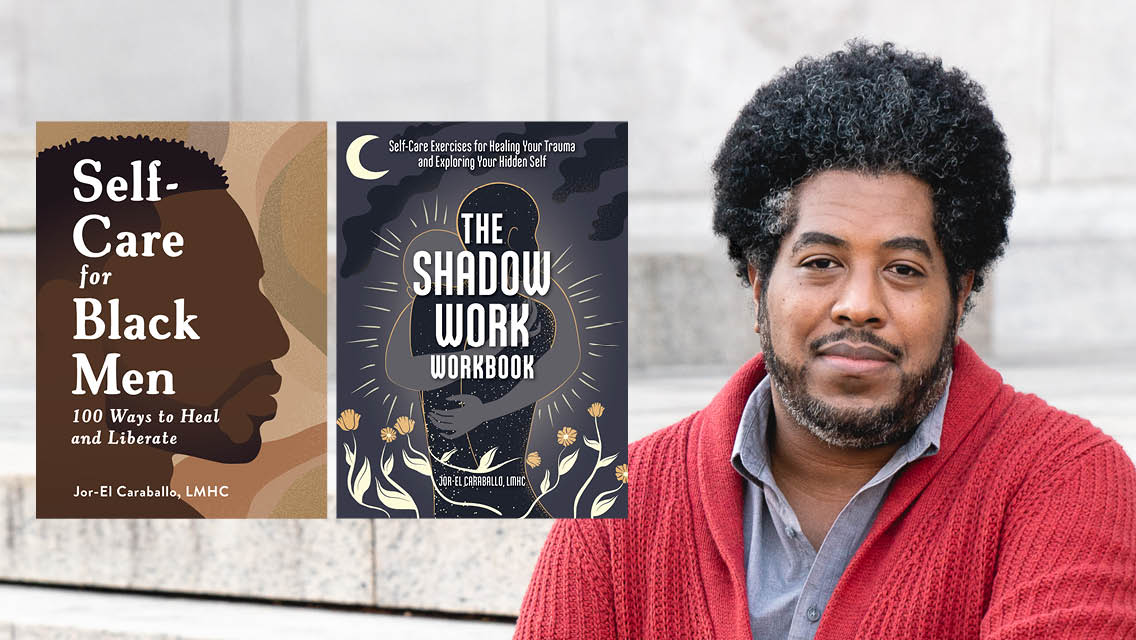
Jor-El Caraballo has long identified as a sensitive empath with a rich inner world. And as a therapist, his goal is to help empower people — in particular, fellow Black men and boys — to get in touch with their internal lives, practice self-care, and discover self-acceptance.
While attending the University of North Carolina Wilmington, Caraballo met a psychology professor who sparked his interest in mental health; Caraballo went on to earn MA and EdM degrees in psychological counseling from Teachers College, Columbia University.
Today, he is a licensed and practicing mental health counselor, he’s cofounder of Viva Mental Health & Wellness, and he has published three books: The Shadow Work Workbook: Self-Care Exercises for Healing Your Trauma and Exploring Your Hidden Self; Self-Care for Black Men: 100 Ways to Heal and Liberate; and, most recently, Mindful Meditations for Black Men: Restorative Practices to Soothe Mind, Body, and Spirit.
Caraballo spoke with us about the complexity of mental health for Black men, the importance of community when navigating these mental health struggles, and cultivating emotional resilience within the Black community.
Q&A With Jor-El Caraballo, LMHC
Experience Life | How can we encourage Black men to embrace vulnerability — especially when it contradicts the cultural messages of hypermasculinity they’ve often grown up with?
Jor-El Caraballo | The way that we create this ability for Black men, in particular, is to actually create those spaces that allow for that vulnerability to exist. Sometimes that will mean starting with a one-on-one conversation with a close friend or with a professional, where you get this model of someone who’s maybe a little further along in their willingness to be vulnerable, in their willingness to be emotional.
This is a large part of my work — being visibly myself in this field. I wanted to show up in the way of being visibly Black, male, talking about these things, normalizing feelings, challenging the status quo of these hypermasculine ideals, creating that space that says, It’s OK if you don’t necessarily fit those hypermasculine stereotypes . . . because no one really does. There’s space for you here.
I think for us, for Black men in particular, we need those concrete spaces that offer that, and sometimes that’s in community events where people can feel safer; sometimes it’s in the pages of a book. You start to first experience that safety in conversational exchanges with close friends, but it does take some bravery to take that first step to ask a question or be asked a question like “How are you?” and pushing past the impulse to just say, “Fine” or “Cool.” And then offering something else that maybe someone can pick up on and help you talk more about.
EL | How might symptoms of depression manifest in Black men specifically?
JEC | In terms of the stereotypes of something like depression, people often think it means that you are sad and you look sad, and what we found and what research also supports is that, for Black populations in particular, you actually see more irritability, anger, or numbness, as opposed to this stereotype of sadness.
It’s not only how you feel, but it’s also how you’re operating within your day that there are signs that you’re not doing well. For a lot of people, it would be in terms of those behavioral signs: They’re sleeping a lot more, or some people sleep less. Some people eat a lot more or eat a lot less. And — this is true for most people with depression — that sense of pleasure is sort of gone.
EL | How does being the only Black individual in predominantly white environments affect a person’s psychological and emotional well-being? And what are the everyday effects of constantly having to code-switch and mask one’s identity?
JEC | You have a lot of pressure for Black men and Black folks to represent in those predominantly white spaces, where they may be met with hostility and challenges every day, like microaggressions. This can limit their effectiveness and even worsen imposter syndrome, which is feeling like you don’t belong.
Existing in those environments really exacerbates all of that anxiety and worry, because then it’s like you realize you have to work harder to be equal, but you also have to swallow some of the hardship because you have people depending on you. Maybe you’re even depending on yourself to reach a certain goal, but now you have to do that while navigating nonsense in the workplace. I think a lot of Black men don’t realize how that chips away at your sense of self, because you’re ignoring all the injuries to keep going.
EL | In what ways does systematic injustice affect the mental health of Black men?
JEC | I call it the “burden of being a brute,” because I think there’s this expectation and stereotype that Black men are brutish. Like big, large, strong figures, right, and that’s generally a positive stereotype, but where it really comes from is our history of slavery in the West and this emphasis on physical strength and the ability to endure pain. That sort of stereotype, for a lot of us, is our identity, so we have to keep up with that performance of strength, of resilience, of being able to withstand things.
And that’s incredibly taxing because it denies humanity. It denies those sad moments, those depressive moments, those anxious moments, those moments where we don’t feel tough and we want to be held by someone because the world is hard on us.
It leaves Black men dealing with things internally, and so they shut down emotionally to other people. It can feel like people never really know them, because they never show what’s happening really, because that’s not how they see themselves, and that’s not how the world likes to see them.
EL | What are some effective ways to begin healing? How do we start to break cycles of generational trauma and change inherited patterns?
JEC | The first step is to just acknowledge and name that something has happened. We have to make it real first. You have been impacted by racism. These are the ways you’ve been impacted.
Now what do we want to do about that? Then we can start to figure out, What’s the plan? How do you really heal now that we can call it out? Calling it out and acknowledging it is the first step for most anything in healing. You have to acknowledge there’s an injury. Then you can treat it.
EL | How can we effectively teach and cultivate hope to support mental health and emotional resilience in Black men and boys?
JEC | For a lot of people, there’s a lot of challenge to feeling hopeful right now, and I think one thing that Black folks can do is to actually look backward: We can look at our history of resilience. We can read the stories of ancestors. We can learn how they navigated those really hard times — and in those stories and in those records are blueprints for how we survive and find hope again. What things were my grandparents or great-grandparents doing during Jim Crow? What were enslaved people doing to feel hope or to feel like they had something worth living for? They were still communing. They were still singing. They were still dancing. They were still telling stories. They were looking into spirituality and mythology.
There are all these things that we have already done that we can call back to and say, OK, here’s the blueprint for us to keep going. Maybe there is still more, and until that more arrives, here are the ways we’re going to look after one another.



Comments (0)