




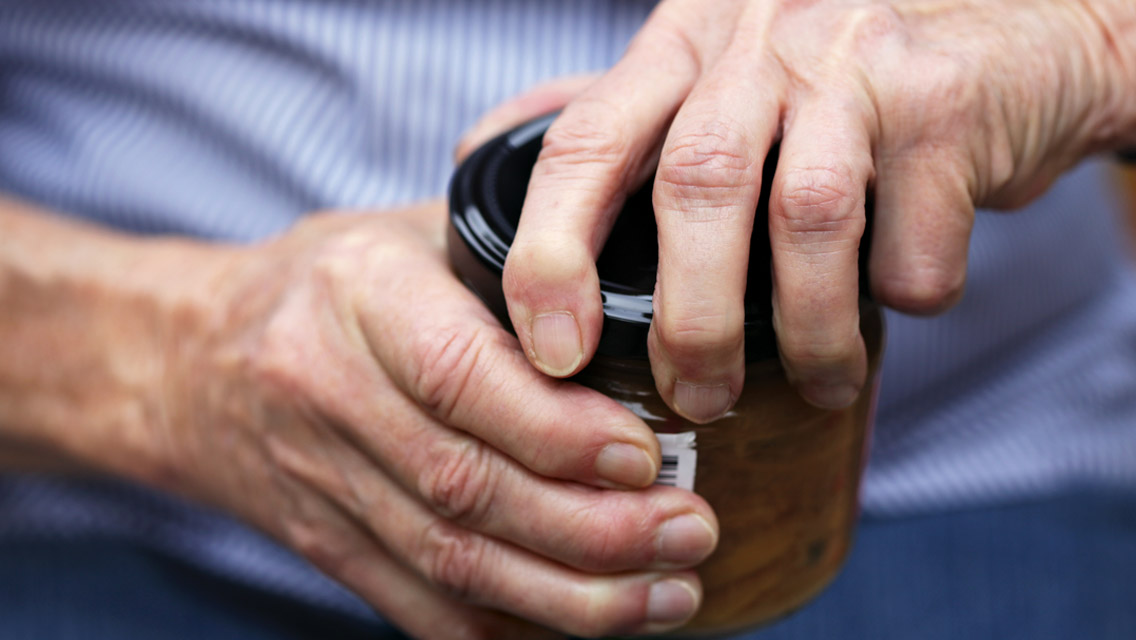
When confronted by a container that refuses her best efforts to unscrew its cap, My Lovely Wife often reaches for one of the innumerable fat rubber bands we’ve collected over the years. She wraps the band around the offending cap and usually manages to wrench it free. On those occasions when even this tactic fails, she’ll hand it over to me and I’ll either demonstrate my superior grip strength or go off in search of a pair of pliers.
These incidents often remind me that volumes of research in recent years have been harping on the importance of maintaining a firm grip as we grow older. Multiple studies have shown grip strength to be a reliable marker of overall health, linking poor grip strength with everything from bone density and type 2 diabetes to depression and sleep issues.
A 2025 report found a strong correlation between grip strength and quality of life among a cohort of older adults in Poland. As lead study author Antonina Kaczorowska, PhD, an assistant professor of physiotherapy at the University of Opole, explains in Scientific Reports, the benefits of a good grip accrue to both men and women, though in different domains. Women displaying a strong grip scored higher on tests related to what researchers termed the “social domain” (relationships, family life) while strong men excelled in the “environmental domain” (functional security in daily life).
“Our research has shown that skeletal muscle strength has a significant relationship with the overall quality of life and with the social and environmental domains,” Kaczorowski writes. “The results of our study show that the greater the hand grip strength, the higher the value of the overall quality of life and [they] thus highlight the importance of skeletal muscle strength in older people.”
More recently, University of California, Riverside, (UCR) researchers released the results of a study suggesting that grip strength may be surprisingly dependent upon neurological functionality. They believe their findings may offer opportunities for intervention long before frailty sets in.
“Grip strength is more than just muscle,” explains Xiaoping Hu, PhD, a UCR bioengineering professor. “It’s a marker of how well your body and your brain are functioning as you get older.”
Hu and his team recruited 55 healthy seniors and measured their brain activity with MRI scans while the participants squeezed a device that measures grip strength. The scans allowed researchers to observe which parts of the brain were most active during the exercise.
“It’s like mapping out all the phone lines in your brain and seeing which ones are linked to how hard you can squeeze,” explains lead study author Amin Ghaffari, a doctoral researcher at UCR. “And one of the clearest signals came from this network involving the caudate.”
Often associated with the management of movement and decision-making, the caudate nucleus has never been known for its role in muscular strength, but researchers believe the increased blood flow and connectivity in that region of the brain during grip tests indicate a significant association with stronger grip strength — regardless of gender. And it may provide a way for clinicians to diagnose the onset of frailty at its earlier stages.
“Just as you might strengthen muscles with exercise,” notes Ghaffari, “we could envision ways to strengthen these neural connections through targeted interventions.”
That would require more research, of course, and perhaps some consensus among the scientific community that neurological interventions are a worthwhile path to explore when treating age-related muscular weakness. But, as Hu explains, it’s all part of a broader approach to aging research.
“We’re trying to understand aging not as a single event, but as a process,” he says. “And of course we hope, long term, that more specific and accurate predictions about how people will age can reduce the worst effects of aging.”
That’s certainly a laudatory goal, though I doubt that MLW and I will ever be ready to embrace a neurological intervention should we begin to lose our grip on things. There’s always the pliers, after all.


This Post Has 0 Comments