


Why Gut Health Is a Key to Better Health (Performance & Longevity Series)
Learn about the gut’s role in almost every aspect of health, signs it may not be functioning properly, and strategies for support.


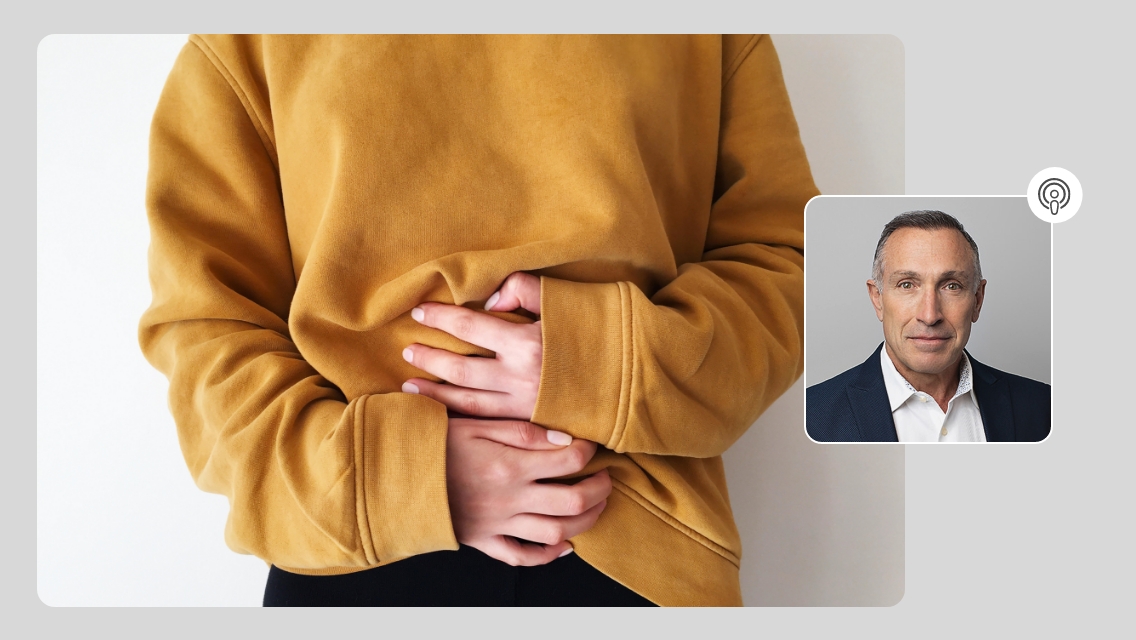



Gut health refers to the well-being of your digestive system, including your gut microbiome — a vast ecosystem of microorganisms that play an essential role in nutrient absorption, immune health, brain function, and more. By understanding how the gut works and what makes it vulnerable, you can use lifestyle approaches to support better health.
In this episode, Jim LaValle, RPh, CCN, explains how the gut is involved in almost every aspect of health and what can happen when it’s not functioning properly. He also shares signs that your gut health may be compromised along with strategies for support.
This episode of Life Time Talks is part of our series on Performance and Longevity with MIORA.
Jim LaValle, RPh, CCN, is a clinical pharmacist, the cochair of the American Academy of Anti-Aging Medicine, the chair of the International Peptide Society, and the Chief Science Officer for Life Time.
In this episode, LaValle emphasizes the critical role of gut health in overall well-being and the importance of maintaining gut integrity. He also underscores the significance of our lifestyle habits in supporting gut health. Insights include the following:
- Gut health is a cornerstone of overall health and is involved in a variety of functions throughout the body, with strong connections to the brain, immune system, and more. The gut is also notably involved in the breakdown and absorption of nutrients, metabolizing hormones, and aiding in detoxification.
- One of the most important roles of the gut is working as a filter and defense mechanism, allowing essential nutrients to pass into the bloodstream while blocking harmful substances and serving as a barrier to pathogens and toxins.
- It’s estimated that about 70 percent of the body’s immune response is located in the gut.
- When gut health is compromised, it can lead to gut permeability, or “leaky gut,” allowing bacteria and toxins to enter the bloodstream; this can trigger systemic inflammation.
- Gut permeability can lead to inflammation and other health issues including autoimmune diseases, cardiovascular problems, cognitive decline, mood disorders, blood-sugar imbalances, food allergies and sensitivities, and more.
- There are several parts to our digestive tract anatomy:
- Mouth: Proper chewing is essential for mixing food with salivary enzymes, initiating the digestive process. Inadequate chewing can lead to poor digestion and nutrient absorption.
- Stomach: Adequate stomach acid is necessary for breaking down proteins and absorbing vitamins and minerals.
- Small intestine: This organ is crucial for nutrient absorption; it releases pancreatic enzymes to help break down fats and other compounds. Compromised pH levels can alter the environment of the small intestine, allowing for the growth of unwanted bacteria and affecting nutrient absorption.
- Large intestine: The large intestine is responsible for eliminating waste and absorbing water and electrolytes. A significant part of your gut microbiome is located here.
- Acid-reducing medications can cause nutrient deficiencies and alter gut pH, affecting digestion and nutrient absorption.
- Diet and nutrition habits play large roles in the health of the gut. Sufficient fiber intake, in particular, is crucial. It’s recommended that the average person consume 30 to 40 grams of fiber daily, but typical diets often fall short. Certain strategic supplementation can be used to both support and heal your gut health.
- Lifestyle and environmental factors also play a large role in our gut health. Among the factors, stress, exposure to pesticides, and diets high in refined sugars can increase gut permeability and disrupt the microbiome.
- If your gut has become compromised, it’s important to work with a professional to take the necessary steps to heal it. A comprehensive approach, including diet, supplementation, and lifestyle changes, can be supportive of long-term gut health.
Transcript: Why Gut Health Is a Key to Better Health (Performance & Longevity Series)
[MUSIC PLAYING]
Welcome to Life Time Talks in our series on performance and longevity with MIORA. I’m Jamie Martin, I’m here with Jim LaValle. He’s the Chief Science Officer for Life Time. And in this episode, we are talking about gut health and why it matters to health. It really is a key to our health and well-being. Jim, how are you?
Doing great, and so is my gut.
I’m glad to hear it. I’m glad to hear it. We want everyone to have a healthy, happy gut. So let’s talk a little bit about what that means, because we’ve been hearing a lot of discussion about gut health. What is it, and why is it so central to our health and well-being?
I think the first thing is what it’s not. So what it’s not is hey, if my bowel movements are normal, that means my gut’s OK. Because I think that’s what — when people hear gut or they hear intestine, they think, well, if I have a regular BM each day, I must have a good gut. And so the gut is really playing a central role in all of our chemistry. So when you think about it, it’s about filter, defense, and repair
So it is responsible for filtering our foods, get our nutrients into our bloodstream that are supposed to go through, and then being a barrier for things that aren’t supposed to go through. So that’s the first step. The second one is the gut’s important for how we metabolize compounds in our body. So how are we going to get rid of estrogen? Gut’s intimately involved.
The next one would be — how is my immune reaction? Because 70% of our immune reaction is in the gut. And it’s in this interplay with our microbiome that is billions and billions and billions of little bugs that are doing their job in order to keep us on track with that inflammation response. And the problem that occurs is that as we start to erode the efficiency of our gut, and a lot of things can happened to cause that, so we should we’ll go through that, our gut loses its integrity, and that’s called gut permeability.
So we lose our integrity of our gut. The gut becomes more permeable. And that’s where the problems really start to hit. So that’s more on the chronic side. Obviously, you could have an acute thing, like you catch a parasite because you went to a foreign country and ate some food. And so that’s where you have a real infection, parasitic, bacterial, protozoa. You get some kind of infection that’s acute.
But the real thing we’ve discovered over the last, I don’t for me, literally, I’ve been working on the gut is part of protocols since at least 1985. It all started with the book The Yeast Connection by Dr. Crook. It’s a long time ago. And so the chronic disruption of the gut is what leads to things like food allergies and sensitivity, neurologic problems, mood disorders, heart disease, autoimmune. I mean, there’s — so it literally is an important component.
And here’s the thing to think about. It all doesn’t start at the gut, but the guts almost always involved. Meaning that if you’re under a lot of stress, the stress could be the trigger that’s causing the gut to have changes in its permeability. Or if you get exposed to something like glyphosate, which is a common pesticide, that’s in a lot of people, that throws off the microbiome and throws off the immune function of the gut. So the gut’s always in the middle of the external and internal world.
Yeah, well, exactly. And I think that’s what’s so interesting is we’ve talked or written in the magazine about how your digestive tract really starts in your mouth. Because it starts — and it’s really — that’s almost an external and not external organ. But it’s exposed to the outside world. And so that’s the first line of defense, I guess you could say.
That’s exactly right.
So talk a little bit about the anatomy of the digestive tract, and then I think we should talk about that gut, that mucosal lining.
Oh, sure. Well, you just mentioned that it starts in the mouth. And one of the big problems people have is they don’t chew their food. So you can’t mix the salivary amylase to the food that starts to break down the food, and it’s from there down you start to see a problem once you’re not chewing your food. And, I have to admit — I remember when I first learned from one of my mentors who started the Ontario College of Naturopathic Medicine. And that was one of the biggest things he was passionate about. He’s like, if you don’t chew your food, you can’t get the nutrients from it. And we all get in a hurry. I’m guilty of it. I know there’s times where I’m just so hungry, and I’m on a short leash that I got to get that food down quick.
Yep. I got to eat something.
Yeah. And so learning to make sure you digest your food starts with chewing and the microbiome health of your mouth. So there’s a couple of things that can throw that off. If people are drinking water all the time. You’re always diluting your saliva, and you use salivary amylase to break down starch that starts in your mouth. So people should drink plenty of fluid, but they should have breaks in that. Instead of sipping all the time, there should be breaks in that to restore some of the salivary amylase so that it’s not continually being washed.
Yeah, makes sense.
Right?
Yeah, absolutely.
And then the other thing people do is they drink a lot while they’re eating. And many times they’re drinking a lot because they’re trying to gulp their food down. They don’t chew it enough, so they have to use some fluid to gulp it down, and so that’s a big issue. So then it hits your stomach, and what’s the stomach have to do? The stomach releases stomach acid to break down proteins and start to break the food down, and actually to start the liberation of your minerals.
So when you have adequate hydrochloric acid, you’re ionizing your magnesium and calcium and trace minerals to be able to be absorbed as it’s going through the intestine. And one of our big issues, of course, is people are on things like proton pump inhibitors or H2 blockers, which are acid reducing drugs. And what is the box warning or the depletions that occur when you’re on those meds? Well, you get bone loss because you don’t absorb vitamin D, calcium, magnesium, protein, and B12.
So you end up — it really starts the very moment you take in your food. And a lot of times why people have that indigestion or quote “GERD reflux” when they’re not chewing your food. Two, they could have a food sensitivity. So dairy or gluten, especially in this country, because people were more sensitive to gluten here than when they go over and they eat wheat in Europe because it’s a non-hybridized grain, and it’s well documented at this point. So now all of a sudden I got to take a medication in order to survive eating.
Right. Which is a daily function. [CHUCKLES] Multiple times a day we have to eat, right?
Something thing that everybody has to do —
Absolutely.
—is we have to eat.
Yep.
And so now I’m not digesting my food and the pH of my stomach is no longer that the correct pH, that changes the pH of the small intestine. So you have the duodenum, and now all of a sudden, when I change the pH of the intestine, that offers an opportunity for things to grow that don’t belong there, and I don’t absorb nutrients the way I should. So then as I’m moving through digestion, and I’ve got pancreatic enzymes that are releasing to help break down fats and break more compounds down from food.
If I’ve overwhelmed that — So as people age, they lose their digestive capacity. Some people do, and they need to take digestive enzymes. But imagine when you’re eating too much, you’re eating too often, and you’re eating too late? And you’re always asking the pancreas, because you’re nibbling in between meals. You’re never giving it a break for it to reset. You can start to get into insufficiencies in terms of your ability to digest food. And hence, OK, I’m bloated. I’m gassy. Why do I feel like I’m 6 months pregnant after I ate that meal?
And literally people will say, I feel like I’m grown out 4 inches, right? And a lot of that has to do with basically poor digestion, unfriendly bugs, the inability to break your protein down. And so when people say, I feel so full after a steak, that’s why I don’t eat meat. I always say that’s like putting a Band-Aid on a bullet hole. That means that you’re deficient in hydrochloric acid, and you probably still need the protein, and you probably still need the heme iron so you don’t get anemic.
So it goes from there to now — So it gets through the small intestine. Now pancreas has done its job. Now the large intestine, you got to absorb things. You got to eliminate things. And when the flora is off — So when you don’t have the friendly flora, the microbiome is disturbed. How would it get disturbed? I don’t know about you, but I know for me, growing up, I thought bubble gum-flavored amoxicillin was part of my food plan.
I literally was on it all the time. I was one of those sickly kids that had allergies. I got sick all the time. They didn’t know I had a dairy allergy, so I’d be getting milkshakes from my dad because he worked late, and that was his way of showing love. And I never breathed through my nose until I discovered that at age 19 —
That you had a dairy allergy.
Yeah, Yeah, a real one. And just not anaphylactic, but I get incredibly stuffed up. And then, of course, using decongestants, getting allergy shots. All the allergy insensitivity stuff that comes on as we’re moving through our young years the guts involved. And you can’t avoid that. And a lot of children are now on acid-blocking medications as infants.
Because they have eosinophilic esophagitis, because the mom didn’t have a good microbiome, the child has more circulating IgE, which makes more eosinophils. We learned that on the last episode a while ago. Eosinophils equals allergies. And so when that goes up now, all of a sudden I’ve got more lymphocytes, more inflammation in the esophagus, as well as through the intestine.
And it [INAUDIBLE].
Yeah, and so drugs can do it. Stress can do it. Eating diets that are high in refined sugars, high in refined carbs, actually, even ketogenic diets will break down the gut lining over time, which a lot of people don’t like to hear that, but that’s the truth. There are plenty publications.
You’ve mentioned that as being ketogenic is more of a temporary thing versus long term for that reason.
Fantastic for a short reset, but it’s not the long term goal. So you’ve got different things that will break down the gut. And we really need to spend time and understand that this is real. The gut breakdown is real. So there’s core things people need in their diet that nobody’s getting today. The average person should be getting 30 to 40 grams of fiber a day. So I got a question for you? Putting you on the spot.
Don’t worry. Let’s see.
How many grams of fiber are in a serving of vegetables?
Oh, after all of my years of doing content in the magazine, I should know this. It’s got to be. I mean, one serving of vegetables. I don’t know this offhand. I failed.
2 grams of fiber. A Fruit?
Yeah.
2 grams per serving. So think how much — And then beans, of course, are 8. So think how much you have to eat vegetables and fruit And we don’t want people eating too much fruit. They should be doing 3 to 1 vegetables to fruit. Getting that 9 servings of veggies and fruit in a day, that just gets you to 18 gram.
You’re not even halfway there at that point.
Right, and fiber is critical to microbiome health. So I’m a huge believer on people need to take fiber these days, because we also — if you’re eating a grain you refine the grains and you lose a lot of that quality fiber. So that’s a big deal, and then some people tolerate beans, some don’t. Some can’t take in that amount of carbs because they’re not that active. So fiber to me is super important for how we protect the gut. But what was really — I think, it was, for me, validation.
So when I was writing — when I wrote Cracking The Metabolic Code, the first edition, because the second edition is coming out here this year. But back in 2002, I talked about permeable gut and leaky gut. And when I was teaching at the University, I got leaky gut, right, there’s holes in your intestine. People were laughing. But we now know. So I have pictures in slideshows that I have of electron microscopy.
And literally, there are just like you have cracks in your tongue, a geographic tongue that shows that you are having a gut mucosal barrier problem. There are cracks in the intestinal lining. And Supposed to have the cilia or the brush border cells are like this, where they’re very tight, and there’s no gaps, and they’re all the same height, but when you get gut permeability problems, they gap.
They gap.
And when they gap, bacteria from the intestine can now get through that lining, enter into your bloodstream, hit the antigen presenting cells, and the immune system takes off.
And that’s where inflammation, right? That’s the start of him.
That’s the start of inflammation And that’s why food allergies and sensitivities have now been implicated in autoimmunity. So autoimmune thyroiditis, psoriatic arthritis. That’s where we see that inflammation signaling now feeding into cardiovascular disease, mood disorders, cognitive decline, even blood sugar problems, because any time you trigger inflammation. So if you think about it this way, anytime you trigger an inflammatory response that’s chronic, you’ve got more circulating cytokines that turn off your insulin receptors.
So by default, you’re at ground 0. As soon as your gut’s making that inflammatory response, sooner or later, you’re going to start to see changes in your blood sugar because your insulin receptors aren’t efficient. Why is that such a big problem? When your insulin receptors aren’t functioning well anymore. You don’t make energy appropriately. So now you push another facet of how you make energy. You make two packets of energy for every molecule of glucose. Instead of 30 plus packets of energy. And the gut, when it’s broken down, is triggering that inflammatory cascade that’s leading to that inefficiency.
And so people that have food sensitivities and allergies complain of what? I’m fatigued. I feel foggy-headed. Why am I gaining weight? It’s because the gut pancreas connection remember, we’re always trying to connect the whole body, is occurring due to the fact that A, I’m not digesting my foods. B, my gut is breaking down, the mucosal barriers eroded, and C, the bacteria are getting through there, but not just the bacteria.
Because I’m not digesting my food, proteins go to peptides. Peptides go to amino acids. Amino acids get absorbed, and now we can use them for building blocks for everything we do. But the issue is when I only go to peptides, I can react to a peptide. So now the antigen-presenting cell says, wait a second, that’s not an avocado, that’s a peptide! And then all of a sudden, now you’re sensitive to avocado. You’re sensitive to coffee. It’s not just oh, gluten is bad. Dairy is bad. Shrimp is bad. Corn is bad. Soy is bad. The big bad boys.
Yeah, the common 7 and 9.
Right. Everybody thinks of that. But literally, you could be eating foods that you think are really good for you. And because your gut is permeable, it’s actually tearing you down.
And that’s where it’s so counterintuitive, because I’ve always been able to eat avocados before, and then all of a sudden, something is happening there that you can’t tolerate them anymore.
That’s right. And that’s the value of food allergy and sensitivity testing, which 10 years ago, it was pretty much when I was talking about doing this. Even, I mean, 20 years ago, I started doing food density testing. One of the biggest issues that occurs is, of course — is that oh, conventional medicine is going, oh, wow, what do you mean? IgG4, that isn’t that important.
Well, now all the research is saying, wait a second, as IgG4 goes up, that makes you more prone to autoimmunity because it’s trying to block IgE. So it’s important to get a comprehensive view of how you’re reacting your foods. Food allergy is the classic anaphylaxis. I don’t breathe. I swell. I get a hive. Not a good reaction.
And that’s the one that you often hear about there. You’re going to need the EpiPen or whatever. Like that quick emergency response.
That’s exactly right. But the food sensitivity component is my joints are swelling, my ankles hurt. I’m foggy-headed. Gee, why is my — why do I have plaque burden that started? All that stuff has been correlated now and published. And so it’s really important even people with — It’s interesting. They estimate that 46% of people with schizophrenia, actually, it’s due to gluten intolerance.
So it’s that powerful that it can disrupt that much. So when you think about gut health — what’s happened in my life? Stress, what drug therapy? Especially when I was a baby. Because you know what? Our health today is the sum total of everything that’s gone on from the time we were in our mother’s womb to today. So if you had a rich antibiotic history as a child, like I did, I’m forever working on my gut, because —
You have that history.
—that was the standard. You know in your first 1,000 days of life is where you shape that. So really important to keep that in mind. And then understanding that gut integrity is a core feature of how you’re going to live a good, long life. And in fact, they showed that Centurions had much lower levels of lipopolysaccharide, remember the compound that breaks down from the bacteria than young adults who had health conditions.
Oh, interesting. So their guts were healthier than —
—than young people.
Yep, OK.
Exactly. So I mean, this is one of my favorite
[CHUCKLES]
Wait, every topic is my favorite topic. But this is one of my favorite topics, because I lived it. And it’s what got me into this work. Was training for a national qualifier in bodybuilding and having rashes pop up out of nowhere, and I’m like, wait a second, I looked fantastic. What could be happening to me? And went to a doctor who in 1982 said, you need to work on your gut, and we’re going to take away these foods, and changed my life and actually put me on the road to doing this work for the last 40 years.
I mean, that’s amazing, and that’s what you got. You’re so passionate about these topics. One thing I wanted to note about food sensitivities and intolerances, is one thing that we have written regularly about, is that reactions to those don’t necessarily immediately happen like an allergy. So sometimes 24 hours later, you might be feeling something and not really correlate it back to that thing you ate or that thing that you took in. So that’s where there can be a disconnect, and a lot of confusion for a lot of people. But what’s causing it?
Absolutely great point. And it’s actually up to 72 hours.
Ugh, yeah.
So that’s why I really encourage people if they’re having GI problems or weight or skin, because the gut skin connection is huge, do a food allergy and sensitivity panel. At MIORA we do a advanced food sensitivity analogy panel that looks at IgE, IgG4, IgG, and then something called the complement pathway, C3BD, which amplifies IgG. So if you have a C3BD, you create a 10,000 times immune reaction in your IgG.
So we look across four categories of immune disruption on 88 foods. So it’s 300 and some basically, reactions. And I have to say, it’s one of the biggest things that changes people’s lives is when they take away the foods that were giving them problems, and they never realize because they always try to put it back in before they’re supposed to. And they go, oh, wait, that’s why I used to feel that way.
Yeah, the reintroduction period. I think there’s always it’s the remove, repair, reintroduce. It’s like the thinking with those things, but making sure they’re done over the right amount of time so that you can —
Once again, professional guidance. You really need to have somebody that’s helping you to pick the right things to repair the gut. Why is it broken down? What aspects or facets do you need to do to correct it? It’s why the team at MIORA is so well equipped, because we’ve got the providers to help you figure out the why. You’ve got dietitians that will help you through the way of learning how to eat that’s right for you. And then, of course, obviously, we’re always wanting to move, and so we’ve got this incredible team of trainers.
To bring them back in, yeah, One, you’ve talked about the gut-skin connection, the gut-pancreas connection. I also want to just talk once more and more time about the gut-brain connection, because it’s so, so critical. We know that there’s a bidirectional pathway between the two of them. So let’s talk about them.
So the enteric nervous system is what connects the two. So the first step is let’s say, you get under stress. And that could be any kind of stress. Physical stress, psychogenic stress, doesn’t matter. Your hypothalamus tells the pituitary to tell the adrenal glands to release cortisol. That’s a direct path. Cortisol causes permeability in the gut because it upregulates something called interleukin-6. IL-6 turns on claudin-2. Claudin-2 breaks the tight junctions.
Opens up and creates —
The tight junctions are supposed to be like this. They’re like gatekeepers, and they fall apart. The protein structure scaffolding breaks apart. That’s one path. The spinal cord also gets activated to create sympathetic tone. So fight or flight, increased sympathetic tone, that signals the enterochromaffin cells of the enteric nervous system. We’re under stress. When you’re under stress, you release more peripheral corticotropin releasing hormone, which is going to make you make more cortisol, but more importantly, when that gets released in the periphery —
Those junctions again.
The junctions break at the gut. And then the last pieces is the corticotropin releasing hormone actually triggers your mast cells, and you make more leukotrienes and more histamine which then triggers the immune activation or antigen-antibody response, now I’m reacting to avocado, and triggering more chronic inflammation, which then tells your brain, you’re under inflammation and under stress. And a vicious loop occurs. So from the brain down, that’s a problem.
The other way that occurs is I’ve got an infection or I’m making a lot of lipopolysaccharide because my circulation to my gut is poor. And so the bacteria are breaking down. The lipopolysaccharides is being released. Lipopolysaccharide should be metabolized through your liver. You should eliminate it through the intestine. The lymph should take care of it. But oh, oh, it’s getting through the blood-brain barrier. Because it goes across the blood brain barrier, and it triggers neuroinflammation, which then creates oxidative stress. And here I go with, I ate that lunch, why is my head so foggy? It’s a lot.
It’s a lot. It’s all connected. We’ve said this 100 times already.
And we’ll say it 1,000 more. We have to stop thinking of compartmentalized medicine. You have this problem. Here’s the pill. You have this problem. Here’s the pill. And I mean that in just health in general. I mean, I’ve taught 20 years at colleges of medicine and pharmacy. It’s understanding a systems biology approach, which of course, is what’s all in the latest literature is that all systems are connected.
Yeah, you can’t separate one from the other. So we’ve talked about a lot of these pieces. We always want to make sure we’re covering off on what’s the supplementation strategy for someone? If they know they have gut issues, how would you get them started on healing their gut?
Yeah so the first part is if it’s strictly, I got bad bugs and most people do. I look at their tongue. It’s usually coated, odd colored. Take something that’s going to knock down the bad bugs, so the disordered microflora or the dysbiotic flora. And that’s if you don’t have an infection. If you’ve got that, usually you got way worse symptoms than that.
So that would be things like cat’s claw, berberine, grapefruit seed extract, olive leaf extract. Make sure you’re taking a probiotic with that. You don’t need to do a food allergy test right away unless you have a known autoimmune disorder. If you have a known autoimmune disorder, probably a good idea to do that food allergy test right away.
But you could do an elimination diet. Get rid of the big allergens, eat more vegetables, a little bit of fruit, lean proteins, chew well, drink water, take fiber. That could be step 1 for your gut. If stress is a component, oh, I need to add something to that. Theanine, Relora, holy basil. Three great compounds. Once you start getting that — and if the person really has significant permeability issues in their gut. BPC-157, a peptide works fantastic for helping to heal the mucosal lining, because that’s what your stomach releases to protect the mucosal lining from the stomach acid it releases. So your body makes it.
So it needs support making it. Essentially, to turn it back on.
And actually, you need to take it because you stop making enough of it. So you could do that for a period of time to help heal that up. Obviously, if there’s a lot of inflammation signaling, you could also use curcumin. And then after that, how do I start to repair? So the first is clean up the mess. Soap up the spill, that’s the fiber. The second one is using compounds like glutamine Allo, zinc carnosine, marshmallow that help to build the mucosal barrier and repair. All the while you’re staying on your fiber.
And then the third phase to this is just, OK, I’m going to go off some of these things. Do I need to be on a probiotic three or four days out of the week and make sure that I’m on my fiber? Is BPC something that’s really helping me heal because I was on NSAIDs or I was on — which you know, non-steroidal anti-inflammatory drugs, ibuprofen, aspirin, et cetera. Or is it just that I’ve been on proton pump inhibitors, and now I’m weaning off of those? Working with my doc, weaning off of those, and I may need to be on that BPC for a while.
But then at the end, what you should be able to do is support that healthy gut with maybe a periodic detox, and be consistent about the kind of foods that you’re eating. And then probably regular probiotics would be smart. Everyday fiber, very smart. And that’s the simplistic journey. There’s other things that you can do for the gut. It’s just these are the staples. These are the things, at least for me, for the last, like I said, 40 years, this is where I start and where I go, and then you can branch off based on that. But is it stress, and you have to remember when the gut’s broken down, sex hormones are going to be broken down.
So you got to keep an eye on the whole system as always?
Yep.
All right, Jim, anything else on gut health? Because I know we could probably talk all day about this if we really wanted.
I’ve got full day lectures on gut health that I give to physicians. So, I mean, look, I think it’s important for people to understand, I started the talk with this, just because you have a normal bowel movement, it does not mean your gut is healthy. If you have cracks in your tongue, if you’re gassy, if you’re bloated, if you don’t even have any of that meaning, hey, I have any of those symptoms, but gee, I’ve got skin rashes, or hey, I’ve been told I’ve got autoimmune thyroid, you got to look to the gut. It’s super important and core to longevity and performance.
All right. To learn more, our listeners and viewers can visit miora.lifetime.life. And to be able to check out this, there’s connections with gut health in literally every episode in this series, so you’re going to want to listen in to all of those. But Jim, thank you, as always, for joining me.
It’s great.
Thank you.
[MUSIC PLAYING]
More like this


Talks — S2, EP3 / Taking Care of Your Gut: Why It’s Critical to Health + How to Do It
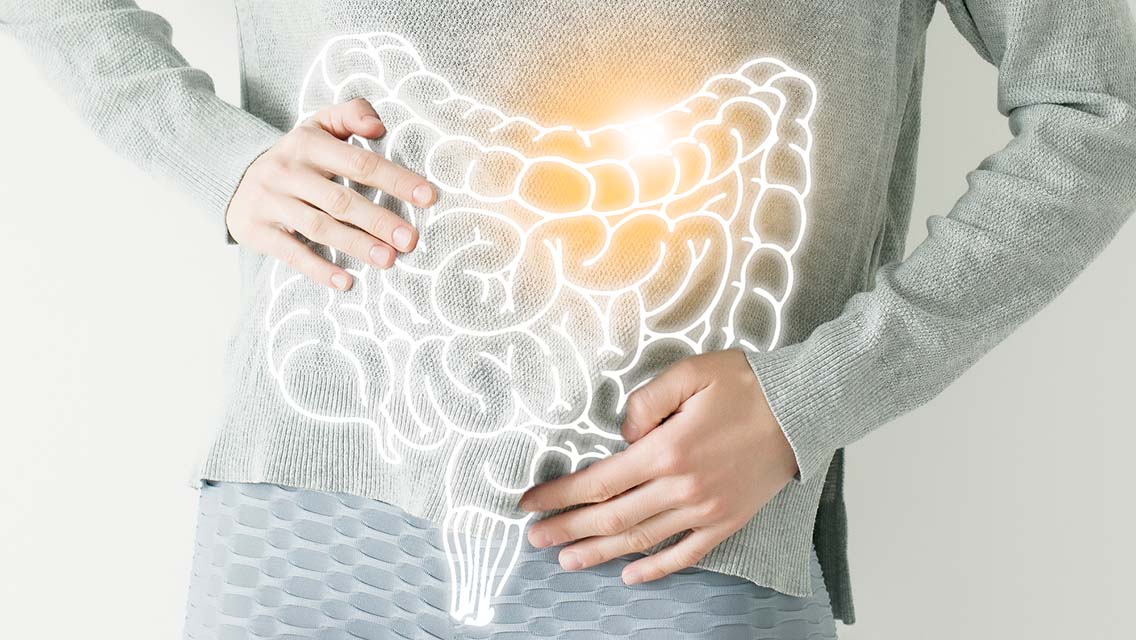
The gut is often considered the gatekeeper to our overall health — and imbalances many times surface in surprising ways. Samantha McKinney, RD, discusses its far-reaching impacts and shares daily lifestyle strategies we can use to support our gut health.



We’d Love to Hear From You
Have thoughts you’d like to share or topic ideas for future episodes? Email us at lttalks@lt.life.
The information in this podcast is intended to provide broad understanding and knowledge of healthcare topics. This information is for educational purposes only and should not be considered complete and should not be used in place of advice from your physician or healthcare provider. We recommend you consult your physician or healthcare professional before beginning or altering your personal exercise, diet or supplementation program.
Life Time provides administrative, non-clinical support to MIORA as well as services and amenities related to general wellness and fitness; Life Time does not provide medical advice, diagnosis, treatment or care.
Advertisement