




Pull-ups are primarily an upper-body exercise, making it easy to dismiss your legs as extraneous parts along for the ride as you aim to get your chin over the bar. But there are several ways to use your legs to make the movement easier or harder.
“It totally depends on your unique physiology and what your objective is,” says Kaycee Dunfield, who manages Life Time’s Barbell Training group fitness program. Here are a few options, in order of escalating difficulty (whatever your preference, let comfort be your guide):
1) Legs supporting you with one foot planted on a box:
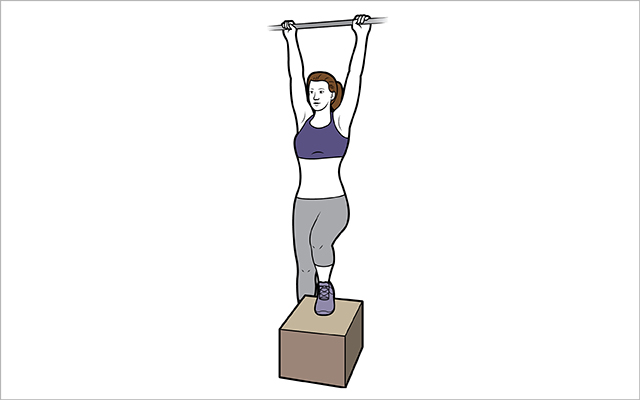
- A great option for beginners, this allows you to use your planted foot for support to pull yourself over the bar.
2. Legs crossed at the ankles, either with legs straight or knees bent:
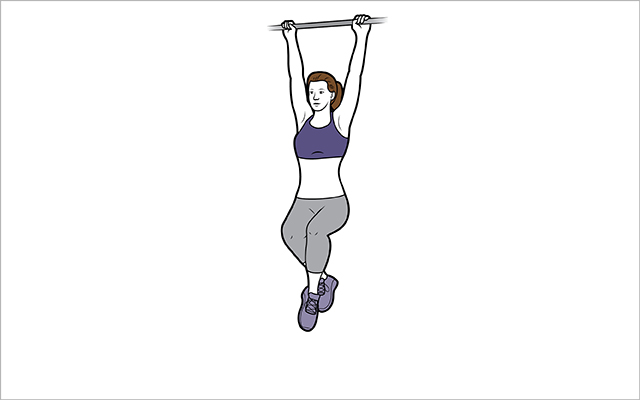
- This takes some of the pressure off your arms as your leg and core muscles support some of your weight.
3. Legs straight, uncrossed, and hanging below hips:
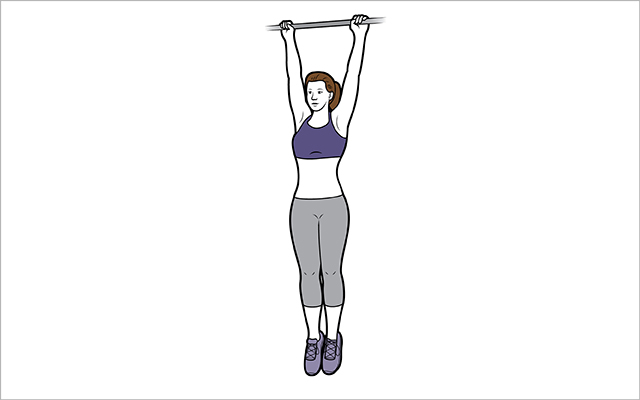
- Your torso and legs are, to a large degree, dead weight, putting the pressure on your arms, back, and chest to do the heavy lifting.
4. Legs straight and extended in an “L-sit” position:
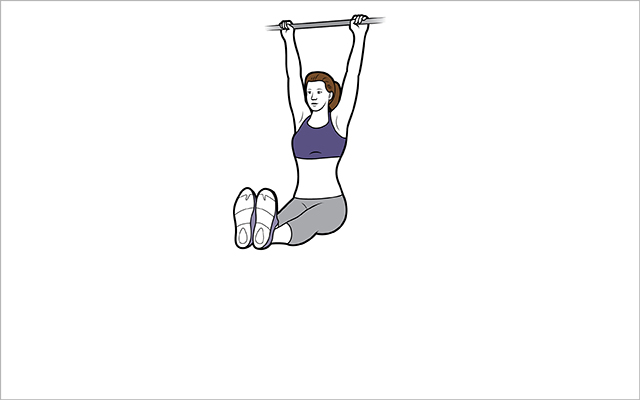
- This makes the move harder overall while also firing up your abs, turning the pull-up into a core exercise as well as an upper-body strength-builder.
For all the variations, Dunfield notes, avoid swinging your legs and using momentum to complete the move. Kipping pull-ups, traditionally a gymnastics warm-up that has been popularized in recent years, might look like a regular pull-up with legs swinging, but the technique is more complicated than that.
“If you’re going to swing the whole time, I’d rather you do fewer pull-ups” or choose an easier version, Dunfield says. She recommends focusing on form and control, increasing the variation and number of reps as you gain strength, and experimenting with your leg placement as you progress.




Comments (0)