



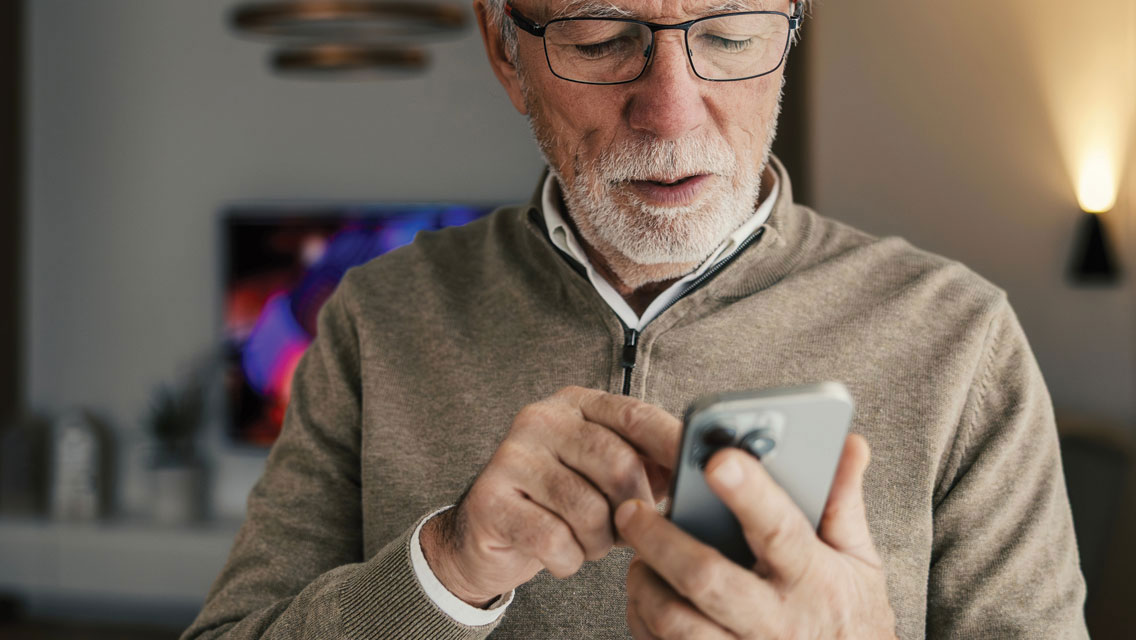
Our thirtysomething son, an IT professional and all-around tech wizard, often tells us about the latest ways he has harnessed ChatGPT to streamline his work life and clarify various personal challenges. His missionary zeal is mostly lost on me and his mother, aspiring Luddites who tend to be skeptical of tools promising to help us think less. We listen politely, comment sparingly, and hope that we’re not responding in a way that may make him feel less willing to come to our aid the next time we need to navigate some glitchy software or fix a malfunctioning digital device.
A few months ago, for example, he came by to help us reset a long-ignored device that had once allowed us to stream programs on our TV. We watched as he fiddled with the TV while consulting ChatGPT for advice — an exercise in futility, he eventually admitted, not because the bot let him down but because the device was too old. We shrugged.
You can count us among the senior set that is reluctant to embrace the various iterations of generative AI. A recent Pew Research Center survey found that a mere 19 percent of respondents 65 years old and older interacted with AI “several times a day,” while 70 percent of those between the ages of 18 and 49 reported that level of engagement.
If we’re to believe the results of a study published last week in JAMA Network Open, our cautious approach may help us preserve our mental health.
Researchers at Mass General Brigham analyzed data from a 2025 national survey that asked more than 20,000 adults to describe their use of chatbots and offer an assessment of their mental health. They found that respondents who interacted on a personal level with these bots on a daily basis were more prone to experience mental health issues, such as depression, anxiety, and irritability, than those who avoided the bots — or who only consulted them for work issues. The effect was most pronounced among daily users between the ages of 45 and 64, who were 50 percent more likely than other daily users to report “at least moderate depression.”
“There’s probably a subset of people where AI use is associated with no change in their mood, or even benefit in their mood,” notes lead study author Roy Perlis, MD, a clinical investigator at the Mass General Research Institute, in an interview with NBC News. “But that also means there are a subset where AI use is probably associated with worsening of their mood, and for some people, that can be substantially greater levels of depression.”
The results, however, do not prove a causal relationship between certain levels of AI use and depression; they only point to a possible association. As Jodi Halpern, MD, PhD, codirector for the Kavli Center for Ethics, Science, and the Public at the University of California, Berkeley, explains, usage rates may be affected by a person’s mental health condition rather than the other way around.
“It could go in either direction,” she says. “It could be a vicious cycle; we just have no idea. So the idea that when people are more depressed, they may use AI more for personal uses is very plausible.”
Nor does the research suggest that all forms of AI are harmful, though Perlis argues that general-purpose chatbots, such as ChatGPT, are not designed to offer social or mental health support. That’s where the risk lies, he says. Indeed, the American Psychological Association has warned that AI should not be used to replace established forms of psychological therapy or treatment.
Though Perlis’s research is limited, Halpern says it may encourage further studies on AI and mental health that would “look at the people we might not have been paying attention to.”
We pay quite a bit of attention to our tech-savvy son these days, but I’m not too worried that it will be his interactions with ChatGPT that will threaten his mental health. Like the rest of us, he’s more likely to be struggling to rise above the troubling uncertainties of current events. And he seemed to be doing OK the other day when he stopped over to help us replace that old TV device with a new one. He arrived with a new cable, connected the device to the TV, pressed a few buttons on my phone, and demonstrated how to navigate the options we’ll get to consider next time we need a little escapist entertainment. No chatbot required.



Comments (0)