




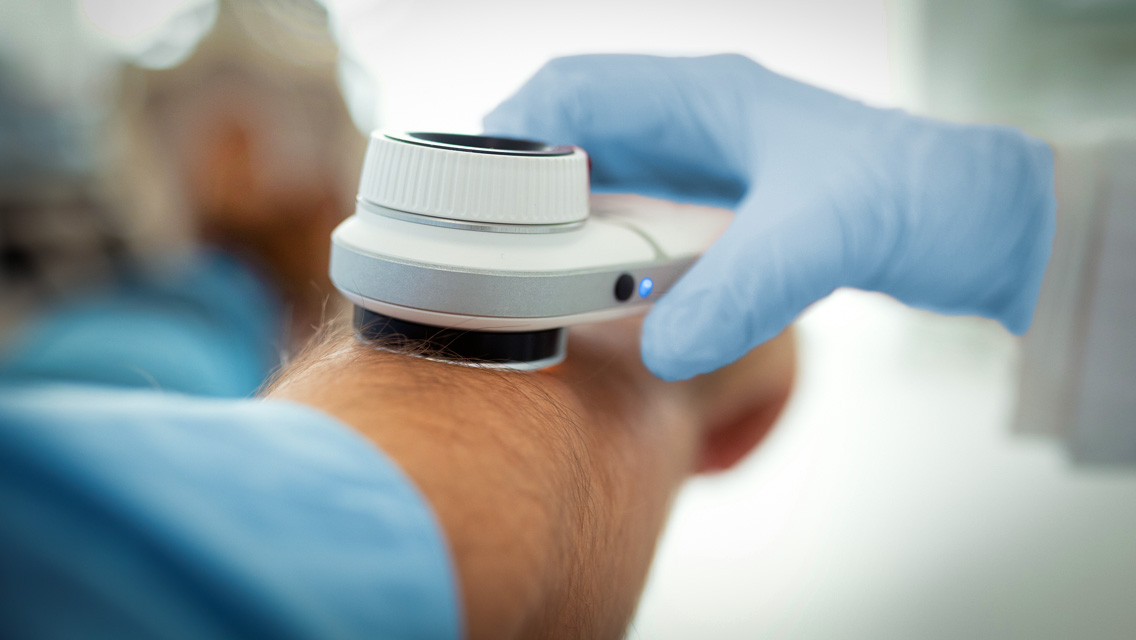
I’ve been putting off a visit to the dermatologist in recent months owing to the capricious nature of my symptoms and my general aversion to scalpels. This is not an unfamiliar conundrum for a guy who spent several years avoiding the inevitable flesh carving required to remedy a trio of lesions that had combined to render my face more interesting than usual. I now know better than to ignore the signs of basal cell carcinoma, or whatever form of skin cancer may now be capturing my attention, but still I dawdle.
Equivocate may be a better term. Concerned about the persistent presence of a mysterious nodule near my right ear a few months ago, I eventually scheduled an appointment but canceled it when I noticed one day that the small mass had simply vanished. It has not reappeared, which doesn’t mean it hasn’t begun boring unobtrusively toward my skull. And, meanwhile, a couple of tiny lesions have erupted — and also disappeared — in recent weeks. I know what I should do (these things don’t really go away), but recent advances in prevention, diagnostics, and treatment approaches seem to hold out hope that if I put off a visit with the dermatologist long enough, I might someday be able to deal with these lesions without deploying quite so many bandages as before.
Or maybe prevent them from erupting at all. I was heartened, for example, to stumble upon a study released in September suggesting that a form of vitamin B3 known as nicotinamide may reduce the risk of recurring nonmelanoma skin cancers.
Researchers, analyzing the health records of more than 33,000 U.S. military veterans who’d been diagnosed and treated for basal cell or squamous cell carcinoma in the past, found that those who took 500 milligrams of nicotinamide twice a day for a month were 54 percent less likely than those who did not take the supplement to face another round of the disease over a five-year period. “I was very surprised at the degree of risk reduction,” lead study author Lee Wheless, MD, PhD, tells NPR.
The study’s results build upon the findings of a 2015 randomized clinical trial that showed a 23 percent reduced risk of new nonmelanoma skin cancers among 386 participants who took nicotinamide twice daily for 12 months compared with a control group. “Oral nicotinamide was safe and effective in reducing the rates of new nonmelanoma skin cancers and actinic keratoses in high-risk patients,” the authors write in The New England Journal of Medicine.
Despite the small sample, the 2015 study was surprisingly convincing: A 2021 survey of 1,500 dermatologists showed that 77 percent of respondents had recommended nicotinamide to their patients. Together with the September study, the research has shifted Sarah Arron’s view of the supplement. “I am going to be more rigorous in recommending it to patients, especially patients who are having their first skin cancer,” says Arron, MD, a San Francisco–based dermatologist. “I think the benefit is strongest if we start it early.”
I probably could’ve raised that question with my dermatologist if I hadn’t canceled that appointment. Of course, my previous experience suggests that these folks tend to cut first and take questions later. Biopsies are the default diagnostic approach when doctors identify visual clues of potential skin cancers, but a couple of recent breakthroughs may one day make this a bloodless procedure.
Swedish researchers trained an AI system to visually identify clinical photographic images of squamous cell carcinoma and compared its performance to that of dermatologists. The bot was able to discern three specific levels of a tumor’s aggressiveness as accurately as the doctors were. The results, lead study author Sam Polesie, MD, PhD, notes, could lead to more precise diagnoses.
“We believe the use-case presented here is a promising machine-learning approach worth pursuing, as it has the potential to assist and augment dermatologists in preoperative decision-making — helping to determine appropriate surgical margins or assess whether alternative, less-invasive treatments might be suitable,” he writes in the Journal of the American Academy of Dermatology International.
It’s hard to know whether an AI intervention would render biopsies unnecessary, however. During my first go-round with a dermatologist, she apparently determined with the aid of a magnifying glass that some blemishes were not troublesome and thus not worth testing, but there was still plenty of tissue extracted — some of which was not cancerous. All this could theoretically be avoided if a technique developed in 2016 came into wider use.
Using a laser microscope, researchers focused on the appearance of a key molecule — nicotinamide adenine dinucleotide — in the mitochondria of skin cells. No dye needs to be injected to identify the molecule, notes lead study author Irene Georgakoudi, PhD, as it conveniently makes itself visible.
“The system allows us to obtain very high-resolution images of individual cells without having to slice the tissue physically,” she explains. “With this technique, we found that in normal cells the mitochondria are spread throughout the cell in a web-like pattern. Conversely, cancerous skin cells show a very different pattern with the mitochondria found in clumps or clusters typically at the center of the cell along the border of the nucleus.”
Comparing the microscopic imagery results with biopsy reports from 10 patients with skin cancer and four without, Georgakoudi’s team found their bloodless approach was just as accurate in diagnosing the disease.
So why wasn’t this option available when I last visited a dermatologist? Maybe the cost of a laser microscope — more than $80,000 — had something to do with it.
Treatment isn’t cheap either, unless your insurance covers it. Without Medicare, my three sessions would’ve set me back by more than $9,000 — and a few boxes of bandages. So, I was intrigued when my primary physician recently prescribed a topical cream ($26) to treat that evasive nodule if it should reappear at some point.
This sounded promising until I checked out the potential side effects, which include itching, burning, blistering, and yes . . . bleeding. I may have to make that appointment after all. Those bandages the clinic provides are so much more absorbent than the ones here at home.



This Post Has 0 Comments