


Skip to content

Get Experience Life delivered to your door

Experience Life
Delivered every two months

Real Health. No Hype.

More than 600,000 subscribers trust us to keep them informed, inspired, and authentically healthy. Join them.

A Closer Look at Skin Cancer

That lump on your shoulder that seems to be growing? The scaly lesion on your cheek that never seems to heal? Those minor blemishes may not be as benign as you think.

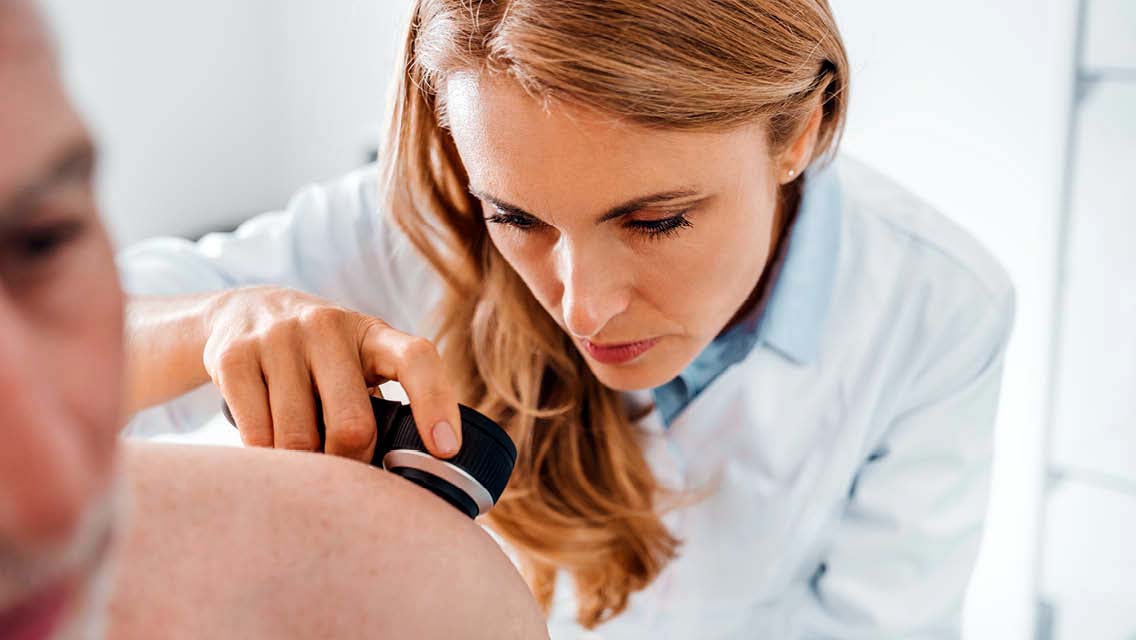
a doctor examines a patient's skin.

That lump on your shoulder that seems to be growing? The scaly lesion on your cheek that never seems to heal? Those minor blemishes may not be as benign as you think.

Signs of basal cell carcinoma, the most common form of skin cancer, are worth noting — and investigating. Leave these lesions and other nonmelanoma skin cancers (NMSC) untreated long enough and they can cause serious damage to tissue and even bone. Recent research, in fact, suggests that these forms of cancer now cause more deaths worldwide than does the more notorious melanoma.

In an October 2023 paper, French researchers reported that NMSC were responsible for more than 63,700 deaths worldwide in 2020, compared with an estimated 57,000 melanoma-related fatalities.

These numbers can be deceptive: NMSC accounted for more than three-quarters of all skin cancers, with some 1.2 million reported cases in 2020, so the percentage of those cases that are fatal is much lower than that of melanoma. Yet lead study author Thierry Passeron, MD, PhD, a dermatology professor at the University Hospital of Nice, says that people need to take them seriously.

“We have to get the message out that not only melanoma can be fatal, but NMSC also,” he says. “It’s crucial to note that individuals with melanin-rich skin are also at risk and are dying from skin cancer. There is a need to implement ­effective strategies to reduce the fatalities associated with all kinds of skin cancers.”

People at high risk include outdoor workers, older adults, and those with suppressed immune systems. Passeron calls for early detection by general practitioners to help lower the mortality rate. “Skin cancers are preventable and treatable, so we need to do more to ensure we are stopping the progression of this disease as early as possible to save lives.”
Craig Cox

Craig Cox is an Experience Life deputy editor who explores the joys and challenges of healthy aging.

Share

More like this

What to Do If You Get a Cancer Diagnosis

Integrative cancer experts offer advice to help you prepare for the journey.
By Laine Bergeson

What Is the Terrain Theory of Cancer?

The health of the body’s internal ecosystem can determine how well the body resists cancer, both before and after a diagnosis. While each of us needs unique support, our diet and lifestyle choices can help us build a healthier terrain right now.
By Laine Bergeson

Good News on the Cancer Front

Here are some positive highlights from the American Cancer Society.
By Michael Dregni

Can Exercise Curb Cancer?

A 12-week exercise regimen suppressed the growth of prostate-cancer cells, according to a recent study.
By Craig Cox

Eating Well During Cancer Care

Integrative cancer experts offer ways to nourish yourself when food seems less appealing.
By Catherine Guthrie

The Connection Between Sugar and Cancer Metabolism

Sugar is the top food to avoid when it comes to cancer, according to an integrative oncologist at the University of California San Francisco.
By Catherine Guthrie

Share a thought

0 Comments

Comments (0)

Leave a Reply

Your email address will not be published. Required fields are marked *

Keep the conversation going

Leave a comment, ask a question, or see what others are talking about in the Life Time Health Facebook group.

Facebook Group

Advertisement

Back To Top