


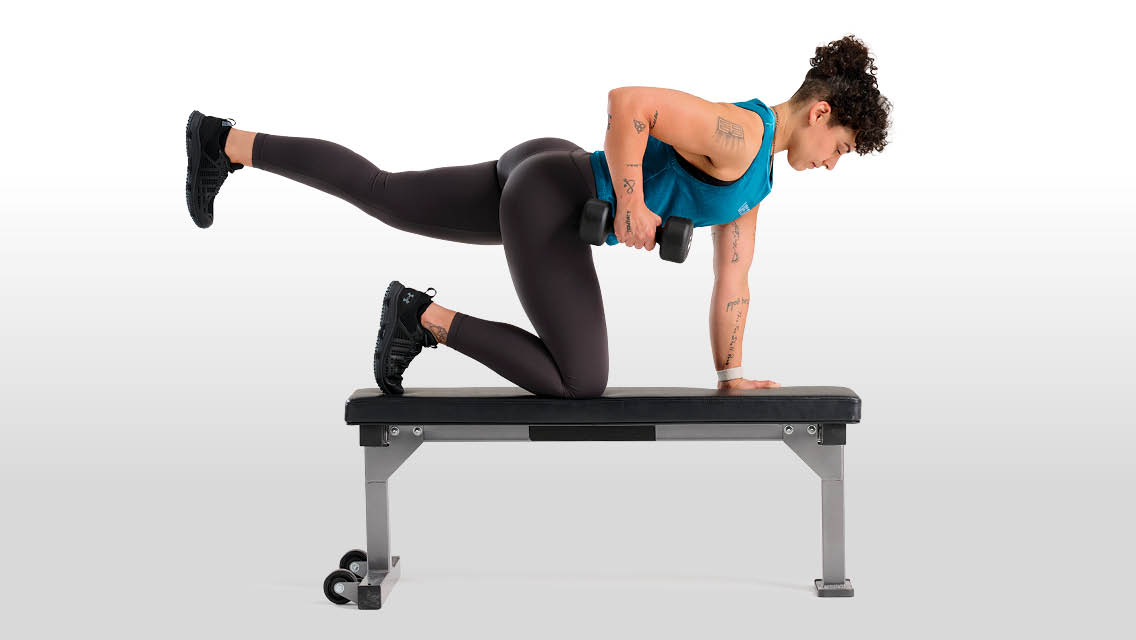
The bird-dog exercise is a fan favorite for core conditioning — and for good reason. Among its benefits, the movement recruits the deep-core muscles, from the chest to the hips and around the back; trains the spinal muscles that contribute to good posture and pelvic-floor health; and improves cross-body coordination, a boon for mobility and cognition.
The bird-dog row builds on all these benefits by adding elevation (on a bench) and load (with a dumbbell, kettlebell, or handled weight plate).
This variation engages the core from multiple angles — working antiflexion and extension, antilateral flexion and extension, and antirotation.
It also adds an upper-body pull, working the mid- and upper-back muscles, which are key components of core stability.
As a bonus, performing rows in the bird-dog position can improve your horizontal pulling form overall. This challenging posture can reveal — and help correct — faulty movement patterns, such as excessive pulling, stretching, momentum, rotation, and low-back compensation.
To incorporate the bird-dog row into your training, keep the following guidelines in mind.
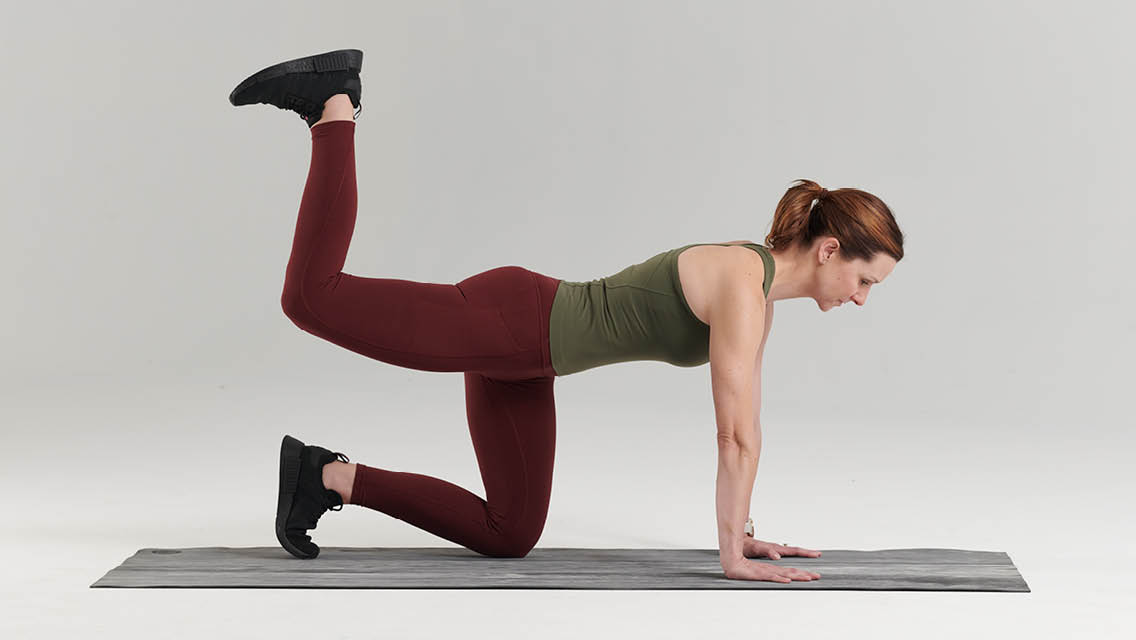
- Pregress to progress. If you’re new to the bird-dog movement, spend some time practicing the body-weight-only variation. (Learn how at “How to Do the Bird Dog.”)
- Start light. Even 3 to 5 pounds is enough to increase the challenge. Add weight gradually.
- Prioritize good form. Common mistakes include arching your back, scrunching up your shoulders, holding your breath, and rotating your hips or shoulders. Consider taking a video to check your alignment.
Additional Cues
- Keep your spine in a neutral posture throughout the movement.
- Keep your hips and shoulders squared toward the floor, and avoid swaying or rotating.
- Maintain space between your shoulders and ears; keep a long neck as you row.
- Engage your core and avoid flaring your ribs.
Instructions
Repeat for two or three sets of eight to 10 reps per side.
1.
Begin by kneeling on a bench in a tabletop position. Find a comfortable position where you can balance on just one knee and the opposite hand.
2.
Grasp a light weight in your free hand. Extend your free leg directly behind you. Engage your core to set your spine in a neutral position from head to extended heel.
3.
Bend your elbow and draw the weight up. Squeeze your shoulder blade and pause for a two-second count at the top.
4.
Keeping the extended leg raised and your core engaged, lower the weight with control until your arm is fully extended.
5.
Repeat for two or three sets of eight to 10 reps per side. Use only as much weight as you can control without compromising form.



Comments (0)