




We took our first steps in the dark. Even with dozens of headlamps bouncing around me, the Grand Canyon wasn’t immediately visible from the North Kaibab Trailhead. But I felt its immensity anyway. Perhaps as a primal reaction to approaching a giant hole in the earth, my instinctual spidey sense activated. My chest tightened. My breath hitched. And I second-guessed my life choices.
I trained for this moment, I reminded myself. The 20-some-mile path ahead is clear, and it’s well marked.
But no amount of positive self-talk and logical reassurance could calm my nerves. So I decided not to worry about it: I can feel nervous — scared, even — and do it anyway.
I stepped gingerly, fiddling with my hiking poles, adjusting and readjusting my pack. A fearless horde of young men parkoured off the rockface to my left, overtaking me.
Within minutes, all the other hikers and trail runners embarking on this rim-to-rim trek — beginning at the canyon’s North Rim, descending into the ancient Inner Gorge, and ascending the South Rim, all in a single day — had passed me too. I kept my eyes on what I could see, my focus on what I could control: the next step right in front of me.
“You don’t need that anymore.” I stopped in my tracks and turned to face a man tapping his forehead, indicating that I could take off my headlamp. “Look,” he said, pointing out to the distance, and I did.
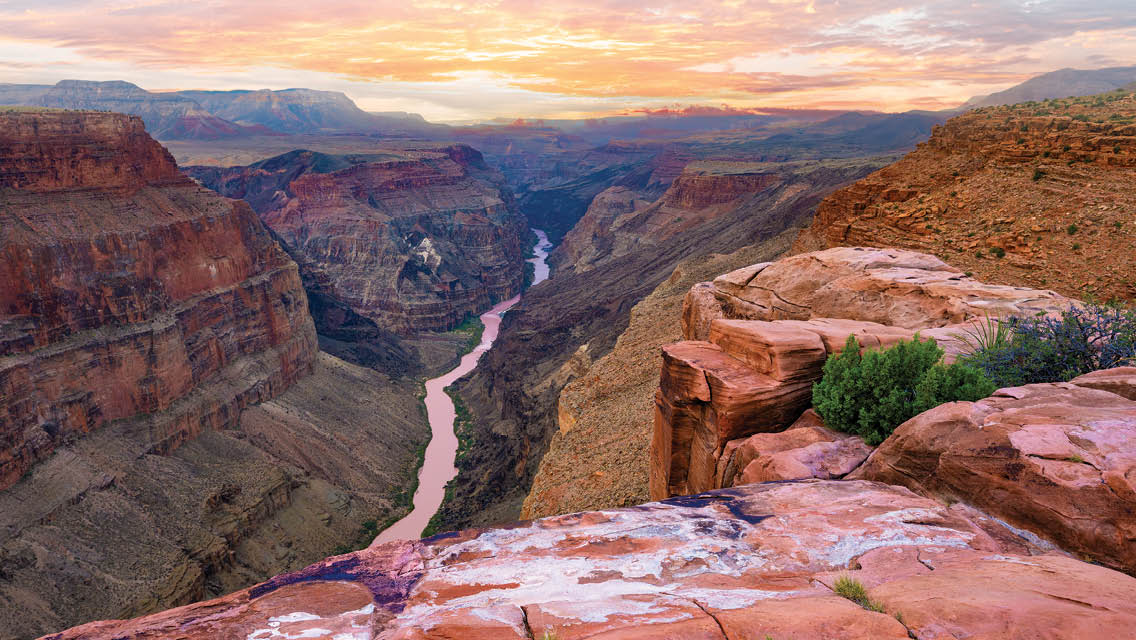
The mid-May sun was rising over the Grand Canyon. Dawn light limned the spruce-fir forest, still dotted with late-winter snow, and cast a golden-pink glow on the canyon’s olive, rust, and beige rock walls.
“Wow,” I tried to say, but the word came out as little more than an awed breath.
“Right?”
My rim-to-rimmate and I stood in silent reverence, looking out across the expanse. My brain called up some facts: The canyon is 278 river miles long, its widest rim-to-rim measurement is 18 miles, and its greatest depth is about 6,000 feet. Some of the rocks of the Inner Gorge are 1.8 billion years old. I cast my gaze around, trying to take in this stretch of space and time. Trying to find what might be my finish line on the South Rim. My eyes burned at the impossible effort.
“Remember to stop and look up once in a while,” my new friend advised as he recommenced his descent.
I followed his cue, and tried to match his light, swift footfalls. But I soon fell behind. The words of my guide, Dave Koch, a Phoenix-based physical therapist who has been leading groups on rim-to-rim hikes for more than three decades, came back to me then: “Hike your own pace.”
I slowed down again, holding tight to the wisdom of those who already knew this place. There’s no need to rush. Take it all in. You’ll finish when you finish.
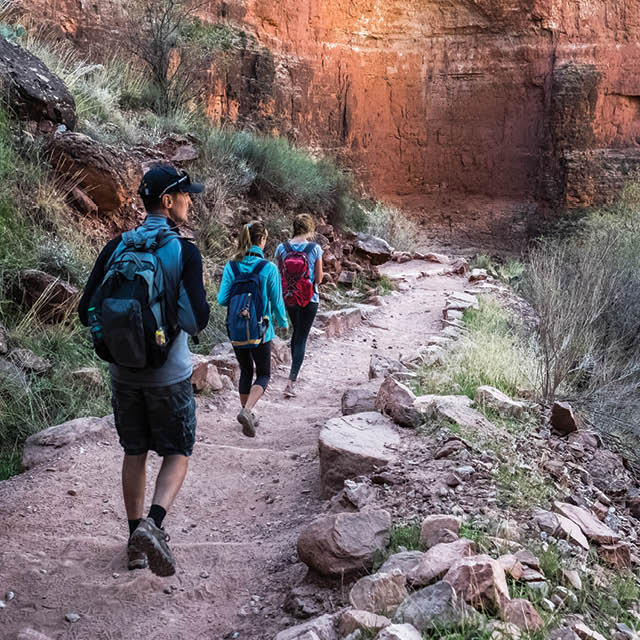
I slowed down again, holding tight to the wisdom of those who already knew this place.
There’s no need to rush. Take it all in. You’ll finish when you finish.
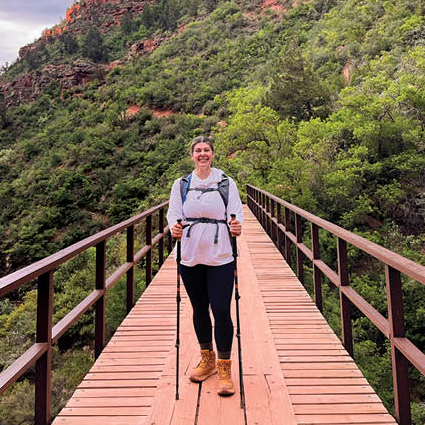
Hurry Up Already
Eight hours later, I was gritting my teeth as I climbed up the South Kaibab Trail. Somewhere along the ascending switchbacks, my mindset shifted and my self-talk went from Don’t rush, you’ve totally got this to Why aren’t you done yet? HURRY!
It’s not a total surprise that I was feeling crabby and being hard on myself. My muscles were fatigued from the slow, controlled descent to reach the base of the canyon. The heat — in the triple digits by the time I reached the Inner Gorge — zapped my energy and my mood. And the overall effort tamped down my appetite, making it difficult to fuel adequately and keep my energy up.
On top of all that, the climb uphill was hard. Harder than I expected. Usually, ascents are the easy part of hikes for me. From traversing the Peruvian Andes to climbing Colorado 14ers, I have always loved going up.
Downhills, meanwhile, have historically been my kryptonite. Starting with the descent had felt like a blessed gift: I could get the hard part out of the way first and enjoy the climb to the finish.
But the heat, the fatigue, and the challenge only fed the gremlin inside me — the one that knows exactly what buttons to push to make me feel bad about myself. To make me want to give up.
To prevail over the gremlin, I pushed harder and dug deeper, only to find I didn’t have more to give. I was already operating at 100 percent. It just wasn’t enough. The gremlin fed off this realization and tried to convince me that I’m a failure. That I’m not fit enough and never will be fit enough. It’s an old cycle — one that I am aware of but still get stuck in, especially when exhaustion meets expectations.
My rim-to-rim effort was no exception. Feeling sorry for myself, I plopped down on a rock and unclipped my pack. I was ready to give up.
But the thing about hiking in the Grand Canyon — and especially when doing a rim to rim — is that giving up isn’t really an option. I couldn’t turn around. I couldn’t take a shortcut. I had no cell service and couldn’t order an Uber or call for help. Even if I were physically injured, I couldn’t rely on emergency services reaching me easily or swiftly. And since I wasn’t suffering from anything more than a bad mood, no one could save me but myself.
I wanted desperately to get out of the canyon. Maybe even more, I wanted out of feeling bad. The only option was to keep moving. And yet I felt stuck in place wishing it could be different. Easier.
As I forced down some fruit snacks and electrolytes, and delayed the inevitable next step, my brain called up an Indigenous story I’d encountered in my research for this trip. According to the account, the Hopi — who have lived in the region for thousands of years and call the canyon Öngtupqa — believe that their ancestors emerged from the underworld through a sacred hole in the earth called the sipapu. Located within the canyon, a few miles from the confluence of the Little Colorado and main Colorado Rivers, the sipapu is believed to connect the “above” and the “below.”
I stood without my pack for the first time all day, stretched my arms out to catch the breeze, and cast my gaze about, looking for the sacred site somewhere in the inverted dome below me.
What I saw once again took my breath away. The afternoon light, filtered through a dusty haze kicked up by the wind, highlighted the canyon’s ruddy peaks and valleys. My eyes followed the outlines of the cliffs and the striations that appeared painted onto the canyon walls.
I understood, then, that I’d lost my way. Not literally, because indeed the path was clear and well marked. But on the inside, I’d forgotten why I was on the path in the first place.
This was a once-in-a-lifetime adventure, in a place I’d dreamed of hiking ever since I understood the Grand Canyon was a real, but no less than magical, place. A place that, due to mounting challenges, might not be accessible for much longer.
Rushing wasn’t the point. Achievement wasn’t the goal. I’d committed to discovering what would happen if I hiked rim to rim in a single day. What would I see? What would I think? What would I feel? No more, no less.
With that, I changed my approach. Instead of hiking as hard and fast as possible and being miserable every step of the way, I gave myself a mission: Take 100 steps max, then find the nearest butt-shaped rock and sit — for as long as I wanted. I could snack, stretch, take pictures, journal, or talk to other hikers or animals that scurried by. Whatever felt right.
As I moved forward, one step, one switchback, and one rock-seat at a time, my mind drifted to my late father. He’d been a mountaineer in his youth and loved climbing the highest, toughest peaks he could find. After his sudden death in 2024, my mom and I visited the Grand Canyon and left some of his solidified ashes on a quiet rock ledge. He never got to see the canyon, but we knew he would have loved it.
Climbing the South Rim, I felt my dad close by. There were the memories of Baba walking with me as a child, taking me to school and to the park, collecting fallen leaves and encouraging me to keep moving, even when I got tired trying to keep up with his long, strong legs. And there was the more recent memory of the last time we walked together, arm in arm, down the hall of the hospital where he would die just a few days later.
I walked with his memory for a while, then took another seat and cried for the first time in a long time.
What I was left with
… was a profound sense of satisfaction
and a little bit of disbelief that I did
what I set out to do.
Let’s Go Again
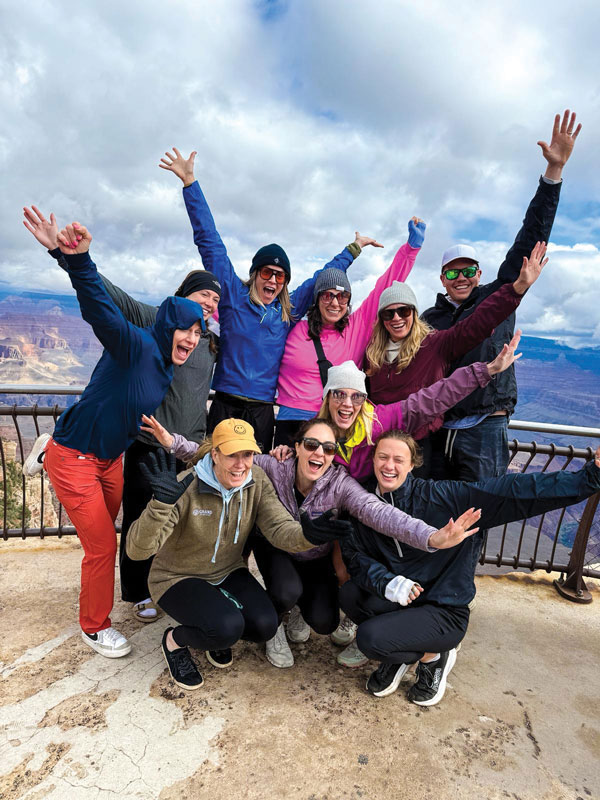
I crested the South Rim of the Grand Canyon at 6:30 p.m., more than 13 hours after starting my journey. My crabbiness had passed. So had my tears. What I was left with, as I took the final steps to the shuttle that would carry me to dinner with the rest of my group, was a profound sense of satisfaction and a little bit of disbelief.
When I sent my family proof of life — a tired but smiley selfie — I told them I’d never do a rim to rim again. That I was so glad I’d done it, and even gladder that it was behind me. One and done, no question.
Early the next morning, as my friends and I stretched our tired limbs and sipped hot coffee, we debriefed about what had worked and what hadn’t. We swapped stories and tips around fueling, hydration, gear, training, and photo ops. We discussed what we’d do differently next time. Next time. The resistance I’d felt the previous night was fading fast.
“Rim to rim 2026?” someone asked.
“2026,” we all agreed.
Less than two months after our adventure, a wildfire blazed through the North Rim. The historic Grand Canyon Lodge, the only lodging on the North Rim and our group’s refuge the night before our hike, was destroyed.
“I think this may be the end of trips to the canyon for a long time,” our guide, Koch, wrote in an email to his contacts. The next guided trip, set for October 2025, was canceled. The May 2026 hike, too, seemed unlikely. The present was sad; the future uncertain.
But “a long time” for us is a drop in the ocean of time for Öngtupqa. The geology of the region has been significantly evolving for the past 70 million years, and the canyon itself, carved by the Colorado River, is more than five million years old. The canyon will survive this — will survive us. For now, for ourselves, we can do our part to ensure the protection of this and other national parks, and to sustain access for Indigenous communities.
And we can still hope. Rim to rim 2026?
Hiking Rim to Rim: What You Need to Know
After the Dragon Bravo Fire blazed through northern Arizona in July, the National Park Service (NPS) announced that the North Rim of the Grand Canyon would be closed to visitors through at least the end of 2025. Additionally, the North and South Kaibab trails, as well as Phantom Ranch in the inner canyon, were closed indefinitely. The South Rim, including the visitor center, lodging, and rim trails, remained open. The tips that follow apply only when the NPS officially reopens the North Rim. For updates, visit https://www.nps.gov/grca/planyourvisit/grand-canyon-national-park-public-health-update.htm.
Go early or late in the season. Rim-to-rim hikes are an option only when both the North and South rims of the Grand Canyon are open. While the South Rim is open year-round, the North Rim is typically open only from May to October, due to winter conditions that make it unsafe. If possible, plan your trip during the first or last week of the season, before or after the inner canyon becomes dangerously hot.
Don’t go alone. The best decision I made was doing my rim to rim with a group. I first heard about the challenge from my Life Time colleague and friend Lindsay Ogden, a personal trainer who completed her first rim to rim in 2024. When Lindsay was rounding up a group for her 2025 rim to rim, I quickly signed on to join her and her guide, Dave Koch, PT, founder of the Arizona Canyon Hiking Experience (ACHE).
Koch has been leading groups on rim-to-rim (and rim-to-rim-to-rim) hikes since 1993. A lifelong outdoor enthusiast and avid hiker, Koch had to stop doing the hike himself after developing Parkinson’s disease. But he loves the canyon so much that he has continued to offer fully supported trips, including food and transportation, from the Phoenix area. I can’t imagine a rim to rim without Linsday, Koch, and the rest of our ACHE crew.
Go at your own pace. As Koch reminded our group repeatedly: Don’t try to hike with anyone else. Don’t push your pace too hard to keep up with (or beat) a friend or family member, and don’t slow your pace to keep anyone else company. You’ll probably end up walking with someone or a few people at various points throughout the hike — and likely make new friends along the way — but the only pace you should care about is your own. In our group, the fastest people finished in about eight hours. Others I spoke to took upward of 18 hours. Take your time, push yourself for yourself, and count on your group to save you dinner.
Train. Then train some more. There are some hikes that, if you’re fairly fit, you can just show up for and complete. It might be hard and you might get sore, but you can finish in reasonably good shape. Rim to rim is not one of those hikes.
Several people from my group worked with Life Time strength and endurance coach Mike Thomson. My four-month progressive program included a combination of strategic resistance training, building on my strong base with endurance-supporting strength work, and cardio training, especially lower-intensity cardio for longer durations to build up my endurance. Finally, it included one long run each week. While longer runs aren’t required, time on your feet is. Whether you walk, run, hike, or have another way that you like to get around by foot, set aside several continuous hours once a week to get used to it.
Trekking poles are nonnegotiable. These will save your knees on the downhill and give you support on the uphill. While you’re at it, wear a pack with a bladder or bottles that allow you to carry at least four liters of water. These might seem like nice-to-haves, but trust me — they’re invaluable.


This Post Has One Comment
I had the pleasure of meeting Maggie and being a part of the group that took this trek. This is such a beautiful account of the hike and your experience. It is hard to describe the scale of the Canyon, the mental toughness needed, and the quiet determination it takes to keep moving. Thank you for sharing the account of your journey.