



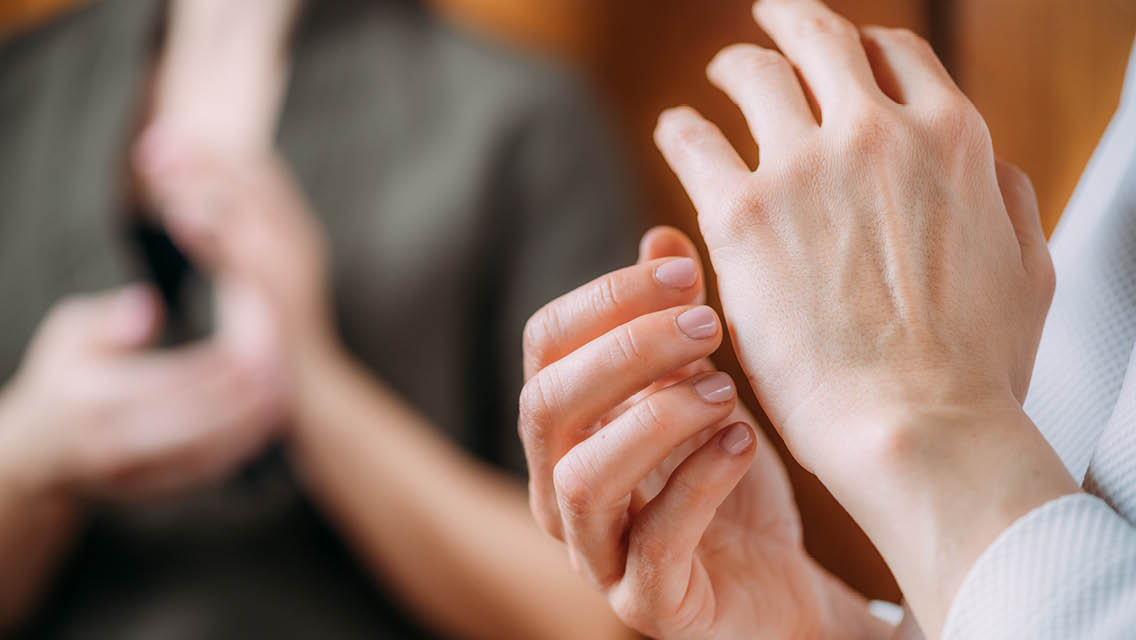
When I was practicing therapy in person, one of my favorite things was to hand my new clients a little gadget called an emWave, an early-model biofeedback device that depicted the pattern of their heart rhythm. It was the fastest way for me to demonstrate that mental health involves more than just the mind.
When clients placed their thumbs over the sensors, the little machine would respond: a red-light “bing,” indicating a herky-jerky, stressed heart rhythm; a blue-light “boop” for a more regular pace; or a soothing, green-light “bong” for an even, wavy rhythm.
This last pattern indicates what’s known as heart coherence. It signals that the body’s psychological and physiological systems are aligned, and it corresponds to greater overall stability, clarity, and resilience.
When a stressed-out client could slow their breathing and focus attention on something that brought them feelings of gratitude, appreciation, or love, the energy in the room would settle and the emWave’s light would turn green. The pleasing, rhythmic “bong” would lull us both into a place of stillness and calm, at which point I’d ask something along the lines of “Have you heard from your ex lately?”
Instantly, the little machine would turn bright red and “bing” in protest. The client, jarred from their peaceful reverie, would look at me in shock, then confusion, before arriving at some variation of “Ah, you got me!”
From that moment, our goal was to see how quickly the two of us could work together to bring the green light back.
This routine allowed us to enjoy a few moments of shared coherence, reducing our stress levels and enhancing our connection.
Professionally, it helped me understand a client’s degree of attunement to their body, as well as how much help they might need to settle themselves after working with distressing material.
Most beneficial of all was that after the exercise, I rarely needed to convince anyone of the need to invite their body to join their mind in the healing process, because they’d just experienced the connection firsthand.
And you can too.
Bringing the BODY to Therapy
Twenty years after the first emWave hit the market, you can now choose from a plethora of biofeedback devices. They can measure your heart rhythm, stimulate your vagus nerve, and track your sleep. Consumers spent an estimated $200 million on these devices in 2025.
Many of us still prefer to address mental health by talking about it rather than feeling it. This helps explain why cognitive behavioral therapy, with its focus on cognitive and emotional processes — largely to the exclusion of bodily ones — has remained the gold standard of psychotherapy since its inception in the 1960s.
Yet for almost as long, some experts who study trauma and PTSD have challenged therapeutic approaches that prioritize talking over feeling. They argue that the imprint of trauma is held in the body and can’t be resolved through talk alone.
Two body-centered, or somatic, therapies that took this view emerged during the 1970s: Somatic Experiencing, created by Peter Levine, PhD, and sensorimotor psychotherapy, introduced by Pat Ogden, PhD.
The somatic framework gained still more traction in the 1980s, when psychologist Francine Shapiro, PhD, developed a treatment model called EMDR, or eye movement desensitization and reprocessing (see “How Does EMDR Work?” for more). She was able to document EMDR’s effectiveness with such an unprecedented level of scientific rigor that it helped pave the way for a multitude of subsequent mind-body therapies that use eye movement, including accelerated resolution therapy (ART) and brainspotting.
EMDR involves a technique called dual attention, during which the patient experiences some form of bilateral sensory input — eye movement, butterfly hugs, or alternate-knee tapping — while focusing on distressing thoughts or memories. Various mind-body models use other forms of dual attention. All of them can help diffuse distress and settle an activated nervous system.
Undoubtedly powerful, EMDR has proved more effective than talk therapy for many people. Still, its speed and intensity can sometimes be overwhelming for those struggling with complex trauma — especially if they are still living in unsafe circumstances. Other somatic therapies are gentler but can be painstakingly slow.
Bringing the Body’s ENERGY to Therapy
As psychologists sought to develop therapies that could bridge the gap between the extremes of body-based techniques, an energy-based model called tapping began to emerge. Its central premise is that, in addition to our mental and physical selves, we have an energetic self — and it is uniquely helpful in the healing process.
On the surface, tapping looks a lot like EMDR: Focus on the distress, add some sensory input, and feel the tension ease. But tapping also engages with a discrete set of acupressure points along the body’s meridians, which are energetic pathways in the body’s connective tissue. According to Traditional Chinese Medicine, the meridians correlate with specific emotions and organs.
Fascinatingly, research demonstrates that tapping on the prescribed points reduces stress much more quickly and effectively than tapping on random points.
Well over 100 studies now support tapping’s use in treating a range of conditions, including PTSD, performance anxiety, and eating disorders. This suggests that the meridian system accesses something stronger than attention alone, something that can help move trauma and distress out of the body.
What EMDR did for mind-body approaches, tapping is doing for the practice now known as energy psychology. (For more on tapping, see “What is EFT and How Does it Work?“)
How ENERGY PSYCHOLOGY Can Help
In a nutshell, practitioners of energy psychology use well-established procedures and protocols, including psychodynamic, cognitive, and mind-body approaches, and then add an element of “subtle energy” to enhance the process. As a result, relief and progress can often happen more quickly and easily and — especially important for patients dealing with trauma — a lot more gently.
“Subtle energy,” so named because it can’t be directly measured in terms of force or motion, refers to the flow and balance of energy in and around the body. It involves meridians, chakras, and what’s called the biofield — the energetic field that extends from our bodies. Energy-psychology practitioners understand any blockages, imbalances, or deficiencies in this energy as potential root causes for illness and distress.
Some practitioners also incorporate muscle testing to help identify problematic beliefs, the root of trauma patterns, suppressed emotions, and even the cause of allergies. Because muscle testing asks the body to identify the problem, it bypasses the analytical tendency of the cognitive mind. (For more insight, visit “What Is Muscle Testing and How Does It Work?“)
Energy-psychology practices range from quick self-help interventions to intricate protocols that incorporate psychotherapy, coaching, and integrative medicine. On the next pages are three of the most powerful practices I know.
Advanced INTEGRATIVE Therapy
In Ayurvedic and yogic practices, chakras are recognized as discrete energy centers positioned along the central axis of the body, from the base of the spine to the crown of the head. Each is thought to regulate the flow of vital energy or “life force” (sometimes known as prana) and to correspond with specific physiological, emotional, and psychological domains.
Advanced integrative therapy (AIT) uses the chakra system to help clear the imprint of trauma, illness, or other persistent negative patterns from the body and the bioenergetic field that surrounds it. This process is as powerful as EMDR but as gentle as a Reiki session.
AIT, which was created by psychotherapist Asha Clinton, PhD, uses muscle testing to hone the traumatic memory or belief before it’s released. During a session, you place your hands on your body’s energy centers to help move the trauma out. You also work with the therapist to identify negative beliefs and maladaptive reactions, and to instill positive beliefs and responses to replace them.
If you’d like to work through a traumatic experience but are concerned that it might be too frightening, take forever, or send you to places you don’t want to go, the gentleness of AIT may be the perfect solution. (Find an AIT therapist at the Advanced Integrative Therapy Institute.)
TAPPING
The most well-known and well-researched energy-psychology modality is tapping. Sometimes called “acupuncture without the needles,” it involves using the fingers to tap on specific acupressure points while focusing attention on stressful thoughts, emotions, or memories.
Different approaches recommend different sequences of points. Thought field therapy (TFT) uses various sets of points — known as algorithms — depending on the issue. There are unique algorithms for anxiety, grief, physical pain, jet lag, even fear of spiders. TFT has several trauma algorithms, and they’re especially effective for reducing the vividness of difficult imagery in the mind’s eye. These can be powerful interventions for nightmares or traumatic events.
TFT requires little talk: You focus briefly on the distressing material and follow along on the tapping; the distress may start to dissipate. This makes it an accessible and effective tool for all ages, languages, and cultures.
It can be used with individuals or groups. Some of the most notable studies show a lasting reduction in PTSD symptoms among Rwandan communities that survived the 1994 genocide.
Emotional freedom technique (EFT), meanwhile, involves just one tapping sequence. It’s easy to use and remember, making it helpful in emergency situations and as an on-the-spot remedy for anxiety. (For more on EFT, visit “What is EFT and How Does it Work?“)
Follow these steps to test the effects of bilateral tapping on yourself:
- Next time you’re feeling anxious, angry, confused, or distressed about anything at all, pause and put a 0–10 score on it.
- Begin tapping alternately on either side of your body while focusing on the source of your stress. This could look like a butterfly hug, wherein you cross your arms and alternate tapping on each shoulder.
- After a few minutes, check in and score your overall tension. If it hasn’t come down, do a few more rounds of tapping.
This approach can work equally well on pets that are afraid of thunderstorms or trips to the vet: Tap alternately on each side of their haunches or gently squeeze each ear until they settle down. (To learn more, visit www.thetappingsolution.com or read Tapping the Healer Within by Roger Callahan and Richard Trubo. Find a practitioner at The Association for Comprehensive Energy Psychology.)
Intention-Based SCRIPTS
The word “abracadabra” is not just a dramatic term uttered by stage magicians: Some theorize that it comes from Aramaic and means “I create as I speak.” It can remind you that your words often have more power than you realize.
Logosynthesis and Ask and Receive are resources that can help you tap into that power. Both use a series of carefully crafted statements, or scripts, to help align the cognitive, emotional, physical, and spiritual aspects of your being.
They draw on principles from other practices, including psychoanalysis, hypnotherapy, and neurolinguistic programming. The scripts offer a graceful, fun, and speedy approach to overcoming blocks, releasing the imprint of adverse experiences and orienting yourself to what you’d really like to see in the world.
You can silently rehearse the following Ask and Receive basic script to get to sleep, find your keys, finish a project, or meet someone wonderful. One of my clients claims it helps eliminate her motion sickness during air travel.
- “There’s a part of my being that already knows [how to go to sleep right now/where I left my keys/how to feel strong and healthy].
- “That part of my being is willing to inform the rest of me now.
- “It is doing so now, with grace and ease.
- “My mind, body, and spirit are receiving this information.
- “Information transfer is now complete.”
Take a deep breath and see what floats to mind. Ideally, if you wait a few moments, you’ll remember where you put your keys or realize what’s needed to finish your project. And if you’re afraid of flying, you might notice yourself feeling noticeably steadier.
DIY ENERGY WORK
Heart-Coherence Exercise
The notion that we can’t help being hijacked by our emotions is a common misperception. By repeating the following heart-coherence exercise daily, you may find you can recover from upsets more quickly, reduce your susceptibility to other people’s emotional states, and even help improve the regulation of those around you. (Learn more about how our energy can affect other people at “What Is Heart Coherence?“)
1) Think of a situation, person, or pet that brings you feelings of deep gratitude. Breathing deeply, focus on the thought and notice the sensations in your body. Is your forehead relaxed? How’s your breathing? Are your hands warm or cold?
You may wish to use your preferred biofeedback device to track your body’s response.
2) Then throw in a “bomb” — a situation or person that is guaranteed to get a rise out of you. Notice what you feel in your body now. Racing heart? Clenched muscles? Sweaty palms?
If you’re using a biofeedback device, check what it reports about your stress levels.
3) Alternate between gratitude and the bomb response a few times, returning completely to the gratitude state before you go about your day. After a period of practice, you might find yourself better at settling your reactions before they cause trouble.
This article originally appeared as “Beyond Talk Therapy” in the May/June 2026 issue of Experience Life.




Comments (0)