




To Build strength, you have to overload the muscles — this is a core tenet of resistance training. It’s not enough to simply go through the motions: Strength training is supposed to be hard.
You can increase strength in several ways. The usual routes are to add to the weight you lift or change tempo to increase the time under tension. Another approach, explains Life Time strength and running coach Mike Thomson, involves increasing fatigue through a protocol known as post-exhaustion.
Post-exhaustion training is a twist on superset training. It pairs two exercises to push a particular muscle or muscle group close to failure; this stimulates adaptations that increase muscle endurance, strength, and size.
A post-exhaustion set typically starts with a compound, multijoint exercise followed by a less complex movement that isolates specific muscles. The first exercise is performed for fewer reps with a heavy weight (see “Defining ‘Heavy’” below), while the second move is performed for more repetitions at a lighter weight.
Who can benefit from this post-exhaustion approach?
“Everybody!” insists Thomson. “It could be for bodybuilders, those that want to improve their aesthetics, or anyone with performance-based goals to grow the size of their muscles. Athletes in a competitive phase of training can add this about eight weeks out for a couple weeks before their last peaking phase prior to their competition.”
It’s also appropriate for all ages, says Thomson: “I coach a 76-year-old woman and just had her go heavy on a seated-row machine followed by a lighter, banded biceps curl to exhaust those muscles.”
Words like “exhaustion,” “failure,” and “overload” might sound intimidating, but they are essential elements of a progressive strength-training program. (New to weightlifting? “A Beginner’s Guide to Weightlifting” breaks down the basics and explains key terms so you can train with confidence.) By pushing closer to the edge of your strength capacity without going past it, you can stimulate positive muscle adaptations associated with performance, athleticism, and longevity.
Thomson designed the following post-exhaustion workouts to target every major muscle group for growth. Do each workout once per week, taking one or two days off in between. Repeat for four weeks.
Workout No. 1
In each superset, move quickly from the first exercise to the second. After completing the second move, rest two minutes. Perform four or five sets total, then continue to the next superset.
Superset A
A1:
Hex Bar Deadlift
Perform 5 reps with a challenging weight.
- Stand inside a hex bar racked with a challenging weight that allows you to do five reps. Hinge at the hips, then bend the knees to reach down and grip the bar with hands shoulder width apart.
- Pull your shoulder blades down and back to engage your lats.
- Press your feet into the floor and push your hips forward to lift the weight off the floor. Squeeze your glutes at the top to achieve a full lockout.
- Hinge at the hips and bend the knees to lower the weight to the floor. Keep the bar in contact with your legs throughout the move.
Note: If you don’t have a hex bar, use a straight bar.
A2:
Dumbell Alternating Reverse Lunge
Perform 10 reps per side, alternating.
- Hold a dumbbell in each hand down by your sides. Stand with your feet about hip width apart.
- Step backward with one foot, keeping your torso upright and shoulders squared over your hips.
- Allow both knees to bend; your back knee should hover just above the floor, and your front knee should align with your middle toe.
- Press through your front heel and step your back foot up to the starting position.
- Perform the same move with the opposite leg. Continue until you’ve performed 10 reps per leg.
Note: If dumbbells are too challenging, start with body weight only.
Superset B
B1:
Triceps Dip
Perform 5 reps.
- Grip the handles of a dip station, palms facing each other.
- Bend at the elbows to lower your body until your forearms are almost parallel with the floor. Maintain a slight forward lean to emphasize the chest.
- Push through your palms to drive back to the starting position.
Note: Use a resistance band or your feet for support, as needed, to lighten the overall load.
B2:
Incline Dumbbell Chest Press
Perform 12 reps.
- Position an adjustable bench so that the back is inclined slightly — about 15 degrees.
- Sit on the bench seat and hold two dumbbells in front of you, resting them on top of your thighs.
- Lie back and bring the dumbbells toward your shoulders, upper arms at the sides of your chest. Palms can face inward or forward.
- Press the dumbbells straight up over your chest and toward the ceiling — rather than diagonally away from your chest — until your arms are fully extended.
- Bend your elbows to lower the weights back down.
Superset C
C1:
Bent-Over Row
Perform 5 reps with a challenging weight.
- Stand holding a loaded barbell (or dumbbells or kettlebells) with feet hip width apart and hands shoulder width apart, palms facing toward you. Choose a challenging weight that allows for five reps.
- Hinge your hips back to lower the weight to about knee height; allow the knees to bend slightly. Brace your core.
- Draw your shoulder blades together and bend your elbows to pull the weight toward your rib cage.
- Reverse the movement to lower the barbell with control until your arms are fully extended. Keep your back straight throughout the movement.
C2:
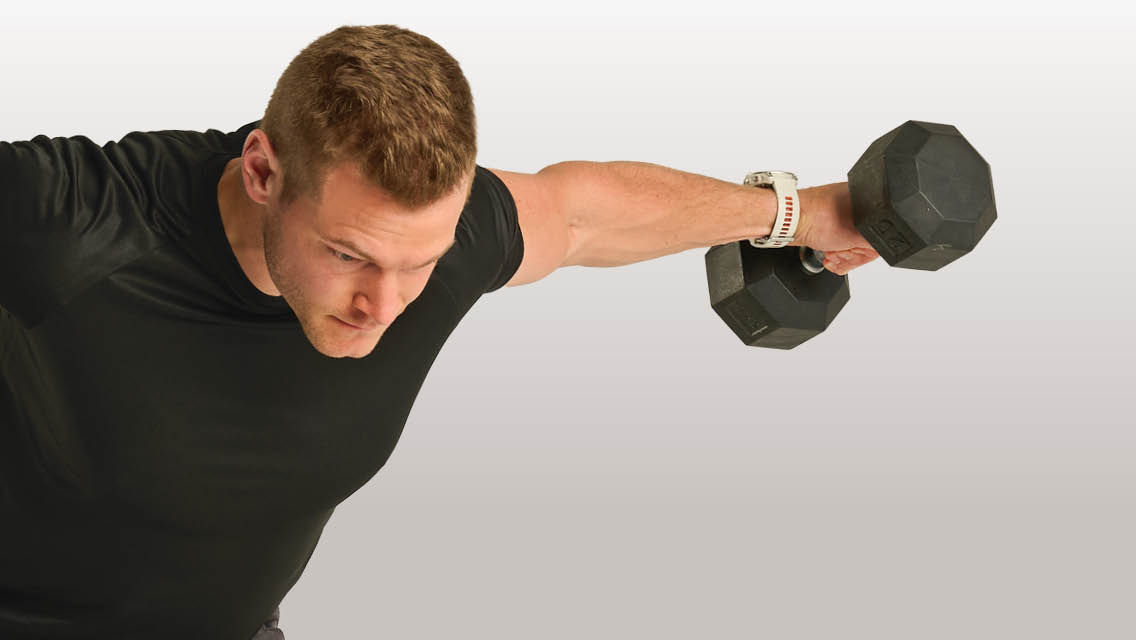
Dumbbell Bent-Over Reverse Fly
Perform 12 reps.
- Stand with your feet hip width apart and hold a dumbbell in each hand down by your sides.
- Bend your knees slightly and hinge forward at the hips; allow the weights to hang at arm’s length, palms facing each other.
- Keeping your back flat and a slight bend in your elbows, squeeze your shoulder blades together to lift the dumbbells out to your sides until your arms are in line with your shoulders. Avoid “jumping” the weights up or otherwise using momentum.
- Lower the dumbbells back down with control.
Workout No. 2
In each superset, move quickly from the first exercise to the second. After completing the second move, rest two minutes. Perform four or five sets total, then continue to the next superset.
Superset A
A1:
Barbell Front Squat
Perform 5 reps with a challenging weight.
- Set up a barbell in a rack at about midchest. Choose a challenging weight that allows for five reps. Then grip the bar with hands shoulder width apart, palms facing out.
- Bend the knees slightly so that the bar is directly in front of the shoulders; bring the elbows forward and try to point them toward the ceiling.
- Remove the bar from the rack and slowly step back. At this point, the bar should be across the front of your shoulders; use your fingers for support only. Set your feet shoulder width apart and point your toes slightly outward.
- Engage your core and bend your knees to squat down, stopping when your thighs are about parallel to the floor. Keep your torso upright and elbows lifted.
- Press through your feet to stand up; squeeze your glutes at the top.
A2:
Dumbell Alternating Front Lunge
Perform 10 reps per side, alternating.
- Hold a dumbbell in each hand down by your sides. Stand with your feet about hip width apart.
- Step forward with one foot, keeping your torso upright and shoulders squared over your hips.
- Allow both knees to bend; your back knee should hover just above the floor, and your front knee should align with your middle toe.
- Press through your front heel and step your front foot back to the starting position. Switch legs.
Note: If dumbbells are too challenging, start with body weight only.
Superset B
B1:
Barbell Bench Press
Perform 5 reps with a challenging weight.
- With either a full squat rack or bench-press-specific bench and rack, set a barbell at an appropriate height so that you could unload the bar from the hooks while lying down on a flat bench (you should have to press the barbell only an inch or two to unrack it, when the time comes). Choose a challenging weight that allows for five reps.
- Lie on the bench. Take an overhand grip on the bar, with hands slightly wider than shoulder width, wrists straight, and thumbs wrapped under the bar. Then, draw your shoulder blades together and pull them down and back.
- Push your feet into the ground (use weight plates or aerobic steps to add height if needed).
- Lift the bar off the uprights. Inhale and brace your core, then slowly lower the bar toward the bottom of your chest. Once there, your elbows should point about 45 degrees from your body.
- Squeeze your glutes and push your feet into the floor as you press the bar back to the starting position.
B2:
Neutral Grip Shoulder Press
Perform 12 reps.
- Stand with your feet hip width apart and hold a dumbbell in front of each shoulder, palms facing each other. Keep your elbows tucked at your sides.
- Brace your core. Press the weights overhead until your arms are fully extended, keeping your arms in line with your ears.
- Pause, then lower the weights to your shoulders with control.
Superset C
C1:
Pull-Up
Perform 5 reps.
- Grip a pull-up bar with hands slightly wider than your shoulders, palms facing forward. Allow yourself to hang from the bar with your arms straight.
- Engage your core, squeeze your glutes, and draw your shoulder blades together to pull yourself up to the bar. Keep your neck neutral and avoid reaching up with your chin.
- Reverse the movement with control.
Note: Use an assisted pull-up machine, a resistance band, or your feet for support, as needed.
C2:
Standing EZ-Bar Curl
Perform 12 reps.
- Start by standing with your feet hip to shoulder width apart. Grip an EZ bar with your hands placed just outside of your thighs, arms extended down, and palms facing out.
- Keeping your torso still and elbows in place at your sides, bend your elbows to lift the bar to shoulder height, then lower it with control to the bottom position while keeping your shoulders relaxed.
Defining “Heavy”
“Heavy” is a subjective — and important — marker in strength training. Lifting a heavy enough weight can mean the difference between an effective workout and an ineffective one.
So how can you know if a weight is heavy?
“There is no absolute number that corresponds to a heavy weight in any exercise,” says Life Time’s Mike Thomson, a strength and running coach. “What counts as heavy is relative. It’s what is heavy for you.”
To determine how much weight to use for post-exhaustion supersets, Thomson suggests lifting with effort in mind. “For the first exercise in each set, ‘heavy’ is something you can do five times with solid form, with just a couple of reps in reserve.”
This means that when you finish the set of five,
you could potentially do a sixth and maybe a seventh rep but no more.
This means that when you finish the set of five, you could potentially do a sixth and maybe a seventh rep but no more. If you could do that weight eight or more times, consider it a sign to add load. Conversely, if you were to struggle to get all five reps without your form breaking down, drop some weight.
Adding and subtracting weight to locate your heavy sweet spot is fairly straightforward when using free weights and machines. But body-weight movements — like the triceps dip in Workout No. 1 — may require more maneuvering.
If body-weight triceps dips are too challenging for five reps, add support from the machine; if using a dip attachment, try a resistance band or your feet for assistance. If the move is not challenging enough, increase weight by wearing a weighted vest, holding a dumbbell between your legs, or adding plates to a belt.
It might take a little trial and error to find your sweet spot, but the results are well worth it.
This article originally appeared as “Super Size Your Supersets” in the March/April 2026 issue of Experience Life.


This Post Has 0 Comments