




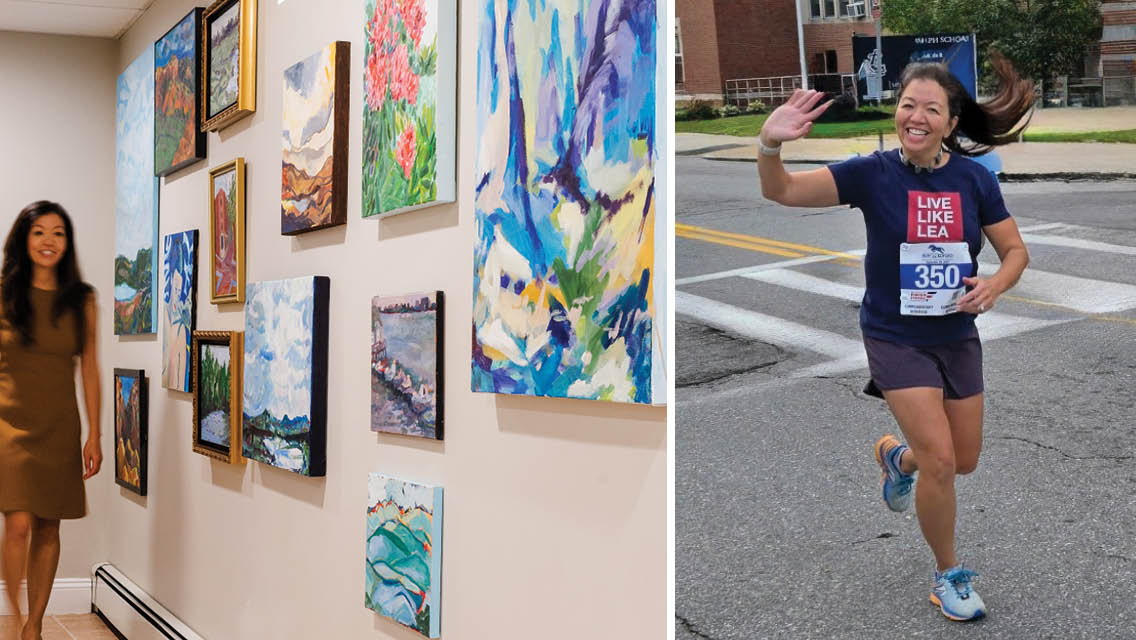
In 2019, I was a single mom with two kids, trying to make ends meet on an art educator’s salary. I rarely had enough energy to make it through the day, let alone follow a consistent workout routine.
I knew I shouldn’t take my health for granted. I’d watched my mother battle four types of cancer and my childhood best friend, Lea, struggle with complications from a bone-marrow transplant for leukemia.
It was a stark reminder of how precious and precarious health is. Lea’s cancer, especially, shocked me — she had always been the picture of health. While managing health issues related to the transplant, Lea convinced me to embrace one of her favorite concepts: radical self-care.
I learned to direct more energy toward caring for my body and making small changes to improve my health, and my strength grew. Even today, I feel most connected with Lea when I’m in motion.
Kindness and Bravery
I met Lea in seventh grade at the lunch table. We were very different — she was tall, blond, and athletic, and I was a petite, artistic Asian American girl in a creative Chinese and Italian family. We became fast friends.
Lea was one of a kind. She lit up every room she entered and cared deeply about others. In school, she noticed how differently we were treated and wasn’t afraid to stand up for me. When kids made fun of me for my Chinese American background, she was always there. Her support was priceless.
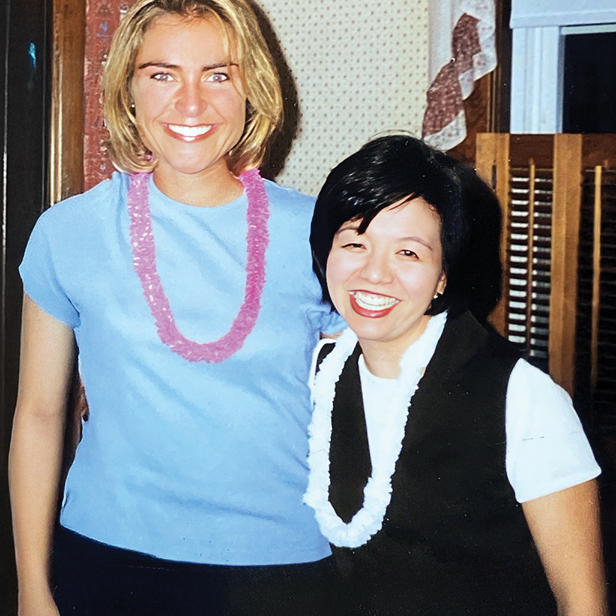 Our friendship grew after my mom was diagnosed with lymphoma when I was 15. Lea adored my mom and became my main support person. Lea and I spent a lot of time together, and she would often show up at my door out of the blue with freshly baked cookies.
We remained close through high school and college. Lea was always training for something. I cheered her on when she competed in triathlons, and I was there when she finished the Boston Marathon in 1999.
In 2005, Lea was diagnosed with chronic myelogenous leukemia, caused by a genetic mutation that drives the uncontrolled growth of white blood cells in the bone marrow. I still remember the day she called me with the diagnosis. I was stunned — she was the last person I expected to get cancer. We cried on the phone together, and I listened as she weighed her options.
Throughout her treatment, I supported her as much as I could. We no longer lived in the same city, so I couldn’t help with in-person needs, but we often spoke on the phone, and I sent her lots of cards. She maintained her positive attitude through it all.
When Lea underwent a bone-marrow transplant in 2007, her body struggled to accept it. But she never complained. It sent her cancer into remission, and she was able to maintain her full, active lifestyle as much as she could for over a decade.
Committing to Self-Care
In August 2019, my boyfriend, Shawn, who is now my husband, gifted me a Life Time membership. I was hesitant to pursue a fitness routine — especially as a single mom — but Lea encouraged me. One of her favorite phrases was “radical self-care,” which she defined as self-care above all else.
Given what she’d been through, Lea certainly understood the importance of caring for yourself. Despite her health challenges, she loved to hike and practice yoga and Pilates. Her commitment to her own self-care helped me overcome my nerves.
Shawn and I began taking cycling classes together. On a real bike, I’d never be able to keep up with him, but it was a great activity to do together at our different levels. Sometimes I’d even get him to take a yoga class. Things were starting to feel good.
Then, in late 2019, Lea died from complications related to her transplant. The loss was devastating and left a huge void in my world. I was honored to be one of five speakers at her celebration of life and to meet so many people who also loved her.
My relationship with Shawn was a blessing in my grief. He reminds me of Lea in many ways, and our relationship has helped ground and motivate me.
Radical Recovery
When COVID-19 shut the world down, in March 2020, my fitness routine was limited to walking. I wasn’t sure what else to do without access to the club, and I felt more connected to Lea when I walked outdoors. With Shawn’s encouragement, I started using exercise bands and lifting light weights at home.
As the world was reopening a year later, I developed debilitating back pain. It was so overwhelming that I had to take a leave of absence from my teaching job. I couldn’t walk or maintain my exercise routine.
Scans showed that I was suffering from adenomyosis, a condition in which endometrial tissue grows into the uterine wall. Surgeons removed the painful tissue with a hysterectomy in June 2021, which brought immediate relief.
Recovery was slow, however, and I felt weak at my post-op appointment six weeks later. I expected my doctor to tell me to take it easy. Instead, she said that I felt weak because I was deconditioned and encouraged me to start moving again.
Lea’s radical self-care was now an essential part of my own recovery.
I started with low-impact exercises, including the cycling and yoga classes I had once enjoyed. Over the following months, I ramped up my running, dedicating my runs to Lea. I completed my first 5K in September 2022 and my first 10K the following June.
Meanwhile, fitness was transforming my work. As an artist, I view my body, mind, and heart as tools for creating. Committing to exercise was helping me feel stronger and more balanced so that I could bring my art to life.
Shortly after running my first 10K, I suffered a stress fracture in my right shin. While recovering, I focused on building muscle. I hired a personal trainer, who helped me progress from fitness bands and free weights to heavier weights and bigger pieces of equipment. I haven’t had any further issues with stress fractures since building up my strength.
Living Like Lea
These days, I’m running more consistently again, and I’ve registered for a half-marathon. I never feel closer to Lea than while I’m on a run. When I’m out on a trail, I talk to her — about how my kids are doing, about fond memories we shared, and about my dreams for her kids.
My art career is thriving thanks to the energy I’ve gained from fitness, which flows into my work. My strength and stamina allow me to create larger pieces, and I’m painting more landscapes — partly inspired by running through the woods.
Fitness is an important part of my relationship as well. Exercise is something Shawn and I value, both because it makes us feel great and because we want to stay healthy and strong for the rest of our lives together.
I think Lea would be proud that I get up each morning and work out before leaving to teach. Her belief in radical self-care was grounded in the idea that this practice allows us to show up as our best selves for others.
That’s how she lived her life, and I’m proud to honor her legacy by living mine that way too.
How to Live Like Lea
- Be brave. “Take chances, be willing to look like a fool, and don’t follow what everyone else is doing,” Christina says. “Just be real with yourself and those around you.”
- Be kind to yourself. “You don’t get extra credit in life for depriving yourself of needs, love, rest, and kindness.”
- Prioritize both fitness and creativity. “I believe that my art and creativity benefit from my good health and ability to move my body,” she notes.
My Turnaround
For more real-life success stories of people who have embraced healthy behaviors and changed their lives, visit our My Turnaround department.
This article originally appeared as “Radical Self-Care.”

This Post Has One Comment
This is glorious to read! You go, Christina!