


Sleep and Resiliency: A Guide to This Essential Recovery and Repair Window (Performance & Longevity Series)
Learn about the critical role of sleep for health and longevity, the barriers that might be preventing you from getting enough quality sleep, and practical strategies for sleep improvement.


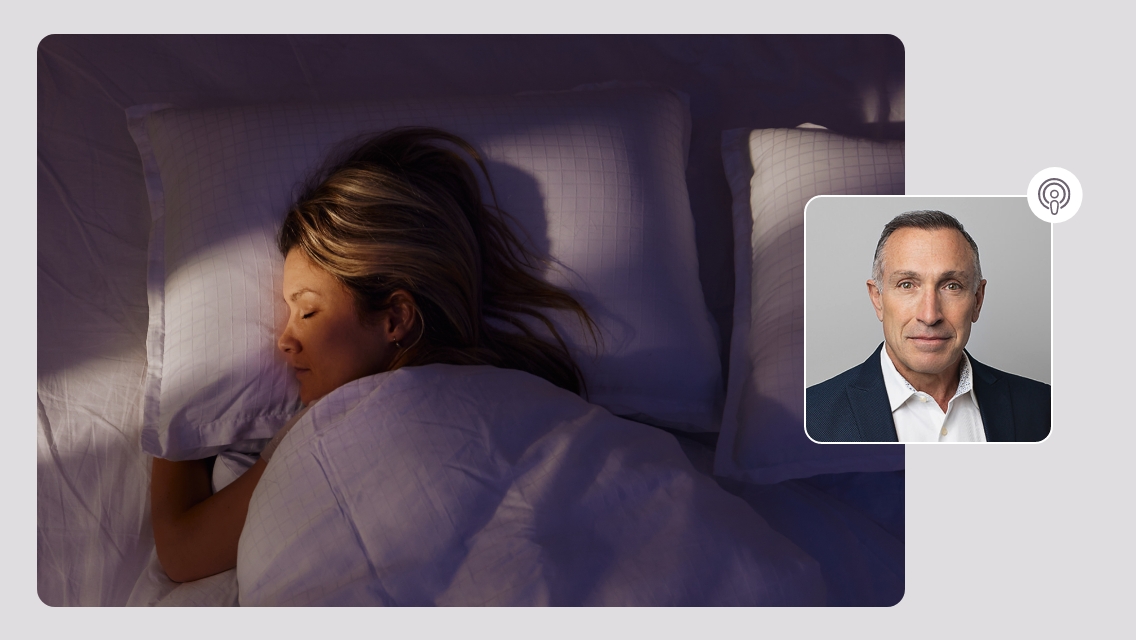


Our bodies need high-quality sleep to perform at their best — but getting good sleep isn’t just about getting physical rest. It’s when our bodies perform functions to help sustain our physical and mental health and it allows our bodies and brains to recover and prepare for the next day.
In this episode, Jim LaValle, RPh, CCN, explains the critical role of sleep for health and longevity, the barriers to getting enough quality sleep, and practical strategies for sleep improvement.
This episode of Life Time Talks is part of our series on Performance and Longevity with MIORA.
Jim LaValle, RPh, CCN, is a clinical pharmacist, the cochair of the American Academy of Anti-Aging Medicine, the chair of the International Peptide Society, and the Chief Science Officer for Life Time.
In this episode, LaValle shares why sleep is crucial for health and longevity and how we can get improved rest:
- Sleep plays a critical role in enhancing performance and promoting longevity. Among its many roles, sleep serves as a vital reset mechanism for the body, aiding in repair and detoxification processes that are essential for health. It also plays a crucial role in maintaining cognitive function.
- Many people tend to compromise their sleep in favor of productivity, often at the expense of their health. There is a difference between reducing your sleep by choice (for example, to fit more into your day) and clinical insomnia in which an individual cannot get to sleep.
- Consequences of insufficient sleep can include cognitive decline, reduced sharpness, increased fatigue, neuroinflammation and reduced neurotransmitter pools, a disrupted immune system, and altered stress hormone responses. Sleep deprivation can also profoundly affect circadian rhythm and hormone production, which can contribute to health issues.
- The use of technology, screens, and exposure to blue light in the evenings can affect sleep quality.
- Insomnia, as described by LaValle, is a disorder of the HPA (Hypothalamic-Pituitary-Adrenal) axis, leading to a state of hyperarousal that disrupts sleep. Various stress and lifestyle factors, including overcommitment and anxiety, can contribute to the development of insomnia.
- Sleep apnea can be caused by various factors, including airway issues, excess weight, and central nervous system dysfunctions. The health effects of sleep apnea can be significant, and include increased heart rate and risk of heart attacks. It’s crucial to identify and address sleep apnea for overall health and to prevent long-term complications.
- Short naps can be beneficial for rejuvenation during the day, but naps too close to bedtime can negatively affect nighttime sleep and lead to further sleep disruptions.
- Maintaining a consistent sleep schedule (waking up and going to bed at the same time every day) is crucial for optimal sleep quality. Sleep hygiene habits are also important and start earlier than in the evening, with helpful steps to consider including the following:
- Morning sunshine is a key factor in supporting a healthy circadian rhythm.
- Stress management techniques, such as box breathing, can be helpful to perform throughout the day.
- Create a bedroom environment that’s conducive to sleep, such as one that’s dark, cool, and free of electronics. Other calming strategies, such as diffusing lavender oil, can also be considered.
- Supplements that can support sleep include magnesium (for relaxation); valerian root, passionflower, and other herbs (for their calming effects); and melatonin (for its ability signal that it’s time to wind down and get to sleep).
Transcript: Sleep and Resiliency: A Guide to This Essential Recovery and Repair Window (Performance & Longevity Series)
[MUSIC PLAYING]
Welcome to Life Time Talks and our series on performance and longevity with MIORA. I’m Jamie Martin. I’m here with Life Time’s chief science officer, Jim Lavelle, and we are talking about one of my favorite topics, sleep and resiliency and why it matters so much to our health. So Jim, you and I have spent quite a bit of time together talking about these various aspects of health. And in almost every conversation we’ve had, sleep has been a fundamental part of it. So let’s talk about why sleep is so important to our health.
Well, sleep is what resets our body for the next day. It’s what helps us to repair. It helps our brain to get rid of the byproducts of its metabolism from the previous day. So sleep is foundational to your health and performing at your best. And all of us know this.
When you don’t get a great night’s sleep, you’re reaching for that extra cup of coffee. You’re looking for that energy drink. You’re yawning at 1 o’clock. We feel it. We’re not as cognitively sharp, and it doesn’t take that many days of that to see the difference. So sleep is really the way that our body repairs and prepares for the following day.
Yeah, and yet, we know this. We know it’s foundational, and it’s still one of the first things that so many of us are willing to compromise. I know I have shared on the podcast in the past that when it comes to prioritizing different things in my life, I’ll often cut my sleep back significantly in order to do all the other things on my to-do list. And I know I’m not alone in that. You hear these statistics about how much average sleep people are getting. I mean, we say, like you’ve said before, seven to nine hours is great. It’s easy to say but harder to do.
Yeah, I think, the modern world, where we’re pushing longer and harder into our days, we’re exciting our brain more. Like, we’re looking at screens. We’re getting more blue light. We come home in the evening, and we turn every light on in our home.
And I think a lot of it is also just because we have our children learning these behaviors, they’re going to two different practices and making sure they’re getting everything done they need to get done, you get to the end of the day — if you have children, they’re in bed. And you finally think, I’ve got some time alone. I don’t want to just go to bed. I want to watch a show. I want to read a book. I want to catch up on housework, whatever that is that we end up extending into that night.
And that’s where it’s a slippery slope. And the very first sign, if you’re having trouble getting to sleep — you’re making a list. You’re laying there. Your mind’s roaming and restless — or you go to sleep right away because you’re just beat, but you wake up at 2:00 or 3:00 Am, and you’re thinking, what do I got to do tomorrow? What am I going to pack for vacation in six months? You’re just thinking of the list. That is the sign that you have hyperarousal.
And it’s interesting. People don’t realize that insomnia, when you have trouble sleeping — so there’s two keys. One, you just cheat yourself of sleep, like what you just said. I’m going to shorten my sleep, and, therefore, I’m going to need to use more coffee, more caffeine, more nicotine, whatever it takes to get me to make it through my day. And we get into that vicious cycle.
That’s just a decision that you make, a voluntary decision of, OK, I’m not going to get enough sleep because I’ve got all these things I want to do. Then there’s insomnia.
Yep.
And one of the leading reasons people walk into a drug store, for example, is to pick up a sleep aid. And whether that’s the traditional ones that are basically antihistamines or reaching for melatonin, people are walking in every day trying to find a way to get a more restful night’s sleep.
And I ask this all the time. I know we were talking about it before the episode that I ask this question, I mean, almost every talk I give, and I give a lot of lectures over the course of a year, is, how much sleep are people getting? I ask a simple question. How many people in the room get seven to nine hours of restful sleep, wake up in the morning, and feel refreshed? Raise your hand.
And then I do a mic check because nobody raised their hand. I’m thinking, oh, nobody must’ve heard me. But it’s very rare that I get a handful of people that report, oh, yeah, I sleep great.
Yeah.
And that’s kind of a — I don’t know — it’s kind of where we are as a society, right? We get up early, we run hard, and we go to bed late. And then we expect some kind of miraculous outcome that we’re going to stay sharp.
Right, that we’re going to feel our best when we really aren’t giving ourselves the chance to feel our best because of how important sleep is for our overall health.
Exactly.
You mentioned insomnia, and I just want to — one of the statistics that was shared is, like, 30% to 40% of Americans will report insomnia this year. That is interesting. So by definition, what is insomnia, just so we’re clear on what that looks like?
Sure, insomnia is a disorder of hyperarousal of the HPA axis, so hypothalamus pituitary adrenal axis. So your brain is getting overwhelmed by too many things to do — maybe a text or an email that kind of got under crawl a little bit. Somebody sent something, or, oh, my god, I forgot to do this, for whatever reason, or you’re just busy. You could be a single parent.
Yeah.
You’re maybe working two jobs to make ends meet. Maybe you have a child that has a disability. I mean, there’s all kinds of things that just happen in life. But in the end, your brain takes on too much stress. Now, when it’s time to go to bed, your brain still thinks a white tiger is chasing you, basically.
Yeah.
And either you’ll get sleep latency, like, hey, I can’t get to sleep. My mind is roving. You may be, just as I said, tired, and you get to sleep, but then you pop up, or you wake up multiple times a night. Pain can do it.
Yeah.
Right? Oh, I’ve got hip pain, or I’ve got shoulder pain, and I roll over, and all of a sudden, the pain wakes me up. So there’s a lot of reasons why you could wake up, but insomnia itself is your brain’s taking on too much stress and can’t create a countermeasure to that stress.
Well, yeah, that’s — but that’s a huge chunk of people who will report that.
I’m — it’s the number one thing. I would say that in 40 years now of seeing people and working with my clinics and my docs and all our other staff, the number one complaint. Number one complaint, no matter what other condition they have coming in.
Yeah.
And then remember, you have people that travel time zones. So they’re flying from one time zone to the next, and that throws off your circadian clock. And that can disrupt your sleep. People that work night shift — I mean, there’s all kinds of permeations of what is going on with sleep. And I think it’s a core reason why people have health issues.
Yeah. Well, let’s talk about that because what does sleep deprivation do to our bodies, or lack of sleep overall?
Yeah, so I mean, the first one is, obviously, it disrupts your immune system. Typically, you’ll see changes in stress hormone response. So you can lose your awakening cortisol response, which is really important for your health. You can see changes in blood sugar. That happens. Cognitive capacity — I mean, what is — and I always go back to this. Well, what’s a form of torture? Keeping people awake.
Yeah.
Because after you keep people awake long enough, you’ve exhausted the neurochemical pools in the brain, and now, all of a sudden, you break down that person’s integrity because they lose the dopamine. They lose the serotonin. The adrenaline pools are down. They’re — and they become cognitively challenged.
Yeah.
And, in a way, when we deprive ourselves of sleep, it really is. It’s a light form of that.
Yeah. Well, you just think about when you’re — some of those times, whether you’re dealing with jet lag or any of those things, just how your body feels. Like, you often feel sick to your stomach. You’re not functioning at your best.
You feel achy.
Yes, your whole body — you feel it across the entire system until you’re like, I just have to lay down. Like, that’s the thing I have to do.
Right. Yeah, and I always say, do you feel like you’re pushing a thought through Jello?
Yes.
That’s the one thing that people always go, man, that’s exactly how I feel. I cognitively can’t get out or respond to something that someone told me. And sleep deprivation leads to neuroinflammation and leads to cognitive changes.
Yep. All right, so let’s look at, what is sleep doing for us? We all — you talked about it at the top of the episode, this time for reset, repair. What’s actually happening in our bodies when we’re sleeping? And — because that’s why it’s so important for us —
Right.
Everybody is doing a lot of important things.
Sure. So we’ve talked in the past about the master slave clock and your circadian rhythm. Your body runs on a clock. Well, it turns out that at different parts of the day, your metabolism is doing different things. So you’re making hormones in the morning, so men release their testosterone in the morning. Thyroid hormones — that’s why you take thyroid hormone in the morning. We release cortisol in the morning.
And then all of these things are cycling, such as I’m eating during the day to produce the energy I need. But I shouldn’t be eating at night because now I’m cleaning up the byproducts of my metabolism for that day. And so what sleep does — and typically, people ask, well, what’s ideal sleep? Oh, yeah, seven to nine hours. Great.
But actually, that circadian rhythm — we are not meant to hang in a cave during daylight hours.
Yep.
We’re not — we’re not meant to be what we call “night owls.” When people say that, I go, oh, boy, you really have got your circadian timing off. So basically, at the hour of 10:00 PM, your body starts to shift. And it’s interesting. The Chinese used to call this your Shen cycles. So Chinese medicine identified this thousands of years ago that your body ran through these different organ-specific times when they were performing functions, which I personally feel is fascinating.
Yeah, that’s —
They figured that out. So you’re doing physical repair the first half of the night, getting rid of waste products of metabolism, resetting the signals that are going to go out through all of your body clocks because you’ve got the suprachiasmatic nucleus clock, the master slave clock, but then all your other organs are working off of that.
Yeah.
So when you throw off that master slave clock because of insomnia or not getting enough sleep, the communication to all those organs are off. So when it’s working well, you’re repairing in the early stages of the night.
Yep.
And in the later stages of the night, that’s when you’re building up those pools of neurotransmitters, and you’re really preparing your brain for the next assault of the day.
Right.
Right? You got to attack the day, right? Your cortisol goes up. Your hormones are going up. It’s preparing you to get going. So that’s the value of sleep. But obviously, it’s the repair of keeping your circadian rhythm intact, releasing adequate melatonin. We know that people that release healthy amounts of melatonin tend to be healthier.
Right.
It’s also very, very protective for the brain, very protective for other tissues as well. So that’s the real nature of getting a good night’s sleep is it’s setting the stage for your body chemistry to perform the way it’s meant to perform the next day.
So talk a little bit about — you started mentioning, like, 10:00 PM, like something — is there an ideal time for most people, like an ideal window for sleep? Is it 10:00 PM to 5:00 AM, 10:00 PM to 6:00 AM? And is it that first half of the night, typically, that repairs, like 10:00 to 2:00? What does that look like?
Well, no, you’re trying to shorten your night of sleep. You want to repair but only have to sleep four hours. I know where this question is going.
No, no, no. I really —
Come on.
I need my sleep.
Yeah, OK, good.
So, well, I mean, honestly — and this varies. There’s some people that can get by on seven hours of sleep. They get by at 6 and 1/2 hours of sleep. So there’s a little bit of variance in this, right? And it also matters when you wake up in terms of what stage of sleep you’re in when you wake up. That matters because you could wake up groggy, but you wake up maybe 30 minutes earlier, and you wake up refreshed.
Yeah.
One of the biggest things is creating consistency.
Yeah.
So consistency of sleep is important. You’re going to bed at relatively the same time. So if you look at the circadian rhythm and how that works, 6:00 — 10:00 PM to 6:00 AM.
Loosely.
And somewhere in between there is good. When you start to shave it down to six hours, that’s that netherworld of some people still perform pretty good, but I’d love to look at their labs.
Yeah.
And other people really start to notice that their performance is down because they’re just not getting enough sleep. And it’s different, if you go to mid — if you — say you stay up until midnight, and you sleep until 8:00, and you get that eight hours, you actually still might not feel rested.
It feels different.
It’s different than getting to bed around 10:00 PM, trying to limit the amount of light that you’re getting exposed to, and resting in accordance to that biorhythm that we as humans have. I mean, like I said, we’re not marsupials.
Right.
So our body has a rhythm.
Absolutely. So you talked about — I mean, when you said that, like shaving off the ends, you hear a lot of people talking about, I’m burning the candle at both ends, or — because it’s like that’s — in this society that we’re living, it’s all about productivity. It seems like that’s what it’s all about, but that comes at a major cost.
Yeah, I think the first thing is, I mean, we pretty much know that after you work about 10 hours, your productivity goes down pretty significantly.
Yeah.
So I really challenge people a lot of times. I go, well, what could you do to be more efficient within that 10-hour window so that you are able to shut down? Because a lot of times, it’s about planning and also organizing because I always — it’s funny. I ask people, so do you make a list? Oh, yeah, I make a list. Do you ever get done with the list? No, I never get done with my list. So the list is always going to be there.
Yeah.
It’s a byproduct of our modern world. It’s really establishing what’s absolutely essential that I get done today, what can be done tomorrow, and also not overcommitting. I know, for myself, I was — I’m, I guess, a recovering overcommitting addict. I would always say, oh, yeah, I can do that.
Yeah.
Hey, could you write a 600-page book for us? Sure, I could do that. I’m — and so learning that, what do I really need to commit to? What’s important? And I don’t think we value the fact that we turn our brain off for a while because think about it when you go on vacation.
I know exactly where you’re going with this.
A, you sleep great.
Yes.
B, you actually problem solve without perseveration. It just comes to you because you’ve opened up that space to allow your brain to process, instead of continuing to throw information in and not allowing the processing. And I always find it — I get some of my most creative thoughts in my off time.
Yep. Well, I think that’s why they talk about it so often. It’s like when you’re out for the run or when you’re on vacation, those big aha moments often happen because we’re not so focused on the list and the next thing to check off, right?
That’s exactly right. And once again, the biggest thing — we’re busy. All of us are.
Yeah.
And we run demanding lives, and the — I’m not saying, oh, you’ve got to slow down because the old story of, oh, you just have to sleep more and stress less. Well, yeah, well, wear my shoes for a day.
Yeah. Yep.
Right? It’s not always easy, but it’s the thoughtfulness of managing your day because what people end up doing with problems with sleep is they want to take something at bedtime.
Yep.
And the reality is, if you’re having trouble with sleep, you need to work on your stress response during the daytime.
Yep.
And then you may need to do something at night.
Yeah.
Right? But it’s not just a, oh, I’ll take a sleeping pill.
Yeah.
Whether it’s natural or a prescribed medication, it’s, well, why are you having that problem to begin with?
Yeah. Let’s talk a little bit about sleep apnea. This is one of those conditions. You’ve mentioned this in a few different episodes we’ve talked through. And I know that’s another sleep condition that can have a real impact on our long-term health and well-being.
Oh, yeah, it’s big. And there’s a lot of different reasons for that. So you have airway reduction, the way the person’s epiglottis is, where their tongue is laying, airway from the sinuses. It could be weight.
When you gain weight, you can change in the diaphragm. And then you could have something called central apnea, which is basically your central nervous system that is creating this rhythmic signal in your breathing pattern, so interrupted breathing pattern.
But more importantly, when you go into an apnea state, what’s basically happening is every so often — it could be 20 or 30 times a night — you’re suffocating your brain. So you don’t get enough oxygen to your brain. That raises your heart rate, and you see that. Your heart rate could go up to 160, 170 beats a minute at bedtime when you’re trying to sleep, and you don’t even know it.
Yeah.
And that imbalance is really what leads to increased risk of heart attacks and increased risk of sympathetic tone, blood pressure, blood sugar because you’re getting these spikes and lacks of oxygenation, and then spikes in your sympathetic nervous system driving your heart rate to go up. And this is a significant health crisis. I think we just don’t do enough to identify sleep apnea.
Right. And we’ve talked — I mean, you want to make sure, if you have a partner, that as soon as they notice something like this, making sure that you’re getting checked out on this because of those effects.
Yeah, absolutely. I mean, it’s one thing if you have a slight snore. But if you notice that, I am not feeling refreshed — and one of the big ones that happens is kind of daytime somnolence, where you’re driving, but you’re having trouble staying awake, and you’re doing something that’s very alert.
Yeah, you need to be awake.
Yeah, midday, you’re on the highway. It would be good to be alert.
Yeah.
And so daytime somnolence, where it’s like, I can’t stay awake —
Yeah.
—that could be a sign, if that’s a chronic thing going on, that sleep apnea could be an issue. And obviously, weight gain, blood pressure changes, even lipid changes — it really starts to create that meta inflammatory signaling that disrupts your lipids and lowers your growth hormone, throws off your sex hormones, throws off your glucose, all because of disturbed sleep, especially in light of something like apnea.
Absolutely. Where do naps fit into that? Like, if somebody — like, I mean, daytime somnolence, I think, is what you called it. Like, you’d think like, OK, I just need to go home and take a nap. Is that — what is that going to do for us? Is it helpful?
I don’t think there’s enough — like, I don’t see enough information on — because people ask, well, what if I only sleep five hours a night during the week, but I make up for it on the weekend? Like, does the makeup count? Probably not.
I would say if you’re tired midday, and a 15-minute nap rejuvenates you and makes you be able to be productive the rest of the day, I would choose taking a nap versus not taking a nap. But one of the problems people have is they may nap for 45 minutes or an hour, say, at 5:00 PM.
Yeah.
And now they’re having trouble going to sleep.
Yes.
And so there’s a — I don’t like using — I use an app called Binaural Rhythm, 10-minute app. Put in your headphones, and it has different types of sounds that put your brain into a better rest mode. And so you could do a 10-minute frequency that helps re-establish kind of normal brain rhythm, and that can be very helpful without saying, oh, I’ve got to have a couch in my office.
Exactly.
But those different types of programs for the brain, fantastic.
I love that, and we’ll have to make sure to link to that. What are some key biomarkers around sleep that somebody may — that may indicate that somebody is having sleep issues or not getting high quality sleep?
Yeah, I mean, I think the biggest one is looking at your circadian rhythm of cortisol. Are you — are you an inverted cortisol producer, meaning your awakening response is low in the morning, and then you’re building up and having higher cortisols at night than you should. That’s an easy one.
You can measure melatonin. I mean, a lot of times, you can look at the indirect effect of poor sleep, like, where is your cognitive function at? Because cognitive function being driven by dopamine and serotonin when you’re not sleeping, you’re not making as much dopamine back into those little buckets or neurochemical vesicles that are holding that — blood sugar, body weight, blood pressure. These are all things that could be a sign, easy sign that there’s some problems brewing.
Yeah, and so, like, whenever we’re talking about this, we also talk about, what can we do about it? So I mean, obviously, we talk a lot — there’s something called sleep hygiene. How do we set ourselves up for better sleep? You already alluded to, it starts earlier in the day. I know one of the first things is morning sunshine makes a huge difference in terms of resetting that circadian rhythm. What else is there?
Yeah, it’s like that morning sunshine is important because it’s signaling the suprachiasmatic nucleus to start the engine and tells your hypothalamus to start sending the signals to all the hormones. It’s time. So that’s great.
I usually have people, during the course of their day, work on doing a little bit of box breathing. Do a couple minutes at noon. Do a couple minutes at the end of your work day. Do a few minutes at bedtime. Reset your nervous system. That’s important.
Identifying, well, how stressful was my day?
Yeah.
What can I do to manage that stress? Because, honestly, it’s easy to say, oh, just don’t let it bother you. Yeah, right. Exactly, right? You could be working for someone. You could be the boss, or you’re working for someone.
Either one of those could be very difficult in the person’s life. And so really assessing your stress during the day, and are you feeling overcommitted during the day? Are you feeling anxious and nervous? Are you craving comfort food?
If you are, you should consider taking something to help you overcome that during the course of your day so that you can start to ease into your night the way you’re supposed to. That’s important.
Magnesium status is super important for sleep, so a lot of people don’t just get enough magnesium. And taking magnesium is really good at bedtime. Usually, people need to take some during the day too, because they think it’s going to make them sleepy. Not really. You can take magnesium during the day. You’ll be fine.
So those things are important. But then, of course, there’s that, you don’t have to have every light on in your home in the evening. You should be progressing to a dark room at night. Don’t have a TV on in your bedroom.
You may need to — lavender oil’s really good in terms of just a little bit diffusing of lavender oil to help calm your nervous system. Taking an Epsom salt bath can be really good for that. Sleeping in a cool room — really big to try to bring the temperature down in the room in order to sleep.
Watching your phone — I mean, I remember I had a client once who traded with Europe and Asia, and he was in the US. And he came to me because he had something called dysphonia. His voice crackled. His vocal cord basically got paralyzed, and it was stress-induced.
Oh, interesting.
And he was a big executive. And he had two phones by his bedside, all night, doing trading so that when he would hear a text or an email ding, and he’d be up.
Oh, man. Talk about disrupted sleep. Like —
Exactly. And so I think you can take your phone and put it in another room. If you’re using it for your alarm clock, which a lot of people do, at least turn the screen off. Move it fairly far away from you, so you can hear it. But you don’t need to be on your digital app, whatever it is — it’s an iPad, whatever. It’s your phone. You don’t need to be doing that right before you go to bed.
Right.
I mean, I think reading a book is great. Now, some people would say, hey, my blue light blocker — I’ve got the blue light blocking on my iPad, and I read.
Yeah.
That’s great. But watching an action movie at 9:00 PM when you’re going to bed at 10:00 PM might excite you.
Yeah.
Right? So stay away from the excitation. Create a lifestyle that’s saying, I’m going to build my productivity during the day, and then I’m going to move towards relaxation state into the evening.
Yeah, I love that where it’s kind of just knowing it’s not just an evening routine. It starts in the morning, but then build up, wind down to set ourselves up for that deeper quality sleep. You mentioned magnesium. You’ve also mentioned melatonin. What about any other supplementation that might aid in some — I’ve heard, like, valerian root, for instance, different things that may help with sleep and support people.
Yeah, I mean passion flower, valerian root. There’s a variety of herbs that can calm me down. Everybody’s different. I have some people that take melatonin, and no matter how they do it, how little or how much, it doesn’t work for them.
It doesn’t make a difference. Yeah.
It just didn’t work for them. Or they get — typically, if they’re getting vivid dreams, it means they haven’t taken enough. They haven’t crossed past REM sleep into deep sleep. So valerian can work. Some people get a hangover from valerian, but other people do fine with valerian. Passion flower — another one that can calm people down.
Magnesium — super important. There’s an extract from magnolia known as honokiol A, which when you take honokiol A, which is a botanical, it helps to induce alpha waves. So that helps because alpha sleep. You’re getting into those transition patterns for sleep. So that can be really good. And really, the go-to for me is usually melatonin because that’s the signaling compound.
Yeah, signaling that it’s time to —
Time to go down. And when your cortisol levels are high, you can’t signal melatonin release. And when you release melatonin, you stop the release of corticotropin-releasing hormone, which is the signal that says, make more cortisol. And that is what allows you to go into deep sleep and do all that repair that we want to do when we’re sleeping. So cortisol and melatonin are like this.
Yep, they work hand in hand.
They work hand in hand, yeah.
I mean, I feel like we’re going to have to do a whole episode just on the stages of sleep because you’ve mentioned alpha. You’ve mentioned deep sleep, R-E-M “rem,” REM. R-E-M is the band.
“Rem” sleep.
“Rem” sleep. But I think it’s worth talking about what’s happening in those stages, and at some point, we’ll come back to it. Are there any other things that are really important for people to know about sleep, just from a base level before we wrap this one up?
Yeah. I mean, it is so important to focus on getting a good night’s sleep because it literally — it’s the window to longevity. A good night’s sleep is going to really build your resiliency, your capacity, your ability to be bright as you’re aging.
You’ve got to watch exercise. Some people push really hard at exercise. Some people, that helps them get a great night’s sleep. Other people, they get revved up, so maybe they got to figure another time for exercise.
And all the more important reason, when I’m dealing with an NBA team or a hockey team, they play a lot of night games. And so they’ll get the calm eye covers that are actually creating a sensory change to get them ready for sleep. They’ll do things like taking melatonin because naturally, after a game, you’re like this, and you have to bring your body down.
And then they have to travel time zones — not too much different than an executive, who has a late night business meeting, and they craft a big deal. And then they’re in a different city. Then they go to bed. Then they’ve got to get up early. They’ve got to get on a plane. This is a problem for a lot of us because a lot of us are all over the country with our work.
Yeah, so how do we make sure we can optimize, even in spite of those challenges and those things that are part of our daily lives for some of us?
Exactly.
It’s so interesting to think about that high performance, and now it’s bedtime. Like, that’s a whole other topic we’ll get into at some point as well. So all right, Jim, we have covered a lot here again. And again, this is going to be one of those episodes, if you’ve listened to any episodes in this series, sleep has been mentioned. So make sure to tune in to this one. Check out the other episodes, and to learn more, visit miora.lifetime.life to learn all about our performance and longevity offerings. Thanks, Jim.
[MUSIC PLAYING]
More like this


We’d Love to Hear From You
Have thoughts you’d like to share or topic ideas for future episodes? Email us at lttalks@lt.life.
The information in this podcast is intended to provide broad understanding and knowledge of healthcare topics. This information is for educational purposes only and should not be considered complete and should not be used in place of advice from your physician or healthcare provider. We recommend you consult your physician or healthcare professional before beginning or altering your personal exercise, diet or supplementation program.
Life Time provides administrative, non-clinical support to MIORA as well as services and amenities related to general wellness and fitness; Life Time does not provide medical advice, diagnosis, treatment or care.
Advertisement