


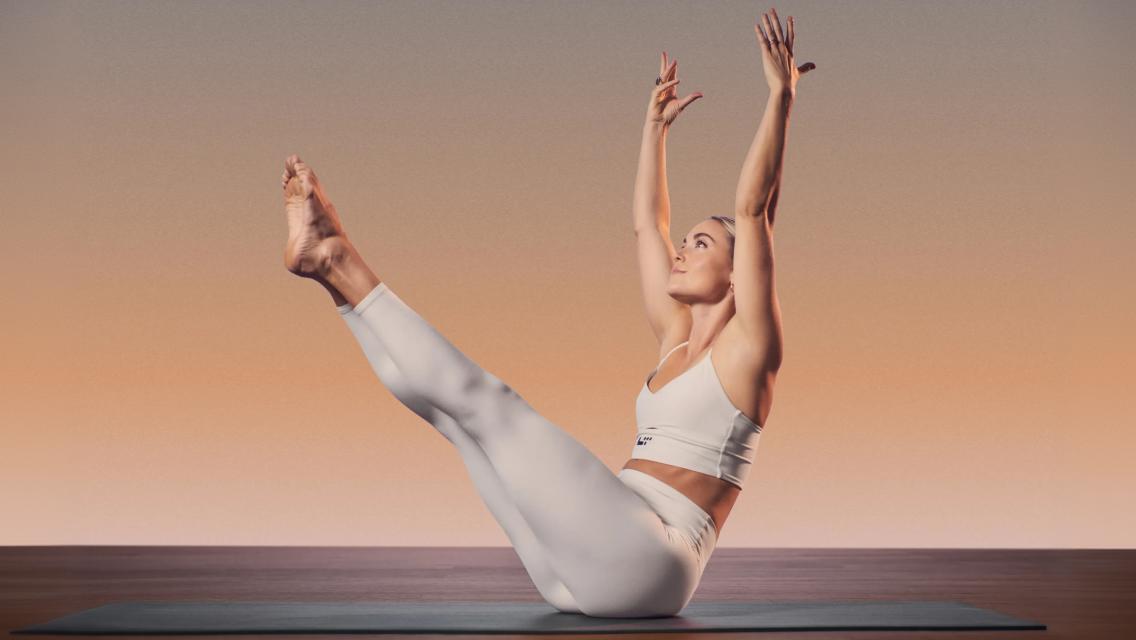
You’re looking for a class where you can walk into the studio, unroll your mat, and get ready to sweat. But when you look at the Life Time schedule, you might see several different options for mat-based classes, unsure which is right for your preferences. Two of those popular options are MAT FUSION and MAT PILATES. Both promise a challenging workout, but the paths they take to get you there are slightly different.
To learn more about the differences and help you choose the right class for your goals, we asked Frances Egbert, class collection brand specialist at Life Time, to dive into the details of each class and demonstrate some moves you might see in both.
MAT FUSION
MAT FUSION, Egbert notes, weaves together the three popular fitness modalities of Pilates, yoga, and barre.
“We’re tapping into the precision of Pilates, the alignment of barre, and the breath-centered awareness of yoga,” she explains. “Unlike traditional, single-discipline formats, the integrated methodology of MAT FUSION creates something entirely new. Each class becomes a sanctuary for growth, where the synergy of three powerful movement traditions leads to extraordinary results.”
Each MAT FUSION class features five segments:
1. Ignite: “We warm up by engaging our muscles with bodyweight movements and igniting the internal heat we use to move throughout the remainder of class,” says Egbert.
2. Power + Precision: “Next, we work through full-body compound movement patterns, activating all major muscle groups to get ready for our balance section.”
3. Align + Balance: “We build onto our previous section by moving into highly adaptable and challenging balance work. We work this section into the middle of each class to help you feel both challenged and supported.”
4. Sculpt + Activate: “Next, we change our focus to engagement of the glutes and deep core stabilizers.”
5. Restore: “The last, but perhaps the most important segment, is where members are guided through intentional stretches to release the tension we created. We also engage in breathwork to activate the parasympathetic nervous system for better recovery post class.”
3 Moves You’ll See in MAT FUSION
Chair Leg Tap
- Start in a chair position with your feet together, knees slightly bent, and arms raised overhead.
- Step your left toe back to touch the ground behind you and, as you step your foot back in, pull your arms down with your elbows bent at your sides.
- Step your right toe back to touch the ground behind you as you bring your arms back up overhead.
- Repeat this pattern, alternating legs, as directed by your instructor.
Single Leg Deadlift With Rows
- Hold light dumbbells in both hands.
- Shift your weight onto your left leg, keeping a soft bend in your knee.
- Hinge at your hips to lift your right leg behind you into the air, while simultaneously leaning forward with your torso. Reach down as far as you can with the weights in your hands while maintaining stability.
- Hold while balanced on one leg as you bend your arms back into a wide row.
- Return your arms back down in front of you and return to the starting position.
- Repeat that pattern as guided by your instructor before adding an upright row and knee lift.
- Repeat on both legs as guided by your instructor.
Bicep Curl with Knee Lift and Overhead Press
- Hold light dumbbells in both hands and stand with your feet hip width apart.
- Keeping your elbows at your sides, slowly move your hands up toward your shoulders in a bicep curl as you lift your right knee.
- Lower with control to bring your hands and knee back to the starting position.
- Repeat this pattern as directed by your instructor before adding an overhead press at the top of the movement.
- Repeat on both legs as guided by your instructor.
MAT PILATES
MAT PILATES is a mindful practice that emphasizes precision, control, and breath. It’s rooted in the classical principles of Pilates, honoring the traditional Joseph Pilates methodology.
“This format transforms the mat into a space for strength, stability, and alignment,” says Egbert. “Every movement is intentional and every breath is purposeful, creating a seamless flow that connects the body and mind. Unlike high-intensity or hybrid formats like MAT FUSION, MAT PILATES honors simplicity and depth. It’s about mastering the fundamentals — controlled micro-movements, core engagement, and spinal articulation — while cultivating a sense of presence that extends beyond the mat.”
Each MAT PILATES class features three segments:
1. Preparation: “We start out by establishing a breath-body connection with deep breathing to activate the core,” says Egbert.
2. Comprehensive Movement Sequence: “Then we move into the main movement sequence of class. We’re focusing on developing muscle control and building core strength on the mat — moving from foundational movements to more advanced balance, stability, and postural exercises.”
3. Realign: “Finally, we transition back to an upright position to realign the mind and body for better movement outside of class.”
3 Moves You’ll See in MAT PILATES
Pilates Hundred
- Lie flat on your back on a mat. Bring your legs into a tabletop position (knees bent at 90 degrees, shins parallel to the floor). For a more advanced version (as shown in this video), extend your legs out straight at a 45-degree angle.
- Lift your head, neck, and shoulders off the mat, engaging your core. Keep your gaze toward your knees to avoid straining your neck.
- Extend your arms straight alongside your body, hovering just above the mat.
- Pull your belly button toward your spine to activate your core muscles and keep your lower back gently pressed into the mat.
- Begin to pump your arms up and down in small, controlled movements. The motion should come from your shoulders, not your elbows.
- Repeat as directed by your instructor.
Scissors
- Lie flat on your back on a mat. Lift one leg straight up toward the ceiling, keeping it as straight as possible.
- Lift your head, neck, and shoulders off the mat, engaging your core. Keep your gaze toward your legs.
- Place your hands behind the leg that is up, gently pulling it toward you while the other leg lowers toward the mat at about a 45-degree angle.
- Pull your belly button toward your spine to stabilize your core and protect your lower back and keep your lower back gently pressed into the mat.
- Switch legs by lowering the leg you were holding and bringing the other leg up toward you.
- Use your hands to gently pull the raised leg closer to your body, deepening the stretch.
- Keep your movements controlled and fluid and repeat as directed by your instructor.
Double Leg Stretch
- Lie flat on your back on a mat. Bring one knee into your chest, hugging it with your arms. Let your other leg stretch out forward.
- Lift your head, neck, and shoulders off the mat, keeping your gaze toward your knees.
- Pull your belly button toward your spine to stabilize your core and protect your lower back and keep your lower back gently pressed into the mat.
- Using your core, switch legs by bringing your other knee into your chest, hugging it into your chest for two pulses.
- Repeat alternating legs as directed by your instructor.