



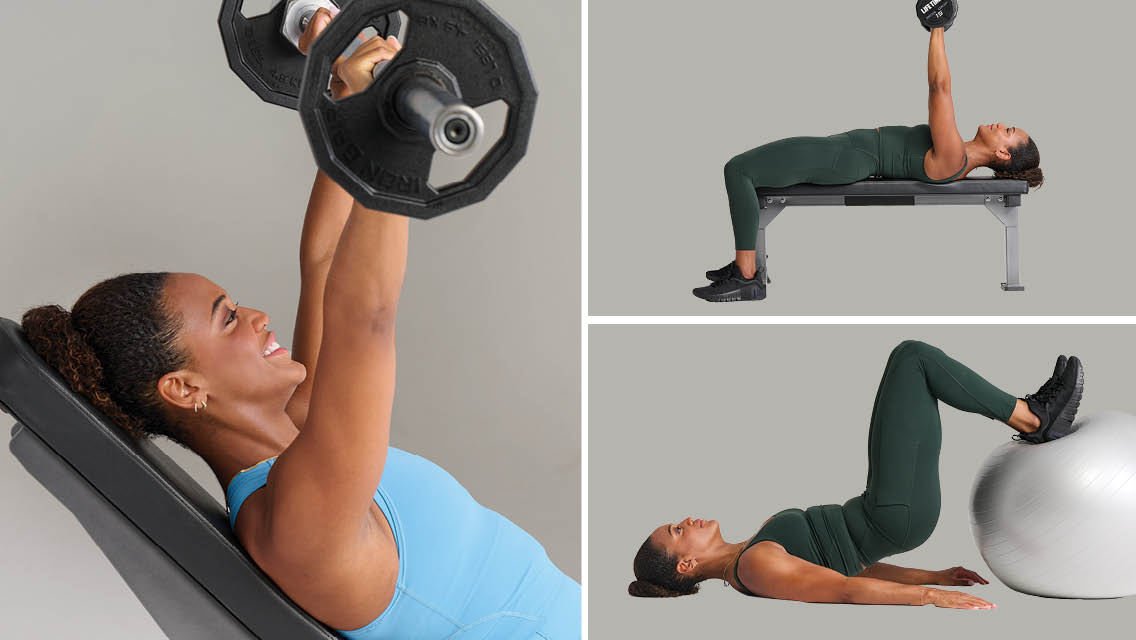
When it comes to strength training, faster isn’t necessarily better. An approach known as eccentric training — which often involves slowing down the negative, or lowering, portion of an exercise — is a proven method for challenging the muscles, making you stronger and more resilient.
 Some benefits of eccentric training include better body control, improved lifting form and technique, increased muscle mass, and stronger connective tissues. (Learn more about these and other benefits at “Expert Answers: Benefits of Eccentric Weightlifting.”)
According to Mike Thomson, a Life Time strength and running coach, these rewards are the result of a simple fact of exercise physiology: We’re all stronger in the eccentric (lowering) phase than in the concentric (lifting) phase.
How much stronger?
“You can eccentrically control about 130 percent of what you can concentrically push.”
“You can eccentrically control about 130 percent of what you can concentrically push,” says Thomson, who uses eccentric training to help clients build base strength.
Here’s what this looks like in practice. Let’s say you can back squat 100 pounds with control. What you may not realize is that while this weight tests what you can stand up with, you’re probably strong enough to safely lower as much as 130 pounds. It might feel impossible to bridge that gap — you don’t want to safely lower 130 pounds to the bottom of your squat only to get stuck there (or worse, injure yourself trying to stand up).
This is where eccentric training comes in. By slowing down the lowering portion of the 100-pound squat, you increase the time under tension on the way down. This allows you to maximize the strength-building potential in the phase where you are strongest, without compromising your form and safety during the concentric phase as you stand up.
To indicate how slowly to move, fitness coaches use a common notation system consisting of four numbers, Thomson explains.
- The first number refers to the duration of the eccentric (lowering) phase.
- The second number refers to the duration of the pause you perform after you’ve lowered the weight.
- The third number describes the duration of the concentric (lifting) phase.
- The fourth number refers to the duration of the pause after you’ve completed the lift.
For example: In doing back squats with a tempo of 3010, you would take three seconds (3) to descend as deeply as you can into the squat position. Without pausing (0), take about one second (1) to ascend to the starting position. Then start the next rep without pausing (0). (Learn more about tempo training and notation at “The Tempo-Based Workout.“)
The Program
The following program, created by Mike Thomson, consists of two strength workouts.
1x-2x | Perform each workout one or two times per week, alternating between the workouts on nonconsecutive days.
8 weeks | Increase how much you lift over the eight weeks so long as you can maintain body control at the prescribed tempo.
3010 | Perform each exercise at a tempo of 3010 — three counts for the eccentric, one count for the concentric, and no breaks at the top or bottom of the movement.
Workout 1
Superset A
- Complete 10 reps per exercise.
- Once you’ve done all reps for the first exercise, move on to the second.
- Then rest 75 seconds.
- Repeat the superset for a total of four rounds.
A1 Dumbbell Split Squat
Perform 10 reps (3010)
- Hold a dumbbell against your chest with both hands, and stand with feet about hip width apart.
- Step back with your left foot.
- Take three counts to bend both knees, bringing your back knee toward the floor and bending the front knee to approximately 90 degrees.
- Keep your torso upright, your weight on your front foot, and your front knee in line with your middle toe.
- Without pausing at the bottom, reverse the move and return to the starting position on a one-count.
- Squeeze your rear glute at the top of the movement and immediately repeat.
- To make the move easier, omit the dumbbell. Switch legs and repeat.
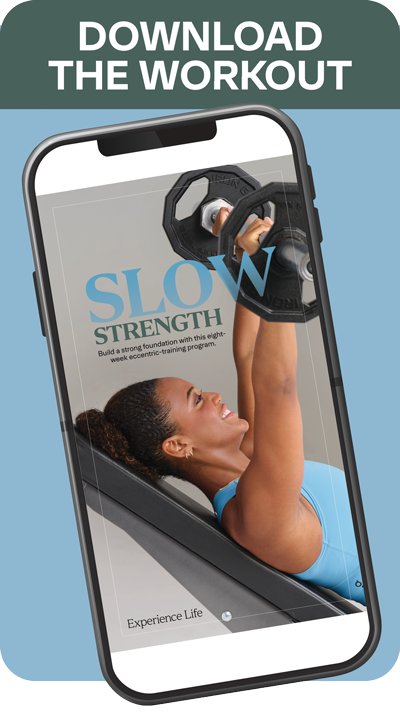
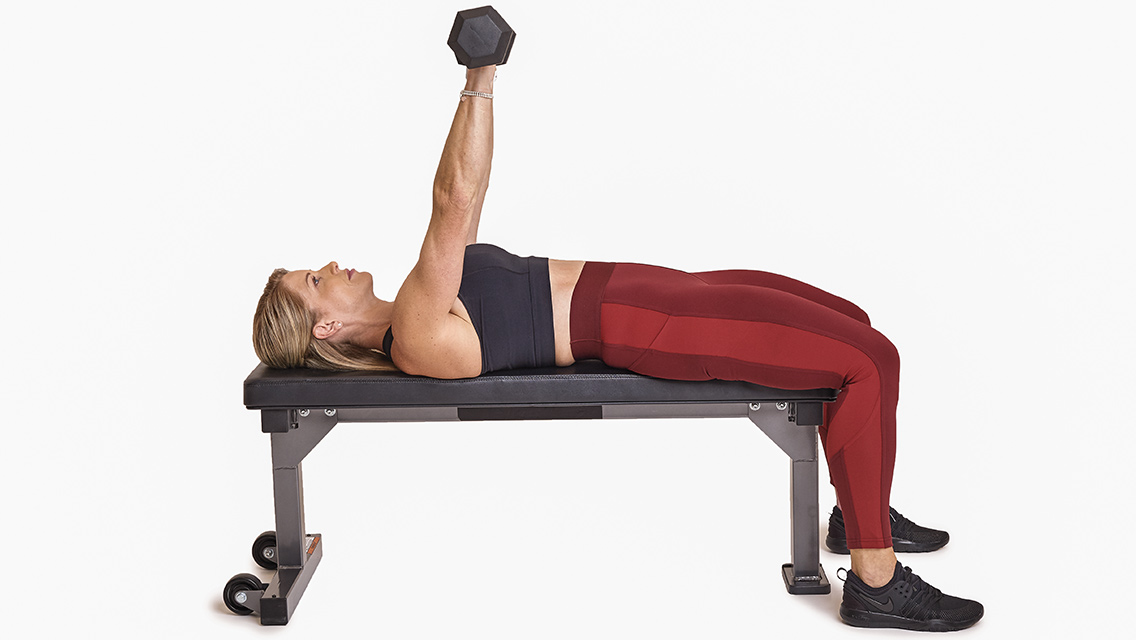
A2 Dumbbell Bench Press
Perform 10 reps (3010)
- Grasping two dumbbells, sit at the edge of a bench with the weights resting on each thigh. Carefully lie back on the bench, bending your elbows so the weights are level with your shoulders, your palms facing your feet.
- Press the weights over your chest on a one-count until your arms are straight.
- Without pausing, lower the weights on a three-count until your elbows drop just below the height of the bench.
- Then immediately repeat.
- Keep your arms close to your body and your feet planted on the floor throughout the movement.
Superset B
- Complete 10 reps per exercise.
- Once you’ve done all reps for the first exercise, move on to the second.
- Then rest 75 seconds.
- Repeat the superset for a total of four rounds.
B1 Dumbbell Front Squat
Perform 10 reps (3010)
- Stand with your feet about hip width apart. Hold a dumbbell in each hand at shoulder height.
- Brace your core. Then bend your knees and hips to squat down on a three-count, stopping when your thighs are about parallel to the floor.
- Without pausing in the bottom position, press through your feet to stand up on a one-count. Squeeze your glutes at the top.
- Immediately begin your next rep.
- Keep your torso upright and support the weights with your arms.
- If this exercise is too challenging, start with body weight only.
B2 Single-Arm Bent-Over Row
Perform 10 reps (3010)
- Start with your left knee and hand on a bench and right leg extended with your foot flat on the floor.
- Hold a dumbbell in your right hand, with your right arm fully extended.
- On a one-count, pull your elbow back toward your hip as you draw the dumbbell toward your rib cage.
- Stop when your triceps is parallel to the floor and immediately lower the dumbbell on a three-count until your arm is fully extended. Repeat without pausing at the top.
- Repeat with your other arm.
Superset C
- Complete 10 reps per exercise.
- Once you’ve done all reps for the first exercise, move on to the second.
- Then rest 75 seconds.
- Repeat the superset for a total of four rounds.
C1 Stability-Ball Hamstring Curl
Perform 10 reps (3010)
- Lie on your back on the floor. Place your calves and heels on top of a stability ball, feet hip width apart and toes pointed toward the ceiling. Let your arms rest at your sides.
- Engage your abs and squeeze your glutes to lift your hips off the floor. At the same time, press your calves and heels into the stability ball.
- From this position, contract your hamstrings to bring the stability ball toward your hips on a one-count.
- Without pausing, reverse the movement to return to the starting position on a three-count.
- Begin the next rep as soon as you straighten your legs.
- You can also do this exercise on a leg curl machine if one’s available.
C2 Single-Arm Shoulder Press
Perform 10 reps (3010)
- Stand with feet hip width apart. Hold a dumbbell in one hand at just above shoulder height, with your elbow bent and palm facing forward.
- On a one-count, press the weight above your shoulder until your arm is fully extended, keeping your arm in line with your ears.
- Without pausing at the top, lower the weight back to the starting position on a three-count.
- Immediately repeat.
- Repeat with the other arm.
Workout 2
Triset A
- Complete 10 reps per exercise.
- Once you’ve done all reps for the first exercise, move on to the second.
- Then rest 75 seconds.
- Repeat the superset for a total of four rounds.
A1 Front Foot Elevated Split Squat
Perform 10 reps (3010).
- Stand on a short aerobic step or a heavy weight plate with your feet about hip width apart. Hold a dumbbell against your chest with both hands. Step back with your left foot, setting your toes on the floor.
- Take three counts to bend both knees, bringing your back knee toward the floor and bending your front knee approximately 90 degrees.
- Keep your torso upright, your weight on your front foot, and your front knee in line with your middle toe.
- Without pausing at the bottom, reverse the move and return to the starting position on a one-count.
- Squeeze your rear glute at the top of the movement and immediately repeat.
- To make the move easier, omit the dumbbell. Switch legs and repeat.
A2 Pushup
Perform 10 reps (3010).
- Get into a high plank position on the floor: Hands slightly wider than shoulder width, arms straight (but don’t lock your elbows), and body straight from heels to the top of your head.
- To a three-count, bend your arms and pull your shoulder blades down to lower yourself until your arms form 90-degree angles, aiming your elbows out about 45 degrees from your body. Keep your core engaged and glutes squeezed the whole time.
- Without pausing at the bottom, push yourself back to the starting position on a one-count.
- Begin your next rep as soon as you return to the starting position.
- To make the standard pushup easier, perform the exercise with your knees on the ground or elevate your hands on an incline.
A3 Lat Pull Down
Perform 10 reps (3010).
- Anchor a resistance band to a sturdy object at about hip height.
- Facing the anchor, grip a handle in each hand and step back until you feel moderate tension in the band while your arms are straight.
- Standing with feet narrower than hip width apart, hinge forward at the hips to bring your torso parallel or almost parallel to the floor. Keep a soft bend in the knees.
- To a one-count, pull the handles toward you until your elbows point behind you. Think of making a goalpost with your arms.
- Immediately reverse the movement, extending your arms to return to the starting position on a three-count.
- Move into the next rep without pausing at the top. Keep your gaze on the ground throughout the movement.
- You can also perform this exercise with cables or a lat pull-down machine, if either is available.
Superset B
- Complete 10 reps per exercise.
- Once you’ve done all reps for the first exercise, move on to the second.
- Then rest 75 seconds.
- Repeat the superset for a total of four rounds.
B1 Romanian Deadlift
Perform 10 reps (3010).
- Stand with your feet hip width apart and hold a dumbbell in each hand in front of your thighs, palms facing you.
- With a slight bend in the knees, push your butt back to hinge at the hips. Keep the weights close to your body as you lower them toward the floor on a three-count.
- Stop when you feel a stretch in your hamstrings and your hips can no longer move backward.
- Without pausing, squeeze your glutes and return to the starting position on a one-count.
- Begin the next rep as soon as you’re standing upright. Keep your back flat and neck neutral throughout the exercise.
B2 Banded Seated Row
Perform 10 reps (3010).
- Anchor a resistance band so that it’s at chest height while you’re in a seated position. Grip one handle in each hand, palms facing each other.
- Move back from the anchor point until you feel tension in the band while your arms are extended in front of your chest.
- Sit tall and brace your core. To a one-count, pull your elbows to either side of your ribcage, stopping when they reach just past your back.
- Without pausing, reverse the movement to extend your arms in front of you on a three-count.
- Immediately repeat.
- You can also use a seated row machine or cable machine, if either is available.
Superset C
- Complete 10 reps per exercise.
- Once you’ve done all reps for the first exercise, move on to the second.
- Then rest 75 seconds.
- Repeat the superset for a total of four rounds.
C1 Incline Bench Press
Perform 10 reps (3010).
- Begin seated at the edge of a bench that’s elevated 30 to 45 degrees. Hold a dumbbell in each hand, allowing the weights to rest on your thighs.
- Carefully lie back on the bench, bending your elbows so that the weights are level with your shoulders, palms facing your feet.
- Press the weights over your chest on a one-count until your arms are straight.
- Without pausing, lower the weights on a three-count until your elbows drop just below the height of the bench.
- Immediately repeat.
C2 Powell Raise
Perform 10 reps (3010).
- Lie on your right side with legs extended and stacked together. Bend your right arm and allow your head to rest in the crook of your elbow.
- Grip a light dumbbell in your left hand and press it toward the ceiling, so your arm is perpendicular to the floor and your palm is facing away from you. This is the starting position.
- To a three-count, lower the dumbbell toward the floor, keeping your left arm straight. Don’t allow your hips to rock back.
- Immediately reverse the movement to raise the dumbbell back to the starting position on a one-count.
- Begin the next rep as soon as your arm is fully raised.
- Repeat with the other arm.
This article originally appeared as “Slow Strength” in the January/February 2025 issue of Experience Life.

Comments (0)