




Next time you grab your phone, tablet, or laptop, take a moment to assess your posture. Are you leaning over the screen? If so, chances are you’re also dealing with tech neck, a condition marked by chronic stiffness, soreness, and fatigue in the neck and shoulders.
“‘Tech neck’ is the term used to describe neck and upper-back strain caused by repeated flexion — or forward — head posture,” says Gbolahan Okubadejo, MD, FAAOS, a New York City–area spinal and orthopedic surgeon. It’s also known as “text neck.”
While your head weighs about 10 to 12 pounds, leaning your head forward at an angle to peer at a screen can exert upward of 40 pounds of force on your neck, he explains.
This can cause stiffness, soreness, and fatigue that can be felt throughout the upper body, plus headaches, changes in posture, and nerve-pinching numbness or tingling in arms or hands. Long-term issues include loss of mobility, more-rounded shoulders, and a forward head posture, says Okubadejo.
The first line of defense against tech neck, he says, is changing your posture: Keep screens at eye level.
Additionally, you can offset the condition’s effects with the following four stretching, breathing, and neural-activation exercises.
1) Chin Tuck
WHY IT WORKS:
“This is one of the best exercises for tech neck since it works to strengthen the deep neck flexors, which are the muscles at the front of your neck that help support and keep your head in the correct alignment,” says Okubadejo.
HOW TO DO IT:
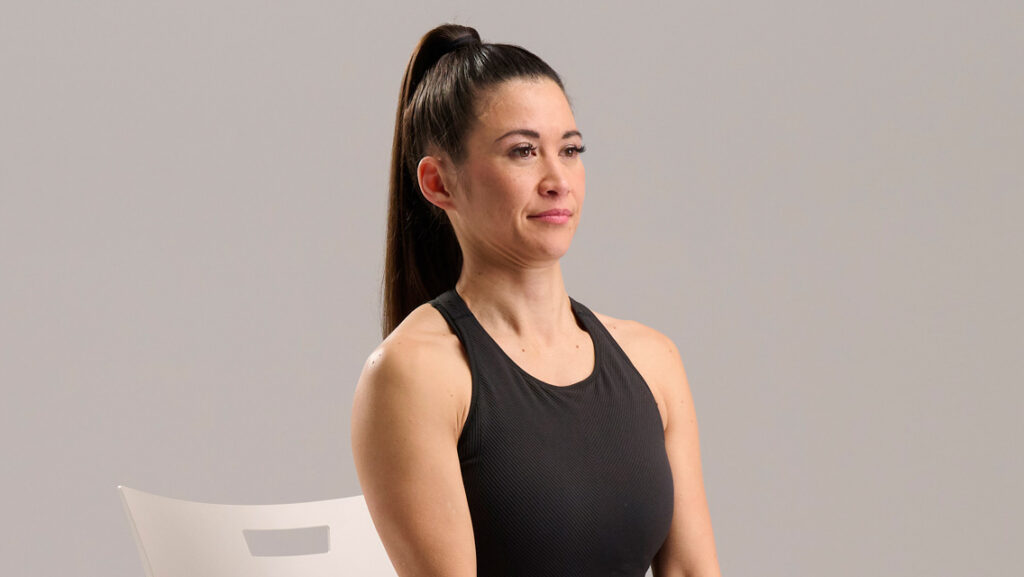
- Sit or stand tall, and relax your shoulders.
- Pull your chin straight back (as if you’re making a “double chin”) but keep your head straight — don’t lift your head up or down. You’ll know you’re doing it right, says Okubadejo, if you feel a light stretching in the back of your skull and tightening in the front of your throat.
- Hold for five seconds, then release.
- Repeat 10 times.
MAKE IT PART OF YOUR ROUTINE:
Perform chin tucks two or three times per day. They’re especially helpful to counteract long stretches in front of a computer, he says. For example, do them after a marathon Zoom call.
2) Upper-Trap Stretch
WHY IT WORKS:
This stretch gets into tight upper-back and shoulder muscles caused by hunching, Okubadejo says.
HOW TO DO IT:

- Sit tall, keeping your shoulders in a neutral position.
- Place your right hand under your right thigh to anchor your shoulder.
- Using your left hand, gently pull your head toward your left shoulder until you feel the stretch along the right side of your neck (you should not feel pain).
- Hold for 20 to 30 seconds.
- Repeat on the other side.
MAKE IT PART OF YOUR ROUTINE:
Aim to do this stretch two or three times per side, once or twice per day.
3) Gaze Stability
WHY IT WORKS:
In the conversation about tech neck, we often miss a critical piece, explains functional neurologist Jeremy Schmoe, DC, DACNB: your eye position as you stare at a screen. “There’s a big eye–neck integration that we shouldn’t forget about,” he says.
A close-up, fixed-eye position may force your neck muscles to do more work to stabilize your head. “This exercise gets your eyes out of that converged position,” says Schmoe. It activates the brain in a way that’s helpful when you spend your day in close-up vision.
HOW TO DO IT:
- Breathe in slowly through your nose (inflate your belly on the inhale), then exhale through your mouth.
- Repeat.
MAKE IT PART OF YOUR ROUTINE:
When you take a break to practice gaze-stability exercises, add a few deep breaths before returning to work.
4) Deep Breathing
WHY IT WORKS:
A hunched-over position makes your breathing patterns shallower. This can affect the amount of oxygen in your bloodstream and contribute to muscle tension, says Schmoe.
HOW TO DO IT:
- Breathe in slowly through your nose (inflate your belly on the inhale), then exhale through your mouth.
- Repeat.
MAKE IT PART OF YOUR ROUTINE:
When you take a break to practice gaze-stability exercises, add a few deep breaths before returning to work.






Comments (0)