




When Craig Michael runs through his hometown of Minneapolis in December, it’s like he’s seeing the city through fresh eyes. It’s a view of the landscape he can’t get while driving his car or peering through an office window.
“It’s easy to love this place in the spring and summer and fall, but to love it in winter is a challenge,” Michael says. “The days are short and cold. But if you get out there, you’ll feel something you couldn’t feel doing the same thing during those other seasons.”
It took Michael, a 57-year-old father of three, awhile to get there.
“I didn’t have that appreciation at all before I started running,” he recalls. “I was an indoor person in the winter. I’d just grit my teeth and bear it, like anybody else. I didn’t know how to enjoy the season change, really. Running’s helped me do that.”
Now Michael enjoys the hush of a vibrant city blanketed in snow. He hears familiar sounds ringing new notes through crisp, dry air. He feels the pride of being one of a handful of runners he sees outdoors when it’s 2 degrees.
“The light hits differently. It’s a feeling of peace,” he explains. “And when it’s really cold, you get the crunchy sounds. The city just feels, sounds different. Now I know I can appreciate that even if I’m walking from the restaurant to my car. I’m able to pick up my natural environment in a way that I wouldn’t have before.”
A new vantage of a familiar place is just one of winter running’s benefits. When done safely, it can provide physiological, mental, emotional, and spiritual boons, including the following.
( 1 )
It supports your metabolism.
Running in subfreezing temps is generally easier on your body than running in warm temps. That’s because exercise increases the rate of metabolism — and metabolism produces heat. If the air temperature is already warm, the body strains to cool down during exercise.
“It’s harder to run and perform well in hot conditions,” says Angela Voight, MD, a sports-medicine specialist with Twin Cities–based Summit Orthopedics. “Your body is working so hard to dissipate heat. It has to vasodilate and increase your sweat rate. Your cardiovascular system has to work harder. That’s without really any benefit to your short-term performance.”
But just because cold-weather running can be easier on your body doesn’t mean it’s easy overall.
It takes longer to warm up. The extra clothing can feel constricting. The speed and strength with which cool muscles contract is diminished, but the muscle activity is greater, according to a study out of Brock University in Ontario. Voight says that means you expend more energy when you run outside in the cold.
That increased energy use offers benefits. The body’s metabolic rate increases not only in response to exercise but also in an effort to regulate its core temperature through thermogenesis. When you’re cold, blood vessels near the skin, especially in the extremities, constrict to force more blood to your core to keep it warm. That vasoconstriction increases your heart rate and makes it work harder to circulate blood; this extra effort strengthens the muscle and, over time, can improve your cardiovascular fitness.
There’s more to the metabolic picture. Most of the fat in our bodies is composed of white adipose tissue, which stores glucose and fat molecules. Brown adipose tissue breaks down that glucose and those fat molecules to produce heat. Cold weather activates brown fat, which works behind the scenes to increase our metabolic rate and drive thermogenesis.
( 2 )
It builds resilience.
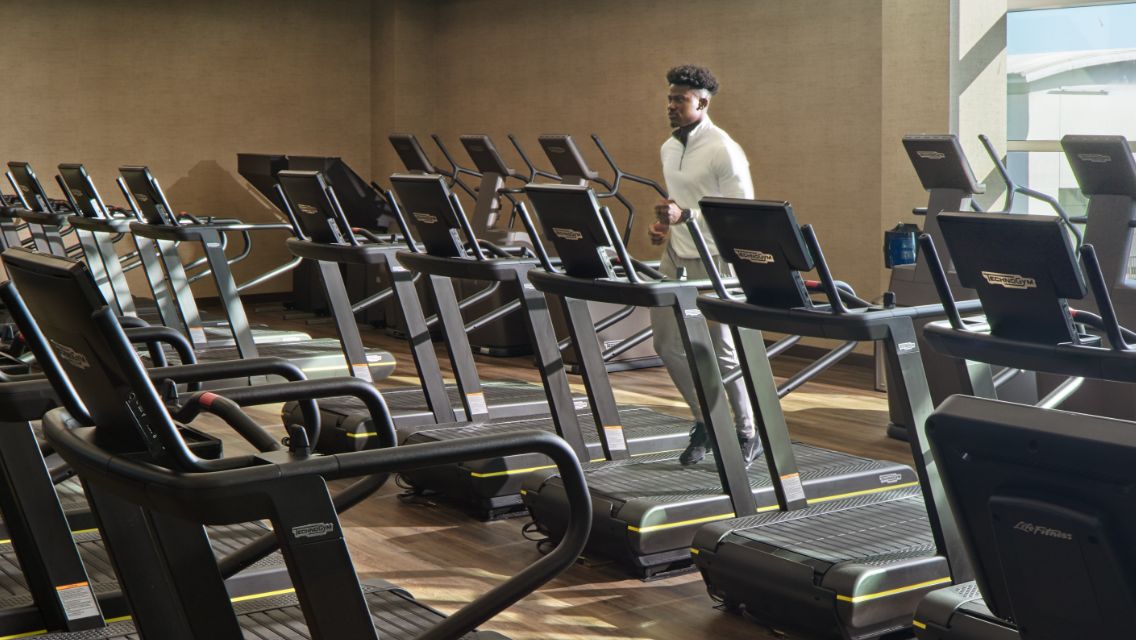
Running outdoors can reduce the risk of overuse injuries like stress fractures, shin splints, and plantar fasciitis, especially in the cold months, when many people rely on the treadmill, Voight says. That’s because moving outdoors forces you to vary your gait pattern: You’re climbing hills and taking corners and navigating uneven terrain, rather than landing in the same spot over and over again.
Michael Rodriguez, DPT, a distance-running coach and founder of Endurance Sports Physical Therapy and Performance in St. Louis Park, Minn., suggests that winter runners who stick primarily to the treadmill should adjust pacing and incline to vary force distribution. Adding another pair or two of shoes to the rotation can also help by subtly diversifying gait patterns and muscle recruitment.
The variability that outdoor running provides is counterbalanced by some obvious risks, though. “There are a few running-related injuries that can occur more frequently in winter for long-distance runners,” Rodriguez says. “Strains of the hip adductors and hamstrings can occur due to poor traction or slipping on the ice.”
Voight notices a bump in running injuries in the fall and spring, when people shift from running exclusively outdoors to exclusively indoors, and vice versa. To mitigate those risks, she recommends a slow transition for either season and a combination of outdoor and indoor running, even when the weather turns cold.
In fact, mixing in some outdoor running with indoor work on the treadmill and strength training can reduce the risk of injury and undergird sustained year-round fitness.
( 3 )
It builds connections.
Michael began running 15 winters ago at his local health club, which offered childcare for his boys and an indoor track for a warm, surefooted introduction to the sport.
After a year, he could consistently run two miles without a break. When a buddy asked him if he’d be interested in being a running partner, Michael had the confidence to agree. With exceptions for travel and below-zero Fahrenheit temps, the pair has been running together weekly ever since.
“Being accountable to somebody every Saturday is a pretty serious thing,” Michael says. “I don’t think I would have stuck with it if it weren’t for him.”
Research supports Michael’s sentiment. Regular runners who responded to a survey out of Glasgow Caledonian University in 2018 reported being happier than the average person — and that the happiness is driven, in part, by social connections. The respondents were registered with either the United Kingdom’s nationwide weekly 5K parkrun or with the fitness-tracking social app Strava.
“The combination of attending parkrun and being able to track your progress on Strava makes runners feel as if they are not on their own,” Emmanuelle Tulle, PhD, now professor emerita of sociology with the university, says in a news release. “It enables them to see the point of running. They are much more likely to maintain regular exercise as a result and reap the benefits.”
Tulle suggests the happiness comes from a combination of togetherness and competitiveness. According to the news release, referring to the survey language, runners reported benefiting from being part of a “positive, supportive, and inclusive community,” which creates “strong bonds” and “encourages you to push yourself to improve.”
Michael appreciates that he has someone to chat with consistently, a perk he knows he could probably find with a local running club. But the relationship forged while doing something that most people would find exceptionally hard — that is, running through snow and ice — transcends the typical social-running milieu.
“We’ve helped each other through serious stuff — job changes, divorce, kids, family, death,” he says. “That’s a good 15-year period of stuff happening in your life.”
( 4 )
It boosts your mood.
Some of the mental benefits come from a feeling that you’re one of a small but mighty cadre of cold-weather warriors.
“I still get a thrill out of running in the cold,” says Olympian and healthy-living advocate Carrie Tollefson. “I still love feeling the sun beat down on my face when it’s 0 degrees. I feel like I’m a rock star if I get through a run and it’s minus 10. I always come back, like, Oh, that was really hard today. My eyelashes are frozen and I have little icicles on the hair on my face — and I’m like, ‘What? I have hair on my face?!’ I always laugh about that, but I think, You did something awesome today.
“You get a mental boost from it — which in turn helps you gain confidence and want to keep doing it.”
Exposure to sunlight initiates the conversion in your skin of 7-dehydrocholesterol into much-needed vitamin D. And it can help ward off seasonal affective disorder, some form of which affects up to 20 percent of the U.S. population, according to a UofL Health article by Jennifer Daily, MD. Daily notes that a lack of humidity in the winter helps boost mood and that cold temps stimulate the parasympathetic nervous system, which calms the body.
And, of course, the runner’s high knows no seasonal bounds. Despite her aversion to winter, runner and content creator Jen Biswas gets a charge from facing it head-on by running through the season. “I hate the snow, and I hate winter,” Biswas acknowledges. “But there’s nothing more peaceful than a run outside while it’s snowing. There’s nobody out — it’s quiet, calm, and so incredibly peaceful.”
And, like Tollefson, Biswas gains a greater sense of achievement.
“I also finish each run in the winter feeling like I accomplished way more than the same run in the warmer months. Just getting outside in the elements is a victory.”







Comments (0)