




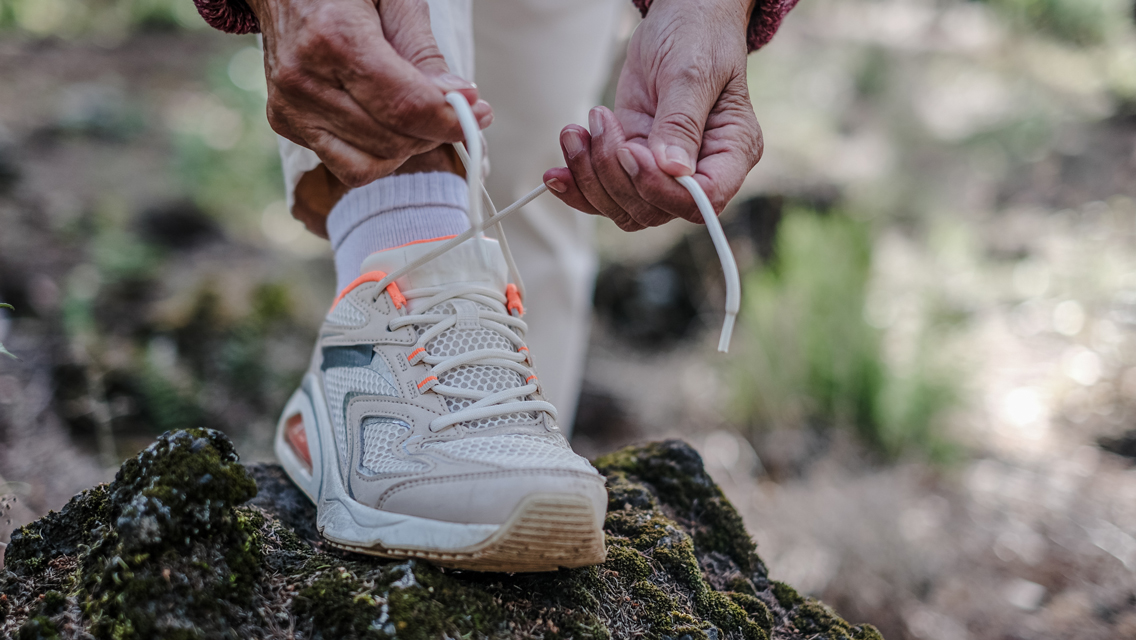
With 26 bones, 33 joints, and more than a hundred muscles, tendons, and ligaments — not to mention some 200,000 nerve endings — your feet are crucial to keeping you active and healthy.
“Feet are the foundation to the body. Every step, jump, or lift starts at the feet,” says Angela Metrou, MA, a Chicago-based mobility coach specializing in joint strength and longevity.
The feet are often first in line for age-related complications: Stiffness, pain, numbness, and tingling are just a few of the common complaints that pop up as you get older. Some of the causes, like the thinning of fat pads and skin, are hard to prevent entirely. But one major contributor to foot problems — the loss of strength and mobility in the lower legs — is relatively easy to address with targeted exercises.
Strong ankles, arches, and toes play a key role in keeping you, well, on your feet. This speaks to those body parts’ highly proprioceptive nature, “their ability to sense where you are in space and adjust your body accordingly,” explains Life Time’s Wes Pedersen, CSCS, an Irvine, Calif.–based strength and running coach. If you feel like you’re about to fall, the feet’s nerves, muscles, and connective tissues work together to keep you upright.
Because of their intermediary role between the ground and your brain — helping relay information that dictates your ability to move and stabilize — Metrou calls feet “your ears on the ground.”
But, she notes, “we start losing sensation to our feet as we age.” This loss can contribute to mobility decline. You may walk less and differently, switching to a shuffling gait. As the quantity and quality of your movements change, this can lead to weakness and pain not only in the feet but also up the kinetic chain, into the knees, hips, and spine. Because of this cascading effect, foot weakness is a strong predictor of fall risk as you age.
To preserve — or reclaim — function, Metrou and Pedersen recommend focusing on two attributes: ankle mobility and toe strength.
3 Exercises for Strong, Mobile Feet
Aim to incorporate the following three exercises, provided by Metrou and Pedersen, into your daily routine. Doing them first thing in the morning is a great way to shake off stiffness in your feet and ankles, but work them in anytime you can do them consistently.
Toe Spreads
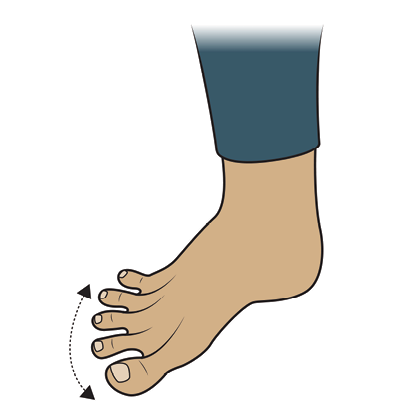
• To the best of your ability, spread your toes apart from each other. Try to use only the strength of your foot muscles to create space between your toes.
• Relax and allow your toes to return to their resting position.
• Repeat 10 times per foot.
Toe Waves
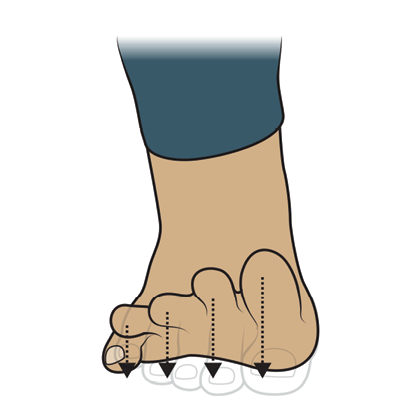
• Raise your toes off the floor. Press only your big toe down, keeping the four other toes elevated. Then elevate your big toe while pressing the other four toes to the floor. Repeat five times per foot.
• Next, raise your toes off the floor. To the best of your ability, try moving each toe individually: Lower each toe, one by one, back to the floor. Reverse the movement: Raise each toe back off the floor, one toe at a time.
• Repeat five times per foot.
Step Downs
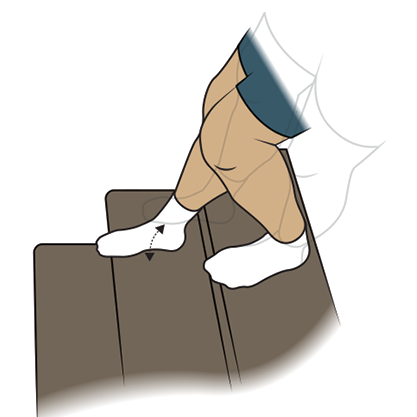
• Stand with both feet on one step of a staircase, facing the lower landing. Hold on to the handrail for balance.
• Lower your right foot and touch the next step below with your entire sole while keeping your left foot down fully on the original step.
• Hold this position for a moment, then step your right foot back up to meet your left.
• Repeat 10 times per foot.
Assess Your Foot Function
Perform these two assessments to determine your foot strength. Repeat them periodically to check for improvements or other changes.
1. Test Your Toes
To assess the strength and control of your intrinsic foot muscles, Angela Metrou, MA, a Chicago-based mobility coach specializing in joint strength and longevity, recommends the following test.
- Sit or stand with your feet planted on the floor or an exercise mat.
- Try to spread your toes apart from each other while keeping them flat on the floor or mat. Use only the strength of your foot muscles (no hands or other assistance) to create space between your toes.
- If you can’t spread them — or if your toes rise and curl away from the floor as they spread — your feet could benefit from intentional strengthening exercises.
2. Appraise Your Ankles
To test your ankle mobility, Life Time’s Wes Pedersen, CSCS, an Irvine, Calif.–based strength and running coach, recommends this two-part test.
- First, perform a body-weight squat. Do your heels come off the floor? The goal is to keep your heels glued to the floor the entire time.
- Then, stand facing a wall, with your toes touching the base of the wall. Keeping your heels down, bend your knees to try to touch the wall.
- Next, step back one or two inches and try to touch your knees to the wall again.
- Step back another inch or so (you’ll be standing about four finger-widths away from the wall at this point) and repeat. Can you touch your knees to the wall from all three distances while still keeping your heels in contact with the ground?
- If you answered “No” to one or both of these ankle tests, you might benefit from working on ankle mobility.
This article appeared as “Best Foot Forward” in the January/February 2026 issue of Experience Life. Illustrations: Colin Hayes.


This Post Has 0 Comments