




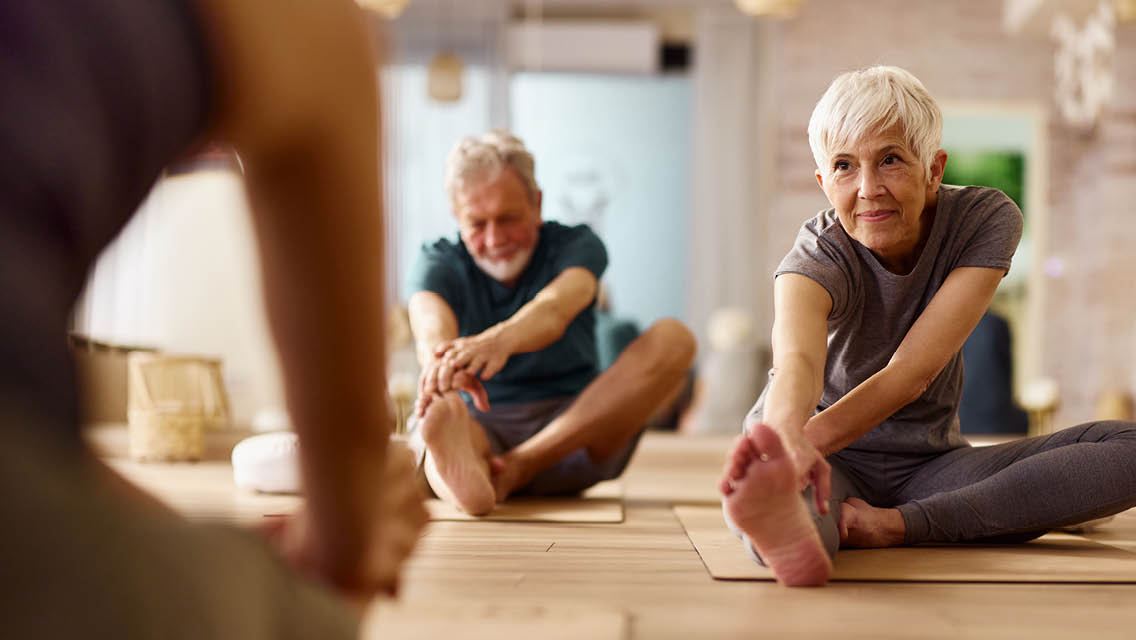
It’s no secret that staying active is key to healthy aging. Strength, mobility, and cardio all support our ability to move well, feel strong, and enjoy life. And yet, even though sedentary behavior is a major contributor to common hallmarks of aging — including muscle loss and inflammation — studies show that inactivity typically increases over time.
If you’ve recently drifted away from physical activity or it’s been years since you last worked out, it can be hard to muster the will to get back into action. We asked two experts for behavior strategies, mindset shifts, and other practical advice to get you moving again.
( 1 )
Honor where you are. Meet yourself where you are right now, advises psychologist Diana Hill, PhD, author of Wise Effort and coauthor of I Know I Should Exercise, But . . . “Your body is changing, and you may not be able to do some of the activities you used to love. This doesn’t mean you’re not capable of moving. Your movement just needs to change with you.”
So, begin by being kind to yourself. “There’s a lot of research on self-compassion being far more motivating than self-criticism and judgment,” she says.
( 2 )
Expand your idea of fitness. Look beyond buff-body stereotypes of what it means to be fit, and think playful and practical instead. “We want to move smart, get strong, stay functional, build longevity, and have fun,” says Rob Glick, senior director of programming and innovation for a variety of class formats at Life Time, including for the 55-plus ARORA program.
“Fitness is really about capability,” Hill adds. “We must be willing to experience a little discomfort in the service of staying flexible and strong, because we want to be able to get down and back up off the floor with our grandkids or participate in other activities we enjoy.”
( 3 )
Shift your narrative around aging. “Sometimes we have internalized ageism,” observes Hill. We buy into the idea that aging means decline, that we’re weak and fragile and therefore incapable, that this phase of life is a time of loss. “Aging is a time of gain,” she argues. “You gain a tremendous amount of wisdom. You move into a stage of life where you can see a bigger picture.” And part of this picture is healthy movement.
“Movement is powerful at any age,” adds Glick. “The human body is incredibly adaptive. Celebrate what your body can do today.”
( 4 )
Seek expert advice. Check in with your doctor before you jump back into exercise. Review current or past injuries, chronic health conditions, and medications that may affect your balance, heart rate, or energy levels, advises Glick. “From there, work with a certified trainer or find a class where instructors know how to scale movement appropriately for your needs.”
( 5 )
Think well-rounded fitness. In terms of exercise, “building and maintaining strength is one of the most powerful things we can do to stay independent, energized, and resilient,” Glick says. “Cardiovascular training, including high-intensity interval training (HIIT), strengthens your heart and lungs, improves your endurance, and supports metabolic and cognitive health. Practices like yoga and Pilates support your joints, mobility, posture, and breath awareness.”
( 6 )
Listen to your body. “Your body has much to tell you,” says Hill, who often guides clients to recognize and honor the body’s signals.
Still, be willing to push back gently if your body argues, for example, that it’s too cold outside to go for a walk. “Tell your body, Let’s just try! If we’re out for five minutes and you’re miserable, we can go back inside. But let’s give this walk a chance.”
Of course, if something is painful in the moment or feels unsafe due to a previous negative experience or injury, back off. “That’s your body telling you something needs to shift,” says Glick. “We’re not here to push through pain.”
( 7 )
Release comparison. “Our minds can give us a hard time when we step outside our comfort zone, learn something new, or put ourselves out into the world — and movement often involves all three,” says Hill. Comparisons, whether to others or to how we used to be, are one way our mind hassles us.
“Shedding this habit requires some degree of letting go of what we look like” doing an activity or in a particular position, acknowledges Hill. “But if we can let go of that, and come more into ourselves, we can enjoy our bodies differently.”
( 8 )
Embrace belonging. Another antidote to comparison is the feeling of belonging. “We’re wired for connection,” says Glick. “A community brings energy, accountability, and joy. When you feel supported and part of something bigger, you keep coming back to fitness — not just for the workout, but for the experience.”
Moving alongside others can also make your workouts feel less taxing, notes Hill. In one study, participants wore heavy backpacks and were asked to estimate how steep a hill was. Those who were physically with a friend estimated the hill to be less steep than those who stood alone.
( 9 )
Commit to small and steady. What movement would you be willing to consider even when you’re lacking motivation?
Hill commits to moving her body every morning. “Some days that means stretching in my pajamas in my bedroom. Other days, I’m going to an exercise class.”
Glick recommends building routines around microgoals, noting that celebrating milestones and tracking progress can fuel momentum: “Begin with consistent movement that offers just the right amount of challenge that it is enjoyable and sustainable.”
( 10 )
Seek growth. “Humans are motivated to build mastery, achieve goals, and build competence. It’s one of our psychological needs,” says Hill. Physical activity is a sphere of life where you can claim growth — such as when you can finally do a challenging yoga pose, walk a certain distance, or hit a tennis ball over the net just so.
“It feels good to build mastery,” Hill adds. “And that doesn’t end just because we’re aging.”



This Post Has 0 Comments