


Supplements to Support Your Energy
Learn the supplements to consider if your energy could use a boost.


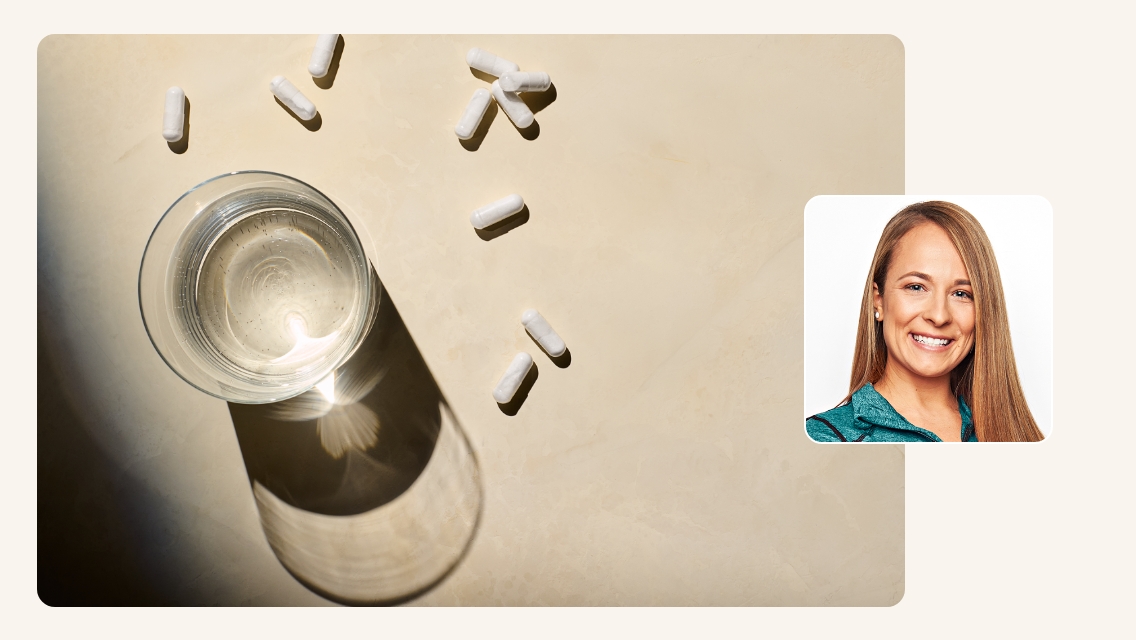


We often hear it: “I feel tired;” “I feel drained;” “I feel exhausted.” When our energy levels are low, everything can feel more challenging. And while there’s no single quick fix or pill that solves energy woes, there are certain supplements that can provide support. In this episode, Samantha McKinney, RD, shares the supplements to consider if your energy could use a boost.
Samantha McKinney, RD, CPT, is the director of LTH at Life Time. She’s been with Life Time for 13 years in multiple roles and is currently on the team that leads nutrition programs and supplements for Life Time members, helping them optimize their metabolism and results from the inside out.
In this episode, McKinney speaks to a number of supplements that can support energy levels, including the following:
- Magnesium malate supports the production of ATP, the body’s primary source of energy.
- Creatine helps enhance cognitive function and your ability to more quickly generate ATP.
- B vitamins are necessary for maintaining overall energy levels. Most people associate vitamin B12 with energy, but it’s the whole family of B vitamins (like those found in a high-quality multivitamin) that work together for the best effects.
- Citrulline is an amino acid that can help open your blood vessels to deliver nutrients to working muscles. Beet root powder can also help with oxygen and nutrient delivery, which in turn helps boost energy levels and stamina. Both can be found in LTH Pump Pre-Workout to support exercise performance.
- Iron is critical for preventing deficiency, which directly contributes to anemia; one of the main symptoms of anemia is chronic fatigue. Knowing your iron status — which you can learn about from bloodwork — is important. It can be problematic to supplement with iron if it’s not needed.
- Coenzyme Q10 (CoQ10) is an antioxidant in our cells that’s involved in producing energy.
Transcript: Supplements to Support Your Energy
Jamie Martin
Welcome to Life Time Talks, I’m Jamie Martin.
David Freeman
I’m David Freeman.
Jamie Martin
In this episode, we are talking about supplements for energy. We hear it all the time, I feel tired, I feel drained, I feel exhausted. And when our energy is low, it can make everything in life feel a lot harder. So in this episode, we’re really talking about some of the strategies we can take specifically with supplements to support our energy. David?
David Freeman
Yeah, and we got our superstar guest back, Samantha McKinney, how you feeling?
Samantha McKinney
I’m feeling great. Thank you for that intro as always.
David Freeman
So let’s give a little background on Sam. So Samantha McKinney, RD, CPT and is the director of LTH at Life Time. She’s been with Life Time for over 14 years and multiple roles and is currently on a team that leads nutrition programs and supplements for our Life Time members, helping them to optimize their metabolism and results from the inside out. Game time with Sam. We ready to get after this today?
Jamie Martin
Absolutely, but first I want to just check in. How have you been? know you had like an addition to your family since we last had you on.
Samantha McKinney
I did, I’m now mother of two, so very excited to have a little baby at home. Things are going well. I’m glad to be back, honestly. Super fun, and obviously the household is busy.
Jamie Martin
Yes, you’ve got your hands full right now, but that’s the fun stuff. It’s a fun stage.
Samantha McKinney
It’s a very fun season.
Jamie Martin
Awesome. Okay, we’re going to dive right into our topic. Low energy. We know a lot of people are talking about this, whether it’s low energy related to burnout or whatever. What are some common reasons that people are experiencing this that you’re hearing?
Samantha McKinney
Yeah, so this is a tough one because it’s probably one of the number one complaints that we hear whenever clients come to us trying to seek help, honestly. It’s like, my energy is so low. And it’s kind of an ambiguous complaint because there’s so many potential causes to low energy and so many, you know, people feel like they’re playing whack-a-mole with like, how do I figure out how to, you know, increase my energy.
I’m like, gosh, it really could be anything. Let’s start with the foundations and then let’s build from there. But it could be blood sugar swings. You guys know I’m a big fan of talking about blood sugar. Always, always, always. It’s just, whether or not you’re diabetic, that’s one of the staples of long-term health and feeling great. You just can’t feel good if your blood sugar’s off, even just a little bit.
Another one is thyroid health. So if your thyroid is off, everything in your body slows down, including your energy levels. It’s just kind of like you’re sort of in slow motion. Your digestion’s in slow motion. Everything’s in slow motion, including your energy.
It could be mood-related, honestly. So that’s a little bit more of a clinical approach. If you’re struggling with anxiety or depression or what have you, could manifest itself as low energy or that could be one of the symptoms you’re experiencing.
It could be just poor circadian rhythm and poor sleep hygiene. That’s another really big one because if your circadian rhythm is off, if your body, silly as it sounds, doesn’t know it’s daytime during daytime, doesn’t know it’s nighttime during nighttime, it will show up as trouble sleeping and poor energy throughout the day.
And then obviously nutrient deficiencies. So there’s so many different essential nutrients to your body, vitamins and minerals. And if you’re low in them, that’s literally your metabolic machinery. So if that’s not working, then the fuel you’re putting in, calories, they don’t work right. I always use the analogy that the carbs, proteins, fats, your calories are like fuel and then nutrients are like engine parts, right? So if your engine parts aren’t there, it’s not gonna function well and your energy is gonna slow down too. So there’s so many different reasons.
David Freeman
Yeah, and I just want us to be able to paint a picture to our listeners. Right now, when you think of, all right, I feel normal as far as within my energy levels versus what we always try to push towards is optimal. So if you can paint that picture for us as far as what normal might feel like because it’s your current baseline versus what optimal should feel like in this space of energy.
Samantha McKinney
That is such a great point. We say all the time within LTH, within the Life Time Health coaching approach is you don’t know how good you could feel, right? So, so many people, they’ve normalized their poor energy levels and they don’t even realize it, you know? Or they’ve normalized their bloating, name any symptom, right? But poor energy is one of the top ones, they’re kind of low energy.
And so, you know, there’s different strategies to answer your question indirectly, like I always like to do, right? But to answer your question indirectly is until you get to the point where you are feeling optimal, you don’t, truly don’t know how good you can feel, you know? But I would say things that people tend to normalize that absolutely are not normal, but are common are that 3 p.m. energy slump, right? Feeling like, gosh, I need to go get myself a little treat. You know, it’s 3 p.m. I think it’s time for a little treat, whether that’s sugar or a fun coffee drink or whatever.
That is, yes, some of that could be habit, but some of that, if you’re relying on that to get through the afternoon, is poor energy, right? If you find that maybe after dinner, you’re sitting down on the couch and you are just crashing, not optimal. The other thing, snooze in the morning. So if you’re not getting out of bed energetic, then that is usually your body waving a little red flag, like, hello, you know, like there’s something we have to optimize here, because you should feel energized, particularly in the morning, right?
So, and I know there’s different chronotypes of people. Some people take a little while to get up, but if you just feel like, I’m just, I’m not a morning person, I just, I’m dragging, then that’s usually not normal, although it’s very common.
Jamie Martin
Yeah, I just think it’s so funny to your point, like how we always just like, this is just how I feel. This is the best I’m going to feel. it’s like, until you get to that point, like, I can, I feel really good. You know, it’s just that change that can happen for sure. Some strategic changes, right? And to that point, oh, go ahead.
Samantha McKinney
Yeah, no, I was going to say it’s probably one of the top things people are surprised on the LTH D.TOX program that we’ve talked so many times about. There’s a thousand different reasons somebody might enter detox. It could be, I’m trying to shed a couple pounds, I’m trying to feel better, whatever it might be. People say at the end of that, I am so energized without caffeine, I can’t believe it. I’m just going keep going. And that is a perfect example or like a little glimmer of what we mean when we say you don’t know how good you’re designed to feel.
Jamie Martin
That’s awesome. Let’s talk about the lifestyle factors before we get into supplements. What are some of the lifestyle habits that could be influencing our energy levels? And we want them to support them ideally.
Samantha McKinney
Yes. Top one, which is going to sound hard when you’re low energy, is exercise. You have to move your body. You just have to. Our bodies are designed to move. And consistent exercise, if you just, yes, force yourself into it. Even if you’re starting with 10 minutes at a time, force yourself into a daily exercise regimen, because that is one of the best ways to naturally boost your energy levels.
And what you find, it’s almost this self-fulfilling cycle in prophecy. It’s like the more you exercise, the more energetic you feel. And you just kind of keep going with that snowball effect. That’s probably the first one.
The second one I would say is you cannot have great energy without great sleep. Your body relies on, we spend a third of our lives sleeping, or we should. nature didn’t make an accident there. There’s a reason that we should be sleeping for a third of our lives, and that’s so crucial. And sometimes people have trouble sleeping even when they’re not doing the right things. I would argue most people that have trouble sleeping, aren’t doing the things within their control to potentially optimize that. There’s obviously some times that it’s still interrupted, but if you’re up on your phone late at night, if you’re doing kind of like the late night doom scrolling, if you are not winding down, if you’re not mindful of getting sunlight during the day, that’s all part of, yes, I know, which is kind of hard, right?
If you think about certain winter months, especially Northern climates, whatever it might be. But you do wanna make sure you’re anchoring your circadian rhythm and your circadian rhythm not only ties to your sleep, but it ties to your morning routine as well too. And that’s what I meant earlier, like your body needs to know it’s daytime. You can’t do that without some sort of sunlight exposure, right? Our bodies are meant to be in the sun during the day and avoiding sun or blue light or artificial light in the evenings. That’s another one.
And then I would also say blood sugar balance. We talk about that all the time. A third of North Americans have some sort of blood sugar imbalance. Even if it’s not full-blown diabetes, it could be pre-diabetes. And you don’t have to necessarily have a weight problem to have a blood sugar issue, right? And one of the number one symptoms that I see in clients is energy levels bouncing up and down. So you’ve got to be managing your blood sugar. I know there’s a ton of content on Experience Life already about that, but that usually starts with obviously exercise, but getting enough protein throughout the day is crucial. So many times people want to jump right to avoiding sugar or limiting carbohydrates, which could be a huge part of that. But usually if you just focus on getting enough protein, for most people the rest of it takes care of itself. So those are kind of like the foundations I would say.
Jamie Martin
And it really, goes back to so many of the pillars we talk about all the time on this podcast at Life Time in general. These are things that are just the lifestyle habits that we want people to be thinking about and hopefully doing something about all the time. And I made that face when you said, like, get the sun lights. Like, I arrived here when it was dark this morning and I’ll probably leave here when it’s dark. I’m like, I gotta get out at lunchtime.
Samantha McKinney
Yeah, and I would say they make now light boxes and things that you can use to try to stimulate that in the morning. And sometimes you’re like, my gosh, that’s so weird. I’m like, well, you don’t think it’s weird to turn on your TV at night? It’s kind of the same sort of concept, right? But if you can find little hacks and things to do. But even just start small. 5, 10 minutes is better than zero minutes.
David Freeman
All right, recap those staples again. We had movement, we had sleep, and then obviously blood regulation as far as those levels. Blood sugar with nutrition as well. So now, if you’re doing all those things, where does supplements come in as far as to help us support the energy?
Samantha McKinney
There’s so many things to start with, but I would say fill in what’s already missing, right? If you have to start with filling in the gaps that your body is relying on in order to function well, and that usually starts with nutrient sufficiency, right? You have to be, because it could just be as simple, and I didn’t even mention this, what if you’re not eating enough? You know, for some people, especially if they have certain body composition goals, or maybe they have a really busy schedule, they tend to skip lunch, you might just be under eating too.
You don’t really know that until you kind of keep a food log, but from a micronutrient standpoint, vitamins and minerals, you wanna start with the basics, right? So I usually always start, people wanna jump right to, for example, vitamin B12 as an example. That’s important, you need vitamin B12 for high energy levels, but you actually want the whole family of B vitamins and that is found in a really great quality multivitamin. So you’ll notice in LTH multivitamins, have a whole bunch of, we have all the essential B vitamins together along with different other nutrients and minerals in order to really optimize it as much as possible.
So I would start there because that’s kind of like an insurance policy for your micronutrient status, if that makes sense. I would say too, with B vitamins, people start to think about, and I didn’t mention this in the beginning, but anemia, one of the number one symptoms that comes up is poor energy levels. If someone is anemic, basically what that means is that your body is not delivering oxygen to all of yourselves the way that it should. And so you’re kind of just always low energy. And when people hear anemia, the first thing they typically think of is iron, right? You can actually have anemia from B12 deficiency, from folate deficiency, iron deficiency. There’s different forms of anemia. Not all of them are directly nutrient-related, but many of them are.
Jamie Martin
How would you know which one it could be related to? there a test you can do that?
Samantha McKinney
That’s a basic blood panel can tell you. And I would say a skilled practitioner that knows what to look for with your red blood cell patterns can actually identify what type of anemia it likely is. So there are different ways to look at it. And again, those are very basic labs that you can kind of do that. Obviously there’s more advanced things that you can start to order, certain iron panels, etc. But usually you can tell if you know what you’re looking for, what type of anemia it is.
But what I will say is out of the decades of lab testing that we’ve done at Life Time, most people have kind of what we call subclinical oxygen deliverability issues. So, right, we’re not gonna diagnose anemia, but you look at it you’re like, these aren’t medically out of range, but you can start to see that someone’s nutrient status is off. And 10 times out of 10, at least for the clients that I’ve worked with, if they start on a high quality multivitamin, right, ours is capsule-based, so it’s easy to break down and absorb. And it’s the right forms of nutrients. And surprisingly, this hangs people up.
Most of the nutrients in there should be over 100% of the daily value on the label. Typically when they do a retest, it’s repeated and things are a little bit more optimal. And people will always ask, why is this over 100% of the daily value? I’m like, well, the daily values on there are to establish the minimum amount needed to prevent symptoms of deficiency. Those aren’t the values needed to feel awesome and feel optimal, right? So most people are going to need more.
Jamie Martin
Yep, you’re going to want a little, go beyond. Well, I mean, I think with all things, we know that taking one single supplement is not going to be a quick fix. So we want to really talk about like thinking about both in the short term and the long term strategies, like what are the things that we can do? So like, how would you address that?
Samantha McKinney
In terms of outside of doing the foundational things? OK, so I would say start with foundational lifestyle habits always. And start with foundational supplements always as well.
So I mentioned the multivitamin, making sure that you’re not just doing this onesie-twosie B vitamin approach. So sometimes people really rely on like energy drinks, right? I have low energy, so therefore I’m going to take an energy drink. I’m like, okay, stop for a minute. You don’t have an energy drink deficiency, right? And a lot of those energy drinks are loaded with added sugars. They have a ton of caffeine in there. And yes, you’re going to feel energized and possibly anxious, right? Doing an energy drink because you’re flooding yourself with a stimulant, you know? And I’m not completely anti caffeine, but if you’re doing that instead of these other things, we’re kind of missing the mark.
But I would say start with foundational lifestyle strategies, start with foundational nutrition, a good multivitamin. Another one to talk about as well that I think that most people could just implement, right? You don’t have to necessarily do 10,000 tests to figure out if you need it, is a magnesium malate. So the LTH magnesium we offer is a magnesium malate on purpose.
There are different forms of magnesium and as long as it’s making you more sufficient magnesium, you’re kind of achieving the objective. But if you start to look at the different forms, they all have slightly different advantages to them as well. So the magnesium malate is not acutely stimulating. It’s not like you take it and you feel a rush of energy like you do with caffeine, for example. But magnesium malate helps your body support ATP production. And ATP, that is the biochemical way of saying energy, right?
So it provides that machinery I was talking about for your body to better make ATP. So I would say if someone’s doing these lifestyle strategies, they’re mindful of their circadian rhythm, they’re trying to balance their blood sugar, and eat enough protein, starting with a great multivitamin that has the full family of B vitamins included in a capsule-based form at 100 % or more of the daily value, plus a magnesium malate. Those are probably, those are two really great starting points, I would say, from a supplement standpoint.
David Freeman
Yeah, you gave some great examples earlier as far as if energy levels are off, how you might have that midday crash, or they might want a sugary snack. Let’s talk about on the other side of spectrum. I could tell you when my energy’s on, I feel like cognitively I’m on point, like I’m Rain Man out this page, right? So is there other ways that we can tell that energy levels are operating in a good way? Obviously, if they’re not having the crash, and maybe if they are functioning high level, is there other ways that they can tell?
Samantha McKinney
I mean, I would say if you are getting through the day, you’re waking up energized, you are ready to tackle your day, you’re not having crashes where you’re like, gosh, I just need a nap, or I just need a little something to get through the next couple hours, and to your point, you’re thinking quickly, right? And you’re cognitively there. Those are all great signs that your energy levels are on point. Now, that doesn’t mean that there aren’t other things that you can kind of do to optimize. You know, we were talking little bit about ATP.
I have to talk about creatine, because creatine is having a moment in, I would say, the fitness space, the bodybuilding world. Most of us in this industry, David, I’m sure you would agree with this, we’re kind of like, finally, like, you know, we kind of want to give a round of applause, like, yay, everybody’s getting caught up. It’s such a crucial supplement that I would say is pretty universally beneficial, right? There are very few exceptions where creatine can’t make a huge difference.
And if you think about what creatine actually does, right, first of all, it’s a substance that’s already in your body. It’s in your muscles, it’s in your brain, your liver, your kidneys to some degree. But what creatine does is it saturates your brain and your muscles with phosphocreatine. That’s kind of the storage form of it.
When your body, and I’m gonna get a little bit nerdy, you guys know I like to do this on the science side. I do believe when people understand the why, it becomes less of an assignment, I have to take this and more of a, I get it, want to do this now. So when you have saturated phosphocreatine stores, your body is trying to make ATP, that energy currency in your body. It goes from ADP, this is adenosine diphosphate, two phosphate groups, to adenosine triphosphate, three phosphate groups.
You need a phosphate donor and phosphocreatine stores donate phosphate so you can more quickly generate ATP. This is why it is so popular in the exercise world is because again, to your point, alpha, whatever you might be doing, if you need to quickly regenerate between sets, you need fast phosphate donors, right? And phosphocreatine is one of the best ways to do that. So you can generate ATP more quickly. That’s why people feel more power in exercise when they take it.
That translates directly to your day-to-day life though, as well too. And because that phosphocreatine goes in your brain, it transfers directly to the cognitive standpoint that you’re talking about, David, as well. And then the other part of creatine is it can, there’s a whole section of your health that, and a lot of processes in your body that rely on something called methylation, right? And what you wanna do is think of methylation as like, there’s a set amount of like methylation that your body needs to do every day in order to function well.
A lot of your methylation capacity, like, 40%, 50%, some estimates say, are to making creatine. So if you take it exogenously, or if you take it as a supplement, you’re kind of alleviating the burden of your body’s methylation a bit so that it can focus on other things and your energy levels can go up for that. So a lot of people will report, my energy levels are way more stable when I’m taking creatine. I know personally for me, if I’m taking creatine consistently, I never need that afternoon cup of coffee, ever. And it’s a notable difference, right? So creatine, we’re huge fans of that for sure.
Jamie Martin
What is the best way or the best timing to take the creatine? I think that’s a question, like, how these things all fit together.
Samantha McKinney
I always say the best timing is the timing you’re most consistent with every day. Most of the research, transparently, is done taking it immediately post-workout because most of the research is on exercise performance. And so that’s how they assign the research subjects to take it. whenever you take it most consistently is best. And so personally, I just add it to my water and electrolytes a couple of times every day. The LTH creatine is five grams per scoop. And I’ll probably do between one and three scoops a day.
So, and again, you can just take every day. You can take a scoop. It’s one of those things where you just want to saturate the phosphocreatine stores in your body. That will translate to a lot of benefits, consistent energy being one of them.
David Freeman
The other thing that stood out to me as far as you saying it helps support cognitive function within the brain as well, and then the recommended dosage roughly around five grams in this space. on a compromised sleep, right, you didn’t get as much sleep. Would you say that dosage can probably go up to help support cognitive function?
Samantha McKinney
Yeah, there’s some cool research coming out about that around your cognition, particularly around sleep deprivation and how increased doses of creatine can potentially mitigate that to help preserve that cognitive function and that mental sharpness, which is really nice. I will tell you anecdotally for me, right? You brought up I just had a baby. Yeah. I’m not sleeping eight hours uninterrupted every night. Let’s be honest.
I, there were immediately postpartum. like while I was on maternity leave, I probably was taking in 30 grams of creatine day. This is again, I’m not saying everybody has to go do that. I’m not telling you to go do that, but I had a much easier postpartum this time around. And I think that that was one of the factors.
Jamie Martin
That’s really interesting. I mean, you have this knowledge in your mind and like understanding that it’s about more than the muscle building side of it, which was what creating for so long was kind of solely associated with,
Samantha McKinney
I think that’s worth calling out. So again, I mentioned creatine is having a moment, but if you’re listening to this and you’re like, I didn’t know creatine was having a moment, like maybe that’s not in my algorithm. I haven’t been seeing a lot of creatine content. Now you will. I do want to call out that the number one thing that most people that aren’t familiar with creatine are nervous about is like, my gosh, I don’t want to look like a bodybuilder. I’m like, I have a couple of comments to that. Number one, looking like a body, nobody woke up accidentally with bodybuilding muscles. That takes a lot of work and a very specific strategy to get there.
But I would also say it’s not going to make you bulky either, right? To get bulky, you need to have a very specific type of training program called a hypertrophy training program. Preach. Yes. You need to be in a very strategic caloric surplus, right? And you need to have the right overall strategy to get there. You don’t, it does not happen by accident. I assure you, you will not wake up and like, my gosh, I’m bulky from creatine, you know? And I’m sure most bodybuilders out there, they’d like, I wish it was as simple as just adding creatine to my protein shake, but so that’s just not something you need to worry about.
I have my parents on creatine. It’s really important as you age too, but I could sing its praises all day long. Energy being one of them.
Jamie Martin
Absolutely. Okay, let’s talk about some of already mentioned B vitamins. Anything else you want to add about the importance of B vitamins for energy?
Samantha McKinney
I think I kind of alluded to this, but people like to take them in isolation. Don’t do that. Don’t do that. They’re meant to work together as a family, right? You need several B vitamins together because if you think of how they occur in food, they usually occur together, right? So you want to take a family of B vitamins, which is why I prefer to take a really rich in B vitamin, multivitamin complex than just stand alone. Now, sometimes you might need to add in an additional B complex based off of blood work or based off of your metabolism to really optimize things.
And then secondly, I would say is the forms really matter. So there are a lot of supplemental forms of B vitamins that I have told my friends that I love dearly and my family, just throw it away. Can I finish? I’m like, nope, just throw it away. Throw it away, don’t take it. Synthetic forms do not work the same way in your body as natural forms. So for example, if you’re looking at vitamin B12, cyanocobalamin, that is a very cheap form of vitamin B12. You can see it on a lot of energy drink labels. You can see it on a lot of supplement labels. you’re looking, turn around your supplement labels.
If the B12 or the ingredient list at the bottom says cyanocobalamin, that is a sign that they are taking the cheap synthetic form of vitamin B12 and putting it in there, right? They can still claim B12 on the label, but it’s not gonna function the same way in your body as like a methylcobalamin or an acetylcobalamin, right? They’re different, right? The other one is you wanna look for a methylfolate versus a folic acid, right? So folate is actually one of the B vitamins as well. So you can find that pretty easily. And then another one that’s really easy to spot is vitamin B6.
Sometimes what you want to look for, it’s called a P5P form. It’s pyridoxal 5-phosphate. You don’t have to memorize that. But if you see P5P, if you’re looking on a label and you see pyridoxine HCL, that’s another sign, gosh, they used a cheap form of vitamin B6 on here. So the forms matter, the dose matters, and then taking them in synergy matters.
Jamie Martin
Okay, I want to ask one more question just kind of related to methylation and the methylfolate. A lot of people have like some epigenetic snips or different things that might affect how they how they methylate. So let’s talk about that for a second.
Samantha McKinney
Okay, so the reason that some of these synthetic B vitamin forms are out there is because biochemically, your body should be able to convert them from those forms into this active form. To your point, an estimated half of the population has different genetic variations that can add varying levels of difficulty to people’s individual metabolisms in doing that. you know, people are really kind of zoned into this MTHFR mutation. I think it’s important.
I don’t think it’s the only genetic mutation that matters. There’s other ones that kind of play into this, but just using MTHFR as an example, because it’s kind of in the limelight right now, a lot of people have heard about it, they’re not sure. For the estimated half of a population that has those different MTHFR mutations, some of them might have as much as like a 90 % reduction in certain conversion pathways. So taking the active form that your body uses that’s at the end of the conversion pathway is just a safer way for most people, or I would say a more effective way for most people to just take it.
And that’s something I’m super passionate about. don’t mind sharing. I’ve tested my MTHFR status, and I have the worst MTHFR mutation out of all of them out there. And so it’s something that I’ve kind of become even more aware of over the last, I’d say, five or six years. But what’s really cool is, and I say this all the time, the LTH supplements that we offer are so mindfully formulated, is that we’ve always had the active forms, even before this MTHFR thing was cool. Because we’re like, why wouldn’t we? Why wouldn’t we put the most active form in there? We want people to feel a difference from what they’re taking. And so that’s one of the ways to do so.
Jamie Martin
Thank you for going into that.
David Freeman
Staying with the energy sources, citrulline, beet powder.
Samantha McKinney
Yeah, so citrulline, it’s an amino acid, and that can really help with energy levels as well, too. It can help with basically your body’s ability to deliver blood throughout your body. And if you think about it, that’s how your target cells get the nutrients that you’re eating, right? Yeah, it’s not like diffusion out of your digestive system to where it needs to go. That’s how it actually gets delivered. So citrulline is really great. There’s a lot of research that shows around 6,000 milligrams or six grams can make a really big difference.
It’s particularly used in exercise performance, right? So I would say if you are struggling with low energy, if you’re like, okay, I’m hearing, I need to start exercising, sometimes adding in that citrulline can be super helpful to kind of get that motivation to do it. It’s not harmful to do it if you’re not exercising, but there’s actually some like heart health benefits to it as well.
But I would say you’ll feel the bigger difference by kind of placing that before exercise as well. It’s one of the ingredients in LTH’s pre-workout complex for that reason, along with beet juice powder.
David Freeman
Pump, pump.
Samantha McKinney
Yeah, so beet juice powder, that’s another one. And what I like about that one is kind of like a food source. think a lot of people are looking for those types of ingredients. I’m like, okay, what can I get from food? But it’s way more potent than what you could get just from eating beets, which is nice. And so you wanna look for like 250 to 500 milligrams or so of that as well.
You can add that into a well formulated pre-workout product. And so we’ve chosen to include those along with different B vitamins and some caffeine and L-theanine to kind of really give people a smooth energy from their exercise. And I do want to say, I love that product, but it is not the thing to jump to first if your number one goal is low energy.
David Freeman
I you gotta share the story, Sam. I don’t think we’ve ever shared the story.
Samantha McKinney
This is so funny.
David Freeman
She said, isn’t a thing you want to jump to. So I was obviously doing like energy drinks . . .
Samantha McKinney
I about killed him.
[LAUGHTER]
David Freeman
We’re at a coach summit. So we’re about to deliver on, you know, just pouring into our coaches.
Samantha McKinney
Well, hold on. Let’s back up a little bit. You had an energy drink in your hand, and we have the rapport where I kind of snatched it out of his hand. I’m like, what is this?
Jamie Martin
Yeah, don’t drink this.
Samantha McKinney
What is this? I’m like moming him about it little bit. Like, what is this? Come on, I got something better for you.
David Freeman
She did. She had something better for me. And then it was our, it pretty much the single packs versus the actual scoops. And she was like, yep, you just take two and I’ll let you take it from here.
Samantha McKinney
Well, I said, let’s back up a little bit. I said the fully effective dose is two scoops, right? So if you look like a full serving is two scoops of it. He had the single serve packets. You got two of them and took two of them. The single serve packets are two scoops each. So the very first time David Freeman ever took LTE just pre-workout, he just, he just champed it out and just basically did four scoops or two full servings like out the gate.
David Freeman
Yes.
Samantha McKinney
There’s another ingredient in there called beta alanine. And that can cause a expected normal non-dangerous tingling sensation throughout your entire body. So he kind of slams them back. He goes back to his hotel room before we’re all supposed to reconvene for him to do this summit. And I’m getting these like frantic texts from him like, do I call 911? Do I need an ambulance? Do I need this?
[LAUGHTER]
And I call him. like, what is going on? He’s like, my whole body. I feel it. My whole body. It’s all tingling. It’s head to toe. And I’m like, David, that’s the beta alanine. That is normal. How much did you take? He goes, did the two packets. I was like, ooh, yeah, you did a double serving. And so that was kind of the joke the rest of the day.
And I would say too, I don’t want to speak for you, from talking to you, that beta alanine, the numbness and tingling, it was more so because you didn’t know it was coming.
David Freeman
Right.
Samantha McKinney
Yeah, because you’re regular user now.
David Freeman
Yes, I’m a fan now. I’m a fan.
Samantha McKinney
So it’s just if you don’t know that that’s going to happen, that’s a little bit separate from the energy conversation, the citrulline and the bee juice, that is a beta alanine. But yeah, that is kind of a funny story about that product. One of my favorite stories. He was, I will say that you were the talk of that summit. People were like, what is he on? I’m like, I’ve got something for you guys.
[LAUGHTER]
Jamie Martin
She knows, she gave it to him. To that point, a real quick question, I know we also have our RALLY product. Is there any of like the citrulline or any of that in that product?
Samantha McKinney
So the amino recovery, no. So what that is is that is fully broken down proteins into amino acids. And so that one, I mean, I think we have content on that too. That one is probably the easiest way to supply your body with protein building blocks or amino acids for recovery and everything.
It’s not going to be a direct stimulant type of a feel, but it’s absolutely crucial for your overall health, particularly if you find you’re not hitting your protein targets. We always talk about aiming for a gram of protein per pound of your goal body weight. People that see huge differences from taking the LTH amino recovery, the further away from your protein goal, the more non-negotiable that one is. But it’s not necessarily a direct energy type of supplement outside of filling and protein gaps if you’re deficient in protein.
Jamie Martin
So you mentioned iron already, but I do want to talk about how to supplement with that strategically.
Samantha McKinney (29:29)
Yes. Please don’t just go willy nilly, start taking iron because your energy is low. I’ve seen that happen too many times. If you are taking iron when you don’t need to be taking iron, it can cause massive metabolic disruption. So stop doing that. That being said, if you are low in iron, supplementing with iron will change your life. It honestly will. So this is why we’re huge believers in regular metabolic and lab testing. Because if you are tailoring things to your body, you can figure out and pinpoint and narrow down what is going to be more efficient and what’s going to work really well for you.
So iron, yes, absolutely crucial. If you are even slightly anemic or slightly having trouble delivering oxygen because you’re not eating enough iron, then it’ll change a lot. Now, I have seen a huge rise in plant-based eating, right? I’ve seen a huge rise in people going vegan and all of that. And whatever your nutrition approach is, realize that there are certain nutrients you’re not getting enough of eating that way. And it’s okay. You just need to assess your blood levels and make sure that you’re supplementing where there are gaps.
And so iron is one of the big things that I’ve seen increasing iron deficiencies over the last five to 10 years at least. So if you’re checking your blood levels regularly, you do really want to aim for optimal and adding in that iron and doing things. In a lot of plant-based sources, they’ll say, well, I eat spinach. I’m like, OK, that is a form of iron called non-heme iron.
And then there’s heme iron, which is found in a lot of animal sources. Your body uses heme iron more efficiently, right? And so that’s not shaming plant-based eating, but it is saying you should probably be taking an iron supplement, maybe with some vitamin C to enhance absorption, if you are choosing to eat that way. But don’t do so without checking your blood labs as well. But I do have to mention it because I have had a couple of clients that I can think of over my career where that was the ticket. And not only was that the ticket for high energy, but that was the ticket for women that maybe felt stuck in their weight loss journey. And it’s like their body was not functioning because they were iron deficient. So it is that powerful, but it’s not that universally powerful, if that makes sense.
Jamie Martin
But that’s again why we have to understand our unique body.
Samantha McKinney
Correct. Yes.
David Freeman
Lastly, CoQ10, I to know as far as what it is and then how does it fit within the energy spectrum.
Samantha McKinney
Coenzyme Q10 is an antioxidant that all of your cells need. And so as we get older, we lose coenzyme Q10. And so it’s a really good supplement that I just generally start to pepper in. I started peppering it in in my 30s, right? And as people start to get older and as we start to age well gracefully, adding in and repleting coenzyme Q10 is one of those things where it can just be part of your ongoing supplement regimen.
Now, as we get older, we’re starting to see more and more people on cholesterol-lowering medications. And the reason that I want to mention this is that coenzyme Q10 gets zapped by statins, right? So oftentimes you’ll actually see physicians, when they’re prescribing somebody a statin or a cholesterol-lowering medication, they’re prescribing it along with the recommendation of immediately starting coenzyme Q10. You don’t have to be on a statin to take it. Like I said, I’m not on a statin, and I take coenzyme Q10, and it’s in some of our supplement blends as well.
But that is one thing that is an antioxidant that your body needs for energy production. And when you start to get really low in coenzyme Q10, other bad things happen. Like you start to get lot of aches and pains. And there’s a lot of other side effects that can happen from some of those statin medications that coenzyme Q10 could potentially help with. So it’s definitely worth an honorable mention. It’s not one of the core energy supplements that I come out gung-ho. Like this is the first thing you got to start on. But it’s absolutely worth mentioning because it does make a huge difference when you need it.
Jamie Martin
Got it. Well, and with all of those, I know you mentioned like you can do lab work to kind of understand like where your iron levels are, but can you do lab work? What would you be looking for in lab work to help indicate if you needed a supplement? CoQ10 or B vitamins or any of the supplements we’re talking about.
Samantha McKinney
Okay, so multivitamin, magnesium malate, creatine, I would just make those universal. Just disclaimer, there’s obviously exceptions out there if you’ve got some sort of, you know, very specific medical need, right? But I’m talking to the general population here, right? That is where you’re gonna start.
The other thing that I would actually mention too is using electrolytes. So, you know, if you are even slightly dehydrated, your energy levels are going to feel lower. And so, so many of us need more electrolytes and we have this really like paranoid sodium-fearing population. like sodium is an electrolyte that you need to stay hydrated really well. And if you’re under chronic stress, or if you’re exercising, you’re sweating, you’re in warm climates, there’s so many different reasons why you could be losing electrolytes, including sodium. So taking electrolytes consistently, first thing in the morning and around exercise, or anytime you’re going to be sweating, maybe doing yard work, what have you, that can really help too. So hydration with electrolytes.
A good quality multivitamin with the B complex in there, capsule-based, right forms, right doses, magnesium malate, creatine, I would say those are pretty universally beneficial. From there, lab work can show if you are in need of even more B vitamins than what you’re taking. If you need to add a B complex on top of that, it can also show if you need iron.
And then for personally, with my coaching clients for Coenzyme Q10, if someone’s on a statin, it’s almost an automatic, like let’s just implement this into your routine. And if you’re aging as well. So kind of like middle age or older, it’s not going to hurt for most people to throw that in there either.
And then the citrulline and the beet juice powder, those are really great add-ons. You can see a huge difference, but those aren’t necessarily filling in the most common gaps I’m seeing, but they’re kind of like boosters if you think about it. If you really want to get the most out of your workout or you know, gosh, I need to be doing this lifestyle habit of exercise and I need something to get over the hump to be consistent there.
Then those can be really helpful if they get you exercising regularly and feeling great during your workout, which David . . .
David Freeman
We want to be great, right.
Jamie Martin
Every time. Every time we go there.
David Freeman
So we hit on a good amount of things throughout all on energy. Is there anything that you can think of that we might have missed that you want to touch on?
Samantha McKinney
No, I mentioned it earlier. I promise it’s not woo-woo, but really this light exposure thing is a very real, tangible. It makes a difference, right? Like getting sunlight every day in the morning can make a huge difference, and avoiding blue light or anything that confuses your body into thinking it’s sunlight in the evening, those are huge, huge factors in your overall circadian rhythm and energy.
But I would say, obviously, if you’re implementing a lot of these, if you’re implementing a lot of these strategies and you’re not seeing a difference, definitely make sure that you are exploring and digging deeper. Don’t accept low energy dragging throughout the day as this is just how my body works. That’s not how your body’s designed to work. And there’s something else going on. You gotta figure out what that is.
Jamie Martin
Yep, there are things that teams of people can help you, like, under, help you better understand yourself and what you can do to optimize.
Samantha McKinney
Reject mediocrity in how you’re feeling. You are designed to feel awesome. And if you’re not waking up feeling awesome every single day, there’s something you could probably do about it.
Jamie Martin
Let’s go.
David Freeman
Mic drop moment time.
Okay, if you had unlimited energy for 24 hours. All right, baby, no baby, don’t gotta worry about taking care of baby. Hubby, just unlimited energy for 24 hours, what would you do?
Samantha McKinney (36:23)
David, you’ve got the best mic drop moment questions. And I’m like, I would like them 24 hours in advance, please. So that I can answer that well. This is going to sound really lame, but I’m going to be me right now. All right? I’m very Enneagram one, type A personality. You guys are going to be like, this is the lamest answer. But this is the honest answer.
I would deep clean my house. Like it has never been deep cleaned before. I told you. And I would be ecstatic at the end of that 24 hours. I would be like, let me go through every single closet, every single drawer. Let me do a good clean detail. My enneagram ones out there, you guys are like, I hear you. I hear it. And everybody else is like, wow, that’s what you would do. But yeah. Isn’t that awesome?
David Freeman
It’s pretty awesome.
Samantha McKinney
Is it?
David Freeman
I mean, relative, yeah.
Jamie Martin
To each their own, right? Like if that’s what you wanna do, that’s what you do.
David Freeman
I can appreciate a deep clean like if you’ve had your car detail before.
Samantha McKinney
I have, I read a quote before and this is just an example of like, hey, there are some people that can’t relax till the dishes are done and some people that need to relax before they do the dishes and then they marry each other. I am definitely the one that I can relax and be, I’m just ecstatic when things are in order and that’s just my personality. And so those of you out there that relate, thank you. Those of you that are rolling their eyes, sorry.
Jamie Martin
I love that you’re owning it for yourself.
David Freeman
When she said what she just said, when Sam said what she just said, it’s something about, for the married couples out there, something about when a man sits down on the couch.
Samantha McKinney
Nothing irritates a wife more.
[LAUGHTER]
David Freeman
All of a sudden, all these things need to be done. I just sat down. So I know exactly what you’re talking about.
Samantha McKinney
I’m glad we all found something to relate to with my answer.
Jamie Martin
Yeah, you can connect with that. All right, Sam. We always love having you on if people want to hear more from you, you have tons of articles on Experience Life. You’ve also been on the podcast and we didn’t count this time, but you’re one of our top guests. So you’ve been here most frequently I would say .So there’s lots of podcast episodes. We’ll link to all of that in the show notes any anywhere else you want to point people?
Samantha McKinney
No, I think you covered it all.
Jamie Martin
All right, great thank you so much.
Samantha McKinney
Thank you guys.
David Freeman
Always appreciate you.
More like this

Talks — S4, EP14 / Why Magnesium?
Magnesium is one of the most prevalent minerals in the body, impacting how we feel and function every day — yet it’s also the second most common nutrient deficiency behind vitamin D. In this mini episode, Samantha McKinney, RD, CPT, explains magnesium’s far-reaching role in our health and offers tips for making sure our bodies have optimal levels.




We’d Love to Hear From You
Have thoughts you’d like to share or topic ideas for future episodes? Email us at lttalks@lt.life.
The information in this podcast is intended to provide broad understanding and knowledge of healthcare topics. This information is for educational purposes only and should not be considered complete and should not be used in place of advice from your physician or healthcare provider. We recommend you consult your physician or healthcare professional before beginning or altering your personal exercise, diet or supplementation program.
Life Time provides administrative, non-clinical support to MIORA as well as services and amenities related to general wellness and fitness; Life Time does not provide medical advice, diagnosis, treatment or care.
Advertisement