


Peptides for Longevity (Performance & Longevity Series)
Learn about the transformative potential of peptides in addressing the effects of aging and enhancing longevity and performance.


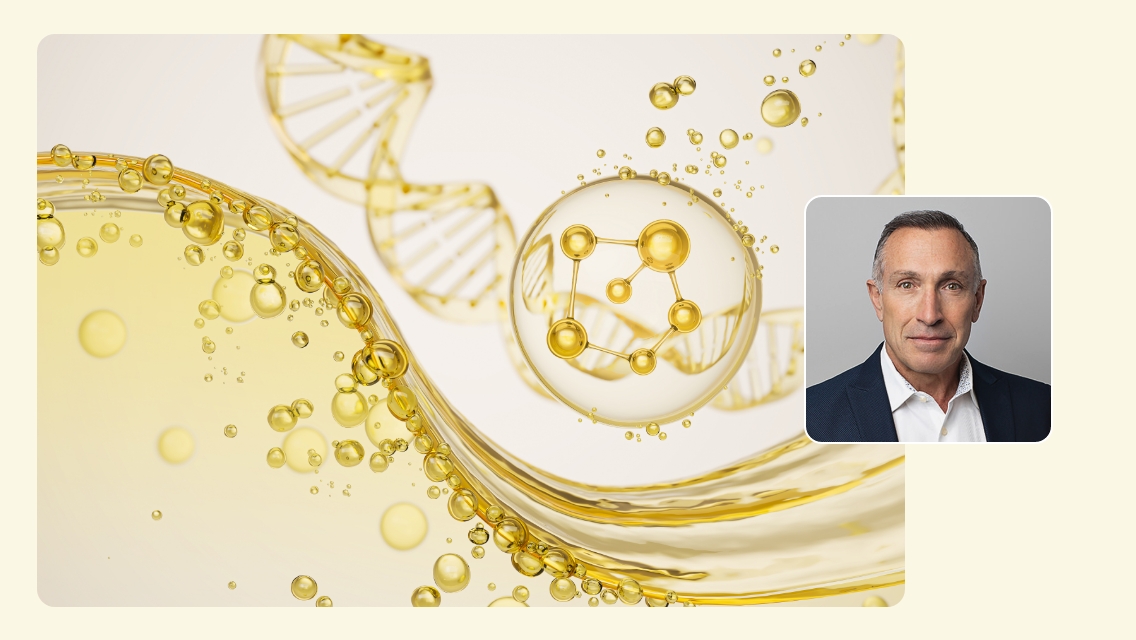



As we age, it’s common to experience more issues with our health, including stubborn weight gain, a loss of lean mass, trouble with blood-sugar control, changes in mood and cognition, and more. Peptides can offer support in addressing these and other areas, serving as a tool to help people redefine how aging looks and feels for them.
In this episode, Jim LaValle RPh, CCN, explores the transformative potential of peptides in addressing the effects of aging and enhancing longevity and performance, emphasizing the importance of using them alongside a solid foundation of healthy lifestyle habits.
This episode of Life Time Talks is part of our series on Performance and Longevity with MIORA.
Jim LaValle, RPh, CCN, is a clinical pharmacist, the cochair of the American Academy of Anti-Aging Medicine, the chair of the International Peptide Society, and the Chief Science Officer for Life Time.
In this episode, LaValle talks about various types of peptides and their uses for conditions related to performance, longevity, and aging, including the following:
- As we age, our body is “swimming upstream,” as LaValle describes it, in an effort to keep our metabolism in balance. This includes managing the processes that cause accelerated aging. But if you’re aiming to age gracefully, there are some target areas in which peptides may be able to be used for support, he says.
- Peptides can help address common issues related to aging, including skin health and appearance, blood-sugar control and insulin resistance, decreased growth hormone release, loss of lean muscle mass, weight loss, bone health, mitochondrial function, and mood and cognitive issues.
- GHK-Cu is a peptide used to improve collagen production and decrease inflammation in the skin. BPC-157 is another popular one for skin that’s applied topically to decrease connective tissue inflammatory signally. Oftentimes skin peptides are combined with other skin therapies like platelet-rich plasma (PRP) or platelet-rich fibrin (PRF).
- Peptides that help with muscle preservation and maintenance include PEG-MGF, which helps the body build muscle and sermorelin and CJC-1295, both of which help your body release more natural growth hormone. This is important because as we age, we lose the ability to release growth hormone, which helps our tissues repair; it also helps create a blueprint for how our cells are being made.
- Epitalon (or Epithalon) is a bioregulator derived from natural sources that works on the suprachiasmatic nucleus, helping your brain to reset its internal 24-hour clock. Re-regulating your circadian clock has the power to dramatically change your health.
- Mitochondrial peptides are important because the one constant with all chronic degenerative diseases, says LaValle, is that we lose mitochondrial capacity. LaValle believes these are the next big category of peptides. Examples of peptides in this category include MOTS-c and SS-31.
- GLP-1 are included in the category of longevity peptides because of their use in combatting type 2 diabetes and insulin resistance, which can damage the brain, arteries, and kidneys, and cause other complications.
- As we age, our thymus gland shrinks, so we can’t produce as many killer T cells; this makes us more susceptible to illness and infection. Thymosin beta-4, Thymosin alpha-1, and LL-37 are examples of peptides that can support the immune system. LaValle shares he does not believe people are giving this category enough attention for its impact on longevity.
- Selank is a calming peptide, while Semax and PE-22-28 can help improve mood.
- Although peptides can offer many benefits for aging and longevity, LaValle emphasizes using them as appropriate and in combination with good lifestyle habits, which can help the peptides work better for you. There’s no escaping the need to care for your body with proper nutrition, exercise, sleep, and stress reduction.
Transcript: Peptides for Longevity (Performance & Longevity Series)
Jamie Martin
Welcome to another episode of Life Time Talks in our series on performance and longevity with MIORA. I’m Jamie Martin. I’m here with Jim LaValle. He’s a longtime clinical pharmacist, clinical nutritionist, and the chief science officer for Life Time. And in this episode, we are talking about peptides for longevity and performance. Jim, how are you?
Jim LaValle
I’m doing great. I’m living long right now, so I’m kind of happy.
Jamie Martin
Okay, so we’re going to just set the stage here. We’ve had some primer episodes on peptides. We’ve talked about that already. But we want to talk specifically about peptides that are being used more and more for longevity and performance. You know, we know that they’re signaling molecules. You’ve explained that to us in the past. They can be used to treat injuries, to optimize health, to help with healing, to rejuvenate the body. Let’s start by really talking about how or about the role that peptides play in aging. Let’s start there.
Jim LaValle
Yeah, that’s great question. I know turning 65, I’ve become really interested in aging. So I love peptides. But the point being is as we age, our body is basically swimming upstream with keeping our metabolism in balance. And when we say the word metabolism, it isn’t just about how many calories you’re burning. It’s about managing the processes that cause accelerated aging. So inflammatory signaling, inflammaging caused by metabolic inflammation. And so those are the big areas or targets that you want to look at. If you’re trying to manage as I’m aging, I want to age gracefully. I want to ache less. I want to think clearer. I want to keep my lean mass, right? Because keeping your lean mass muscle is the currency of longevity.
So you want to maintain that. And so that’s where you start to think about, what are some core things that you can do with peptides that are going to help address those core targets? Obviously, as people age, in addition to longevity goals, people’s blood sugars start to go up. They tend to gain weight. Hence, there’s even peptides that work for that, things like the GLP-1s that have become so popular. But we’re also seeing GLP-1s being utilized for other areas, like mood, cognitive function, right? A lot of other issues that are out there that these peptides can be worked on as it relates to longevity. Yep.
Jamie Martin
So multifactorial and multi, like many impacts that can happen as a result of working with Yep. So we know that there’s a lot of different types of peptides out there today. Specifically, again, like we’re going to talk about aging, but let’s talk about like some of the top ones that are used like skin peptides. Like what are skin peptides for aging that you’re seeing in more use of right now?
Jim LaValle
Sure, mean copper peptide, GHK-Cu, is a peptide that actually helps to improve collagen production. It decreases inflammation as well in the skin. But probably the most important thing about it is that it’s involved in that as we age our skin sags, we don’t make collagen as well, so we lose that kind of scaffolding. And so that’s probably the most important aspect of copper peptide.
Another one that’s being used topically right now, being used with microneedling as well, is BPC-157, which is going to get back on the compounding list, I think, shortly. But it’s another compound that works on decreasing connective tissue inflammatory signaling. You know, if you are healing from a surgery or you have scarring, you want to try to help that tissue heal as best as it can. Another one called TB 006, another peptide that helps with bone healing and also works on collagen and connective tissue. So those are some of the key ones that are out there.
And a lot of times they’re combined with other therapies, things like PRF or PRP. Some people, you know, you hear the vampire mask or the blood mask. They’ll combine peptides with that in order to enhance the effect of that PRP or PRF, is basically, if you don’t know what that is, it’s basically, you know, it’s way of taking blood out of your own body and they spin it down and then they get growth factors from that that are great to regulate your immune system, but then you add the peptides to it and it almost supercharges it, is the way I would put it, and you get better outcomes from it. So that’s the skin. There’s certainly other ones that you can think about. Even the growth hormone secretagogues can have benefit for skin, but those are the key ones.
Jamie Martin
Yeah, I mean, when I think of skin and aging, like I often think of like my great grandmother who, know, her skin would, was almost like it was clear and papery. Like you’re saying that can have an impact.
Jim LaValle
Loss of collagen.
Jamie Martin
Yep, that’s what that is.
Jim LaValle
That’s what that is, right? The fit, the skin is thinning because that lack of collagen integrity. So you lose the ability of your collagen to be kind of integrous and tight and it gets lax. And then we get to hear words like crepey, crepey not creepy, but it’s crepey is kind of creepy though, as we’re aging, right? I mean, you you gotta think of that.
Jamie Martin
Okay, we’re gonna move on to the category of muscle. And what I think is so interesting of this is, you we start to hear, at least the coverage that we’ve had is like, people start to lose muscle like in your 30s at a natural rate, right? Right. So let’s talk about peptides for muscle kind of preservation maintenance.
Jim LaValle
So some of the ones that have been in the research, PEG-MGF, otherwise known as Pegylated Mechanical Growth Factor, is one of the peptides that’s been in the research that helps you to build muscle. One of the ones that I really like, which is already an FDA approved drug, it’s also compounded in compounding pharmacies, and we love using it when people are on GLP-1s is a compound called sermorelin. And sermorelin is a growth hormone releasing hormone peptide. So it tells the body, release growth hormone. And it’s the growth hormone you already are making. So you’re not putting growth hormone into your body. You’re telling your body, hey, remember how to make it? Cause you said it exactly right. Once you get past the age of 30, you start losing that ability to release growth hormone.
And so then it gets harder and harder to maintain lean mass. And I can say, living through six decades now, that with each decade, it seemed to become harder to maintain that lean mass without trying to support the maintenance of lean mass. So what sermorelin does, and then there’s a couple other peptides that are in that family that a lot of people listening have heard about. They’ve heard of ipamorelin and CJC-1295, which is another peptide that works on a secondary path for helping your body release growth hormone.
These secretagogues help your body maintain lean mass. And the other thing that they do really well when you take them to bedtime is they help restore circadian rhythm for not just growth hormone release, but other hormones as well.
Jamie Martin
So what’s happening at sleep, it’s helping to kind of optimize what’s happening then, ideally.
Jim LaValle
When you think about it, once you’re not sleeping right, you’re switching all of your circadian timing of how your hormones are supposed to be being released. And that’s pretty important.
Jamie Martin
They’re all interconnected, right? So you mess with one, it’s going to have an influence on the other.
Jim LaValle
People don’t even realize if you’re not getting a good night’s sleep and you throw off your circadian pattern, you’re the it’s called the master slave clock. Yeah, you’re it throws off your insulin release for the whole next day. So it’s no wonder we’ve got a nation of people that need GLP-1s because nobody gets enough sleep. Their sleep is interrupted, right? They’re not moving, picking the wrong foods. Well, of course. So so so the big one, if you think about the tip of the spear for longevity, would be growth hormone secretagogues because as we age, we lose that ability to release growth hormone. Growth hormone is what kind of helps our tissues to repair and create the new blueprint for how our cells are being made, right? And then it has the circadian timing.
The next one would be, and they have this as a bioregulator, which is basically a peptide, but derived from natural sources, epithalamin or epitalon and so epitalon actually works on the suprachiasmatic nucleus. It actually helps your brain to reset that 24 hour clock and they act they’ve had I mean there’s an amazing study that was done on elderly people that did epitalon just 10 days twice a year a significant reduction in their all-cause mortality. And these were people that already had illnesses. So just by re-regulating that circadian clock, there was this dramatic change in their health, which makes sense.
Jamie Martin
Absolutely, so it is something that if we were living by the natural rhythms of day and night and light and dark, like we wouldn’t be awake and doing a lot of the things that we’re doing or getting up as early if we didn’t have all the, you know, non-natural.
Jim LaValle
Noise and air and light pollution.
Jamie Martin
Right exactly. Those things that keep us up.
Jim LaValle
The big three. Yeah, so I think that one is very interesting as well. And then you get into mitochondrial peptides. So mitochondrial peptides are important because as we age, the one constant with all chronic degenerative diseases is that we lose mitochondrial capacity. So our mitochondria are basically the powerhouses of our cells and we’re supposed to make new ones and get rid of the old ones. Right. Mitochondrial biogenesis. But the problem is, that when we get stuck in insulin resistance and we get stuck in chronic inflammatory signaling, it just doesn’t have to be insulin resistance. It could be chronic pain syndromes. They basically are throwing out a lot of inflammatory compounds.
You start to damage your ability to make mitochondria and be able to make mitochondria be healthy so that they can generate energy. You don’t get a lot of what’s called electron leakage. So know when the mitochondria is not working really well, basically there’s holes in them and you leak out oxidative stress. So your rate of rusting is the way I think of oxidative stress is how quickly you’re rusting, right? So with the mitochondria, you’re your rate of rusting of those are going up, you’re getting ragged mitochondria, they’re getting damaged, and now your cells can’t get the energy they need to perform, and that leads to problems.
So mitochondrial peptides, I think, are the next big peptide category, as we’re now starting to finally kind of get that information out about the mitochondria, how important it was. think if I said mitochondria five years ago, everybody would look at me like, what? And now everybody’s talking about mitochondria.
Jamie Martin
Yep. And we should just do a whole episode at some point just on mitochondria, because I know there’s also like testing that’s happening, like around to test your mitochondrial health and get more individualized nutrition, or not nutrition, but information. And then you get key statements about what to do around that.
Jim LaValle
What’s damaging it? How do you repair it? A lot of times what’s happening is people were like doing step three protocols or programs for their mitochondria. So they’ll use injectable NAD or they’ll use a peptide called SS-31, which is a mitochondrial peptide that helps to protect the inner lining of the mitochondria. So you got an inner lining, outer lining. But the reality is this is where nutrition is so important with peptides.
So this is the point I want to make that I probably should have made when we did our initial talk about peptides, is that if you’re nutritionally competent, peptides are going to work better. So for example, phospholipids, phosphatidylcholine, phosphatidylinositol, phosphatidylethanolamine, these are phospholipids that our body uses for all our cell membranes, but guess what? You need them for the inner lining of the mitochondria. So when you take them, it nourishes that area of the body that needs repair. And then you send the signal of the peptide to say, Hey, now that you’re repaired, let’s get moving.
Jamie Martin
Let’s do this.
Jim LaValle
Right.
Jamie Martin
So let’s talk. I mean, I don’t want to go too far on the path, but I do think that nutrition point is so important. So you’re thinking like, there’s phospholipids. Like, how do we support them with like a whole foods diet? are there foods that would be ideal to pair while you’re doing peptide?
Jim LaValle
Well, I think, you know, obviously phospholipids from fats, things that have phosphatidylcholine in them, eggs rich in phosphatidylcholine, for example. And I think a lot of times people could just take some phospholipids as well. They could take a powdered phospholipid or a pill just to kind of get that extra amount. Eggs are a great source of phospholipids, especially the yolk.
Jamie Martin
Get that yellow in there.
Jim LaValle
Yeah, get that yellow in there.
Jim LaValle
Yeah, and and so I think it’s just a real key thing for people to not lose sight of when we’re talking about longevity. Peptides are awesome for longevity. Far none. We haven’t even finished talking about all the peptides.
Jamie Martin
We still got a couple more to go.
Jim LaValle
But there’s no escaping better eating, no escaping exercise, no escaping a good night’s sleep. And even when you talk to, know, major universities, they’ll tell you, you know, for a lot of the therapies that we think about doing for longevity, whether it’s bioidentical hormones or peptides or whatever we’re doing, the better you can become grounded in the foundation of a health style. That’s what’s important.
Jamie Martin
Yep, your health style.
Jim LaValle
Yeah, your health style. That’s really what I think is important is, you know, developing your own health style because then you’re giving a peptide the opportunity. think a lot of times people are looking at peptides going, wow, I don’t need to work for it anymore. That’s kind of what happened with the GLP-1son weight loss, right? They said, I don’t have to work on it. I just take it. But then as soon as they stopped taking it, problems come back because they didn’t develop a program.
Jamie Martin
The habits surrounding it to support it so they can work better with you, right? But I think that’s just so important in any conversation that we’re gonna have in this series is always like, we’re talking specifically about peptides and peptides for health and longevity, but it’s like, it’s always goes back to those health style, lifestyle factors that we’ll talk about at nauseum. You’ve already said it’s like the stress management, sleep prioritization, movement and healthy eating. So just to get that in there when I reemphasize that important point you just made.
Jim LaValle
And the big thing, for example, sermorelin, BPC we talked about, the already you get and you want to stay physically active, well, it’s a little bit harder to recover. So where the peptides also help is they help you to recover from physical exercise. They keep your body in allostasis or keeps your body in balance so that you’re not stressing your immune system, for example. another, so we’ve got the growth hormone releasing hormone peptides and the ghrelin related peptides that release growth hormone, [INAUDIEBLE], CJC, sermorelin.
Then we think of mitochondrial peptides. So MOTS-c was the big one that everybody learned about, but SS31 actually became an approved drug. And then there’s, well, what about immune health? Thymic peptides.
As we age, our thymus gland shrinks. When our thymus gland shrinks, we can’t produce as many T killer cells.
Jamie Martin
So we’re more susceptible potentially to illness, infection, other things.
Jim LaValle (
Well, sure, and that’s why if you’re an adult that’s over the age of 65 or, know, let’s say a geriatric population, one of the top five things that ends up, you know, cause a death are flus. And that’s because you can’t fight them off and then you end up with the pneumonia and, you know, they create big problems. So the immune peptides, I think we don’t give enough attention to for longevity. We all think about longevity and think growth hormone, which is good. And now we’re talking about the mitochondria, because the mitochondria are at the cellular level is what keeps you healthy. Every chronic disease that’s non-communicable, meaning non-infection, has a mitochondrial component. So that’s why the mitochondria piece is important.
And then when you think of the model of metaflammation, metabolic inflammation. So here’s the things that go wrong. I become insulin resistant. So, are GLP-1s a longevity peptide?
Jamie Martin
I would say yes. Are you saying no?
Jim LaValle
I’m saying yes. You’re right.
Jamie Martin
Yes, I’m like, not trusting myself, but yes.
Jim LaValle
Absolutely, you win a prize. That’s exactly it. No, they are, they’re really important and they’re important because one of the things that will help you to kind of exit this life early, one of the biggest things is being a type 2 diabetic or being insulin resistant and that’s because when you have that, you damage your brain, you damage your arteries, you damage your kidneys, you have all these complications that occur. So, GLP-1s is a longevity peptide that actually helps you to build muscle. Everybody thinks you lose muscle with GLP-1s, you do not. You gain muscle if you eat. Once again, let’s bring in that, that, that other support side. You got to know how much protein you need to eat in order to not lose muscle. then the next step is bone health. When you’re aging and an accelerated rate, 30% of men over the age of 55 have osteopenia.
Jamie Martin
You don’t hear about that talked about in men very often.
Jim LaValle
Well, no, it’s because women are really good about explaining the problems that are out there. And there’s a, there’s a true women’s fellowship and, and category in medicine. is no real men’s. And I think, I think men, don’t hear, you know, 4% of men have osteoporosis, 30% of osteopenia. That’s, that’s a big number.
Jamie Martin
That’s one-third of our population.
Jim LaValle
Right. And of course women are more at risk because of how big estradiol plays a role in their bone health, right? But what you also don’t realize is you have estradiol receptors on your mitochondria. So that’s why all of this works together. But the point being is now we have to think about, what else would be a longevity peptide that relates to bone health? Well, things like, BPC is one that can help with bone health, bone and connective tissue health, for example. And there’s other peptides that strengthen your bones.
But then as you go down that process of what else is causing you to accelerate in age, then there’s issues around the brain. You lose what’s called neuroplasticity. So your brain doesn’t communicate well.
Jamie Martin
Yep. And that gets into the cognition category.
Jim LaValle
Cognitive category, that’s it. And that’s big for longevity, right? I when you think about this, we want to be crisp and clear. And so there several peptides, Solanke, which works on GABA to calm you down, Semax, which helps with, you know, dopamine and mood, PE-22-28, that sounds very exotic as a nasal spray. Another peptide that’s really good for helping with mood and sparing right because when you get anxious you get nervous. It’s you’re you’re changing the way your neurotransmitters are communicating in your brain. You’re not feeling well.
Jamie Martin
You’re rewiring your brain every time those things happen, right? In a not so positive way in that case when there’s stress and anxiety.
Jim LaValle
Exactly. So that’s a piece that’s important. And then the bottom of that funnel is, of course, we already talked about it as the mitochondria. So it gets down to the cellular level. And I think just in general, the peptides like TB-500, it’s actually TB 004. So thymosin beta-4 is a peptide that helps our immune system, thymosin alpha-1, a peptide that helps our immune system. There’s one called LL37.
Jamie Martin
Geez.
Jim LaValle
I know, it’s maddening.
Jamie Martin
I feel like I’m like flying a plane and it’s a flight number or something.
Jim LaValle
Exactly, exactly. But the point being is longevity for every category that relates to going down the funnel towards what’s aging us. from losing growth hormone release starting in our thirties to then becoming more insulin resistant to then thinking about bone loss to then thinking about, I’m starting to get short-term memory lapses. I’m thinking foggy and cognitively not as sharp to, now I’m feeling like I don’t have enough energy. I just can’t do the tasks that I used to do. And then that final expression of when it gets down to the cellular level and you’re losing mitochondrial function is, that could be a neurodegenerative disorder like Parkinson’s or an autoimmune disorder or dementia. There could be any number of things that start to play into that.
Jamie Martin
Okay. It’s complicated, but it’s also like this is the natural aging process and how we can be proactive potentially within that with these, with the use of these potentially, if it’s right for you.
Jim LaValle
Yeah, no, I think, look, if you’re interested in a true attempt at aging without errors, longevity, developing a health style, creating a plan that’s going to help you into your 80s and 90s, I think it’s totally achievable for more and more people. I’m not going to go into that everybody can live to 100 yet. Right. But I do think with peptides, given where we’re at in the arc of a lot of people didn’t do a lot of good things for them their first 50 years of life. Now we got to try and repair that. I think it gets them into their 80s and 90s now being relatively healthy by the proper use of peptides, looking at seasonality of peptides, not just staying on one, but looking at what’s right for me now. What should I be doing, say in the fall or in the winter? Is there any seasonality to it? Because there is. And I think it’s just, you know, for people, it’s that opportunity to really grow old and enjoy it.
Jamie Martin
Well, it’s all about we talk about the health span within your lifespan, right? To be able to do the things that you want to do for as long as possible, live your best life for as many of those years as you have, right?
Jim LaValle
That’s exactly it. mean, I know, and honestly, just speaking personally, you know, I did turn 65. I still am able to train at a very high level. I do do the right things for my body. Eat well, try to get rest, you know, exercise, but utilizing peptides over the last 10 years has made, and not over utilizing, but being a, picking the right things, creating seasonality.
It’s made a tremendous difference, I think, my, you know, kind of my aging process. And I think in the thousands of docs that I’ve taught this to would, I’d say, also agree for their patients.
Jamie Martin
Well, and to that point, I do just want to emphasize or ask, how important is it to work with a health care provider as you’re doing this? I’m assuming, because it’s so individualized, it’s not just a one size fits all. It’s really like what works for you, Jim, is going to be different than what might work for me or somebody else.
Jim LaValle
Yeah, I think one, it’s what you need. And I think working with a health care provider makes sense. know, you know, with what we’ve developed with MIORA at Life Time, there’s that health care provider that is there to help make a plan for you that’s specific to your goals and what you need. And therefore those peptides, although there are these big categories, sometimes they’re more appropriate right away. Sometimes you have some groundwork you’ve got to do before you apply them. And I think those are the kind of things that when you do that, I think you’re just more efficient in a program. You’re not just, I hate to say it this way, wasting money online.
Jamie Martin
Right. You’re being very intentional and proactive in that way. So, you know, obviously talking about in your, this is for longevity and aging, but if we want to be proactive about this, I’m somebody in my early forties, you know, is this something that is, I should be thinking about right now or could start thinking about right now? And is it ever too late? Kind of a both and like, is it too early to start thinking about this? And is there a too late point?
Jim LaValle
Well, it’s never too late. Never too late. And I mean, I’ve had lots of personal stories working with clients in our clinics that people in their 80s turn their life around and they’re happy. got that last, whatever, five years, 10 years. Put it this way, if you could live your next year feeling fantastic, even if it was towards the end of your life, I think I would pick fantastic.
Jamie Martin
Agreed.
Jim LaValle
Right? And then you bring up, in my 40s, is it appropriate actually? If you’re not, because if you’re a tested athlete, meaning you’re a professional athlete or a collegiate athlete that’s being tested, peptides aren’t something that you’re allowed to do. It’s strictly because of organizational rules. But if you’re just a weekend warrior out there to get the best out of training and be a part of a community of people that enjoy working out, you can start peptides in your 20s, depending on which ones. Obviously when you’re in your 20s, shouldn’t be too much need for growth hormone, releasing hormone peptides, unless maybe you turned them off through the amount of stress you’re under.
Jamie Martin
Again, it’s individual.
Jim LaValle
And you have to reboot it, right? So I think once you’re an adult, any of these could be appropriate. You’re struggling from anxiety but don’t want to go on a med drug that, you know, sometimes like the benzodiazepine class of drugs, there’s a high, a little bit of an addictive rate to it and very hard to get off of them. Why not try something different first. And so that’s where I think they apply from the time we’re an adult onwards. And even in children, know, there’s peptides that are FDA approved drugs that children are on.
Jamie Martin (
What would — what use cases in that case for kids?
Jim LaValle
Well, GLP-1s.
Jamie Martin
Oh. Yeah, I haven’t really heard, I feel like I haven’t heard a lot about that yet. Like it’s kind of not talked about broadly as use for kids yet, but we can get into that. We have a whole episode on that coming up.
Jim LaValle
Right.
Jamie Martin
On GLP-1s, so.
Jim LaValle
Great.
Jamie Martin
Awesome. All right, well, Jim, we went into a lot of detail there. We have a lot of letters, numbers, names of peptides. I mean, we’ll have all of this in the show notes, but thank you as always for joining me. If people want to learn more, they can visit me miora.lifetime.life.
Jim LaValle
Thanks for having me.
More like this



We’d Love to Hear From You
Have thoughts you’d like to share or topic ideas for future episodes? Email us at lttalks@lt.life.
The information in this podcast is intended to provide broad understanding and knowledge of healthcare topics. This information is for educational purposes only and should not be considered complete and should not be used in place of advice from your physician or healthcare provider. We recommend you consult your physician or healthcare professional before beginning or altering your personal exercise, diet or supplementation program.
Life Time provides administrative, non-clinical support to MIORA as well as services and amenities related to general wellness and fitness; Life Time does not provide medical advice, diagnosis, treatment or care.
Advertisement