


For many parents, swim lessons feel like an important milestone for their children — but knowing when to start isn’t always clear. Is there an ideal age for kids to begin learning?
“As early as possible” suggests Eric Kaufman, Life Time’s lead facilitator for kids and aquatics education. “At Life Time, our kids swim lessons start at 3 months old. Having kids in formal swim lessons early on can significantly reduce the risk of drowning, which is the most common preventable cause of child mortality.”
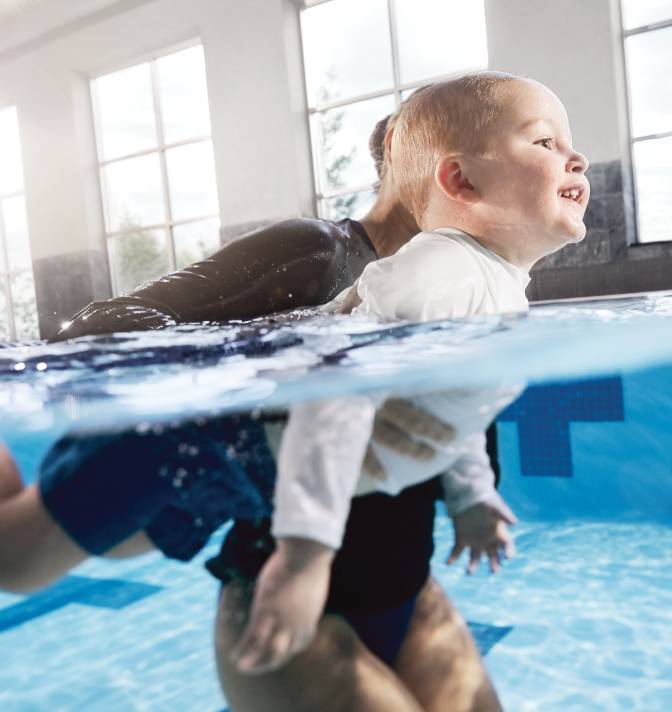
But starting swim lessons early isn’t only about early independence in the water; it’s also about early water comfort. “At this stage, infants are highly receptive to new environments, making it an ideal time to introduce water in a safe, supported way,” Kaufman says. “Rather than teaching formal skills, these lessons focus on comfort, trust, and gentle exposure.”
Beginning lessons at an earlier age and focusing on water comfort also makes the process of becoming a confident swimmer more streamlined, he adds. “When water is introduced as a calm, positive environment, children are more likely to develop confidence instead of fear as they grow. This foundation often leads to smoother progression when formal swim skills are introduced later.
“I have students who started taking lessons with me at about 10 months old and now at 5 years old, they’re swimming on their neighborhood swim team and passing the Life Time swim test,” says Kaufman. “The swim test is required in order for children under 12 years old to be more than 10 feet from their adult caregiver; to pass, they need to safely swim 25 meters without assistance. Kids who start swim lessons later, at 3 to 5 years old for instance, may not be at that point until 7 or 8 years old, because it can take longer for them to develop a comfort level in and around water.”
At Life Time, each swim class level involves a set number of skills, and kids can progress to the next level once they’ve mastered all the skills in their current class. “There are multiple age groups for each level,” notes Kaufman. “Splash is for ages 3 months to 2 years old; Ripple is for 3 to 5 years old; Wave is for 6 to 8 years old; and Surf is for 9 to 13 years old.”
| Lesson Level | Age Group | Skills | Progression |
| Intro to Splash | Less than 2 years old | Water comfort | Building water comfort. |
| 101 | Splash, Ripple | Developing water comfort; learning to do skills such as floating and kicking while assisted.
Safety skill: Jumping in and turning back to the wall.
|
Building water comfort first, then developing assisted skills. |
| 201 | Ripple, Wave, Surf | Learning skills such as floating, kicking, elementary backstroke, and paddles in the front 4 yards of the pool.
Safety skill: Bobs. |
Transitioning from doing the skills with support to doing the skills independently.
First floating, then gliding and kicking independently, before layering in the arms and foundational breathing techniques. |
| 301 | Ripple, Wave, Surf | Advancing the foundational skills into streamline kicks, freestyle and backstroke, and starting breaststroke kicks and butterfly kicks.
Safety skill: Jumping and swimming 4 yards in the front area of the pool without goggles.
|
Continuing to layer in the skills to advance their technicality and increase the swimming distance.
At the end, students will be able to do freestyle and backstroke for 7 yards. |
| 401 | Ripple, Wave, Surf | Freestyle progresses to rotary breathing; backstroke is smoothed out; the full breaststroke form is learned; the butterfly arms are learned.
Safety skill: Treading water for 30 seconds.
|
Technicality and distances are increased. At the end, they will be able to swim freestyle for 15 yards, backstroke for 15 yards, and breaststroke for 7 yards.
|
| 501 | Wave, Surf | Freestyle and backstroke continue to be smoothed out, breaststroke is advanced, and the full butterfly form is learned.
Safety skill: Treading water for 60 seconds.
|
Technicality and distances are increased. At the end, they will be able to swim freestyle for 25 yards, backstroke for 25 yards, breaststroke for 15 yards, and butterfly for 15 yards. |
| 601 | Wave, Surf | Everything is being smoothed out, swimming distance is increased, and turns are learned.
Safety skill: Swimming 25 yards, fully clothed.
|
Technicality and distances are increased. At the end, they will be able to swim freestyle for 50 yards, backstroke for 50 yards, breaststroke for 25 yards, and butterfly for 25 yards.
|
“The first priority the Life Time Swim instructors have with the students in the 101 level is helping them develop their water comfort,” Kaufman says. “The students are putting their faces in the water and blowing bubbles.
“At the 201 level, that’s where children start to swim independently,” he says. “Then in the 301 level, we progress the technicality: We’re going to layer in skills such as body position, kicking with the legs, and strokes with the arms, and then breathing. At this level, we want them to be able to stay on top of the water and connect that movement with effective breathing.
“Then we’re progressing to freestyle and backstroke; we’re layering these skills in, but it’s not like we’re throwing 37 different skills at them at once,” he explains. “Once they complete all the skills in one level, we’re able to seamlessly move them from one level to the next level.” (Learn more: “Everything You Need to Know About Life Time Swim Lessons.”)
Kaufman recommends a cadence of two times in the water per week for children. “One swim lesson and one family swim session are great for kids just starting out in the water,” he says. “I generally don’t recommend more than two lessons a week as more can tire kids out too much or create an aversion to the water.”
3 Benefits of Early Swim Lessons
Swim lessons help kids build water-safety skills, but the benefits extend far beyond that.
- Family time: “It’s an activity that allows families to bond and spend quality time making core memories by being able to spend time in the water together,” says Kaufman. “It also strengthens caregiver trust through shared, guided experiences.”
- Confidence: “It helps kids build confidence in themselves and learn how to persevere and work hard when they’re able to master a skill and progress to the next level,” he says.
- Healthy lifestyle: “It also helps instill a healthy lifestyle for the child by supporting coordination and movement in a low-impact setting,” he adds.
It’s also never too late to start swim lessons. “I know instructors who teach 80-year-olds,” says Kaufman. “I recently taught a 42-year-old man how to swim, and he loved it so much he got his 70-year-old father to sign up for lessons with me. Being a confident swimmer in the water can lead to core memories that will always be cherished.”
Life Time Swim lessons are organized both by age and skill level, he notes. “Your child will be with other kids roughly the same age and skill level, so a 12-year-old is not going to be in the same class as a 3-year-old.”
This helps make the kids feel more comfortable during the learning process, he adds. “The instructor differentiates their approach to really connect with the kids in that age group, and they then focus on that individual progression, because we’re not teaching cookie-cutter; we’re going to tailor what we’re doing inside of our methodology to meet the needs of each individual.”
Everything taught in a Life Time Swim lesson is also rooted in safety. “Our group lessons have very strict kid-to-instructor ratios,” he says. In the 101- and 201-levels, there aren’t more than three kids in class, and even at the more advanced 501- and 601-levels, there aren’t more than five or six kids.
“This also helps to prioritize engagement with the students, because engaged swimmers learn best,” says Kaufman. “A key part of encouraging engagement with the swimmers is also interweaving fun. One of the biggest aspects of bringing that fun is the relational element. Your kid will have the same instructor every week, and so they’re able to build that relationship. We want it to be a fun experience, and we want it to be positive.”