




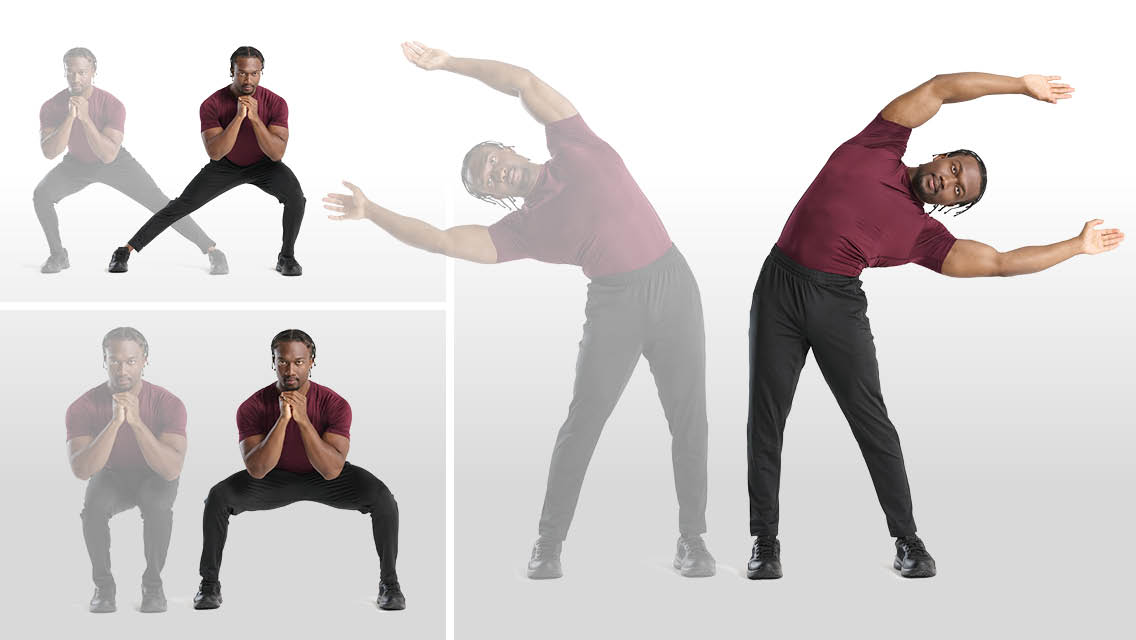
Gym staples like squats, pushups, and lunges are powerful compound exercises that build full-body strength — but did you know they’re not quite as full body as they could be? That’s because these and many other common exercises move the body through the sagittal, or longitudinal, plane. Sagittal-plane exercises take you forward and backward, but you can also move side to side (through the frontal plane) and in a rotational arc (through the transverse plane).
Triplanar exercises — that is, moves that cross all three planes — can help shore up imbalances and build what functional-movement specialist Gary Gray, PT, FAFS, calls “three-dimensional strength.”
“We live in three-dimensional space, and we ourselves are three-dimensional, so it makes sense to exercise in 3D,” says Gray, founder of the Gray Institute in Adrian, Mich.
3D training has existed for centuries — tai chi is a perfect example — but Gray notes that modern fitness programs have drifted away from the multiplanar approach.
Instead of moving the body in every direction, the typical workout isolates joints with movements through limited ranges of motion. And even when compound, multijoint exercises are programmed, people often forgo multiplanar variations for conventional ones.
Returning to a 3D training approach can improve your movement quality in sports and daily life, says Gray. He also notes that 3D training tends to be more efficient than conventional strength training because it targets more muscle groups and joints at once. Often, that means 3D strength workouts can require fewer moves — and less time — than what many gym-goers expect.
“If your goal is to move better, enjoy life more, and be more effective and efficient with your training,” he says, “the strategy should be to move in 3D.”
The Workout
For a full-body routine, Gray recommends the following three — yes, three — exercises. Flow through the different components of each exercise in order, slowly and with control. Begin with five reps of each exercise flow. Gradually work up to performing 10 reps each as you build strength and improve body awareness. Perform the workout up to three times per week on nonconsecutive days.
3D Lunge Matrix
This lunge variation targets all the major muscles in the lower body: the quadriceps, hamstrings, glutes, and calves.
Perform five to 10 reps
Directions
Part 1:
- Stand with your feet about hip width apart.
- Step your right foot forward and lower into a forward lunge.
- Reverse the movement by pressing through your heel and stepping your right foot back to the starting position.
- Repeat with the left foot.
- Then step your right foot backward and lower into a reverse lunge.
- Reverse the movement by stepping your right foot back to the starting position.
- Repeat with the left foot.
Part 2:
- Next, step out to the right and lower into a side lunge.
- Reverse the movement by stepping your right foot back to the starting position.
- Repeat with the left foot.
- Then step your right foot behind the left into a curtsy lunge.
- Reverse the movement by stepping your right foot back to the starting position.
- Repeat with the left foot.
Part 3:
- Next, open your hips and rotate your body to the right as you take a large step back with your right foot. Allow the right knee to bend.
- Reverse the movement by stepping your right foot back to the starting position.
- Repeat with the left foot.
- Then step your right foot forward and diagonally across the front of your torso; allow both knees to bend.
- Reverse the movement by stepping your right foot back to the starting position.
- Repeat with the left foot.
3D Handswings
This upper-body exercise works the shoulders, latissimus dorsi, rhomboids, and trapezius in every direction.
Perform five to 10 reps
Directions
Part 1:
- Standing tall, extend both arms out in front of your chest, palms facing each other. This is the starting position.
- Keeping your arms straight, lift them overhead, and then lean back as far as you’re comfortably able.
- Return your arms to the starting position.
- Then bend at the hips to swing both arms toward the floor; allow your hands to sweep along the outside of your legs and behind you.
- Return your arms to the starting position.
Part 2
- Lift your arms overhead, palms facing forward. Lean your hips to the left and bring your arms to the right; then repeat on the other side.
Part 3:
- Return your arms to the starting position; then turn your palms so they’re facing down.
- Rotate at the hips to swing your arms to the right and behind you; repeat on the other side.
Tip: To increase the challenge, hold a light dumbbell in each hand, or hold a medicine ball.
3D Squats
This squat variation emphasizes every muscle in the lower body, with the focus shifting depending on the position of your feet.
Perform five to 10 reps
Directions
Part 1:
- Stand with your feet about shoulder width apart, toes pointed forward. Brace your core. This is your starting position.
- Bend your knees and hips to squat down until your thighs are about parallel to the ground.
- Press through your feet to stand up.
- Step your right foot slightly forward and squat down. Stand up, then return your right foot to the starting position. Repeat with your left foot.
Part 2:
- Bring your feet narrower than hip width apart. Squat down. Press through your feet to stand up.
- Step your feet wider than shoulder width apart. Squat down. Press through your feet to stand up.
Part 3:
- Return your feet to the starting position, but rotate your toes inward. Squat down. Press through your feet to stand up.
- Rotate your toes outward. Squat down. Press through your feet to stand up.
This article originally appeared as “Train in 3-D” in the November/December issue of Experience Life. Photographer: Kelly Loverud; Styling: Pam Brand; Model: Nehemiah Owusu.



This Post Has 0 Comments