


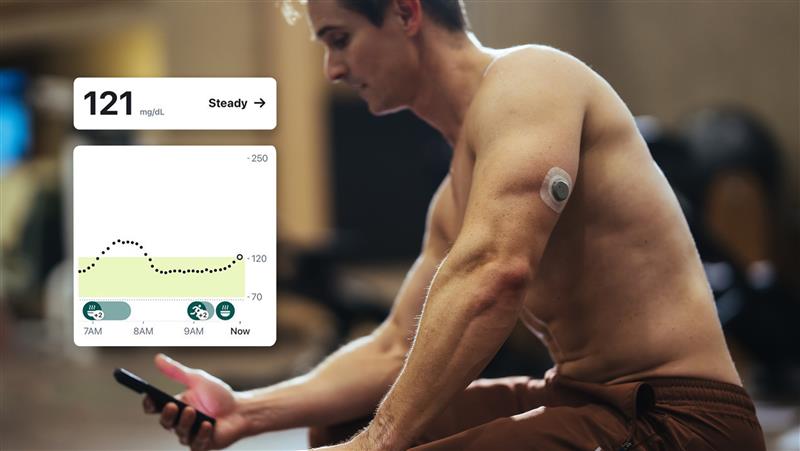
You track your macros. You count your reps. You monitor your fitness progress. But what if you could go one step further and see how your body is responding to your meals and activities 24/7?
Harness the power of your glucose data
With the Stelo Glucose Biosensor, you can get a behind-the-scenes look at how food choices, workouts, sleep, and even stress impact your glucose levels. Having that visibility—along with personalized insights about your glucose trends and patterns in the Stelo app—gives you the power to make nutrition and training adjustments that work specifically for you.
When you use Stelo to understand your glucose patterns, you get the insights you need to gain a serious edge in optimizing your performance and recovery.1 Let’s explore how understanding those patterns can help you fine-tune your health-and-fitness routine.
Wearing Stelo can help provide insights into how to fuel your workouts for optimal performance.
What is a glucose graph?
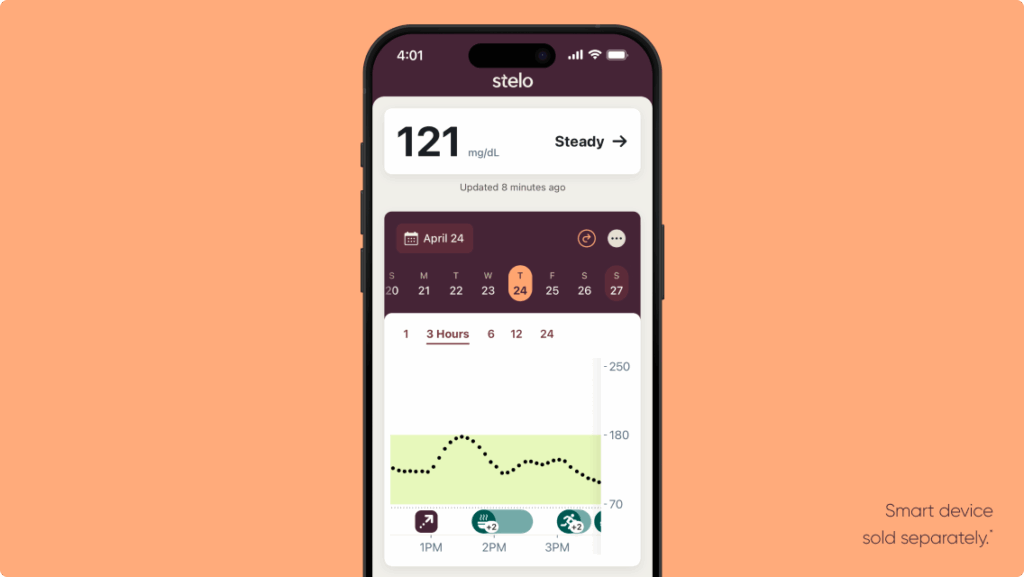
Think of it as your personal health map. Found in the “Glucose” tab of the Stelo app, it’s a visual representation of how your glucose rises and falls throughout the day. Your glucose graph shows
how your body reacts to meals, movement, and more. It also shows customizable target ranges to help keep you in the optimal zone—whatever your training plan or exercise routine.
Spot the patterns, fine-tune your routine
When you start tracking your glucose with Stelo, you’ll start to connect the dots between how you feel and what your body is doing. Pretty soon, it will begin to reveal patterns across all phases of your training, helping you gain more visibility into what your body is doing so you can fine-tune your routine.
Here are a few patterns to look out for outside of training or exercise:
- Morning highs: A spike in glucose levels after waking up, before you eat (this is called your “fasting glucose” level)
- Post-meal spikes: Spikes usually occur 1-2 hours after you start eating and can last from a few minutes to several hours. The duration and intensity can differ from person to person, and even from meal to meal.
- Nighttime lows: Drops during sleep can be caused by factors such as physical activity, medications, or meal timing and choices during the day
Understanding how your body responds to different times of day, habits, and behaviors can offer valuable insights for fueling your body. This knowledge can help you feel better, train more effectively, and enhance your recovery efficiency.
Your data = your power
 Your glucose graph isn’t just about numbers—it’s about understanding how your habits shape your health. While trends give you a snapshot of your daily rhythm, patterns reveal the bigger picture. By looking at data over time, you can spot recurring issues and celebrate progress.
For example, do you consistently receive spike notifications? That could mean it’s time to experiment with portion sizes, balance carbs with protein and fats, or adjust your meal timing. Are your fasting levels creeping up? This may be a signal to make some lifestyle adjustments. Consider evaluating what you are eating before bed and how it might be affecting your blood sugar levels.
It’s also a good idea to assess your sleep hygiene. Are you getting enough restful sleep? Incorporating more physical activity into your routine and making healthier food choices can also help manage your fasting levels effectively.
Two easy ways to use your glucose graph:
To better understand your glucose levels, you can use different approaches at different times:
1) Observe your glucose curve
WHEN: At any time, when you want to reflect or look for a pattern
HOW: Use the 24-hour or daily view to zoom out and see multiple data points at once. Look for patterns such as steep peaks, valleys, or smooth waves. Smooth waves indicate steady glucose levels, while steep peaks or deep valleys suggest fluctuations that could impact your energy. These fluctuations may signal the need for adjustments in your food choices, exercise, or even the need for a different recovery plan.
2) Note key events
WHEN: In the moment or after receiving a nudge or spike detection
HOW: Use the Add Event feature in the Stelo app to log specific events like meals, workouts, or stressful moments. You can also connect the app with Apple Health or Google Health Connect so you can view your activity, exercise, and sleep data automatically. By reflecting on these smaller sets of data points, you can start to see how these events affect your glucose levels so you can make necessary adjustments.
Following the approaches above can reinforce positive behaviors by providing immediate feedback and insights into how your actions impact your glucose levels. For example, observing a smoother glucose curve after making dietary changes or incorporating physical activity can motivate you to continue those healthy habits. Similarly, noting key events and reflecting on them can help you identify and replicate behaviors that lead to better glucose control.
All in all, tracking your glucose with Stelo can unlock powerful insights about how food and exercise choices affect your glucose response, helping you enhance your performance and recovery.2 From optimizing your meals and workouts to improving your recovery, understanding your glucose patterns helps you take control of your health and fitness in a smarter, more personalized way.
*For Stelo app compatibility information, visit stelo.com/compatibility.
Resources:
1 Bowler A-LM, et al. Int J Sport Nutr Exerc Metab. 2023;33(2):121-132. 2 Cox DJ, et al. J Endocr Soc. 2020;4(11):bvaa118. 3 Holzer R, et al. Sensors. 2022;22(5):2030.
Disclaimers:
STELO IMPORTANT INFORMATION: Consult your healthcare provider before making any medication adjustments based on your sensor readings and do not take any other medical action based on your sensor readings without consulting your healthcare provider. Do not use if you have problematic hypoglycemia. Failure to use Stelo and its components according to the instructions for use provided and to properly consider all indications, contraindications, warnings, and cautions in those instructions for use may result in you missing a severe hypoglycemia (low blood glucose) or hyperglycemia (high blood glucose) occurrence. If your sensor readings are not consistent with your symptoms, a blood glucose meter may be an option as needed and consult your healthcare provider. Seek medical advice and attention when appropriate, including before making any medication adjustments and/or for any medical emergency.
INDICATIONS FOR USE: The Stelo Glucose Biosensor System is an over-the-counter (OTC) integrated Continuous Glucose Monitor (iCGM) intended to continuously measure, record, analyze, and display glucose values in people 18 years and older not on insulin. The Stelo Glucose Biosensor System helps to detect normal (euglycemic) and low or high (dysglycemic) glucose levels. The Stelo Glucose Biosensor System may also help the user better understand how lifestyle and behavior modification, including diet and exercise, impact glucose excursion. The user is not intended to take medical action based on the device output without consultation with a qualified healthcare professional.
Dexcom, Dexcom Clarity, Dexcom Follow, Dexcom One, Dexcom Share, Stelo, any related logos and design marks are either registered trademarks or trademarks of Dexcom, Inc. in the United States and/or other countries. ©2025 Dexcom, Inc. All rights reserved. MAT- 9143