


Insights for Living a Pain-Free Life
Expert insights and guidance for those with chronic pain and for those looking to reduce their chances of it in the future.


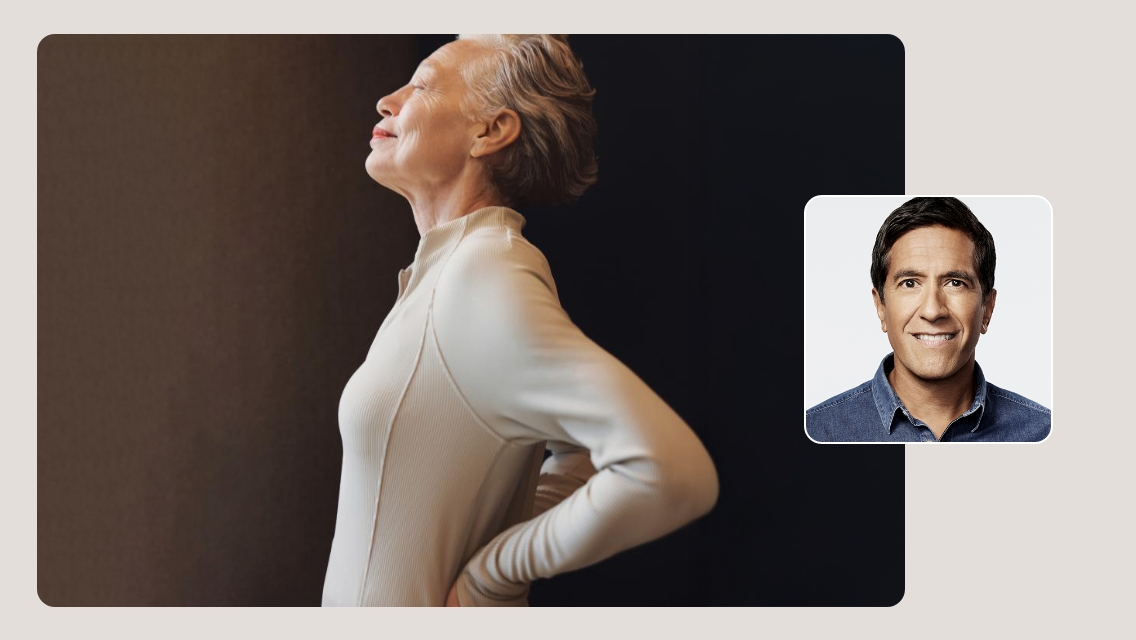


More than 50 million people experience chronic pain in their day-to-day life. In this episode, we’re speaking with Sanjay Gupta, MD, about his latest book, It Doesn’t Have to Hurt: Your Smart Guide to a Pain-Free Life, which features a wealth of science-backed strategies that address this topic. He offers knowledge and guidance for those with chronic pain, as well as those looking to reduce their chances of it in the future.
Sanjay Gupta, MD, is the multiple Emmy® Award-winning chief medical correspondent for CNN and host of the CNN podcast Chasing Life. A practicing neurosurgeon, Gupta plays an integral role in CNN’s reporting on health and medical news for all of CNN’s shows domestically and internationally, and regularly contributes to CNN Digital.
Since 2001, Gupta has covered some of the most important health stories in the United States and around the world. On March 9, 2020, Gupta penned an op-ed announcing the network would refer to the novel coronavirus outbreak as a “pandemic,” ahead of the WHO and the CDC. Throughout 2020 into 2021, Gupta reaffirmed his role as a trusted guide to viewers worldwide on navigating between facts and fiction surrounding COVID-19 and the pandemic.
In addition to his work for CNN, Gupta is an associate professor of neurosurgery at Emory University Hospital and associate chief of neurosurgery at Grady Memorial Hospital in Atlanta. He serves as a diplomat of the American Board of Neurosurgery. And in 2019, Gupta was elected to the National Academy of Medicine, considered one of the highest honors in the medical field.
His latest book, It Doesn’t Have to Hurt: Your Smart Guide to a Pain-Free Life, published in September 2025, is a New York Times bestseller.
In this episode, Dr. Gupta shares numerous learnings about the prevalence of chronic pain, as well as approaches for both preventing and treating it. Insights include the following:
- Chronic pain is the fastest-growing chronic condition in the United States, surpassing cancer, dementia, and diabetes.
- Pain is defined as “chronic” if it lasts for three months or longer.
- The evolutionary purpose of pain is to serve as a signal aiming to teach your body not to do something again. For example, if you touch a hot pan, your hand hurts, but then the pain goes away and you’ve learned the lesson not to touch a hot pan. When pain lasts longer, experts think of it as an entirely different entity — it’s chronic instead of acute.
- Of the 50 million people who have chronic pain, about 20 percent of them experience high-impact pain, meaning that pain has changed the way they live their lives.
- Chronic pain can hijack your identity, says Gupta. After spending a few years interacting with pain patients, he witnessed firsthand how it takes over their conversations and can change their physical appearance and the way they physically move.
- There is no human population that is immune from chronic pain — it affects people in all countries. But the way we’ve approached it in the United States has been vastly different than other countries around the world.
- Chronic pain is a condition in and of itself, not to be viewed simply as — or only as — a symptom. It may exist for a reason, but that doesn’t change the fact that it’s a condition in and of itself.
- Gupta recalls a striking comment that a Mayo Clinic physician made to him when he visited the pain clinic there: “Pain never occurs in isolation. It always comes with baggage attached.” Acknowledging pain is generated in the brain does not mean that “it’s all in your head” or that it’s “made up”; rather it’s recognizing the vast majority of people with chronic pain do have other things attached to it, such as depression, anxiety, psychic pain, or mental health issues.
- For so long, chronic pain has been treated like acute pain — you’re prescribed a pain pill or advised for a procedure, for example. Treating the pain in those ways could be the right answer, but it’s an incomplete treatment if you’re not also addressing the baggage and the brain-body connection, believes Gupta.
- Lower-back pain, hip pain, migraines, fibromyalgia, and joint pain tend to be the most common chronic pain conditions.
- In a 2022 survey from the U.S. Pain Foundation, only 35 percent of respondents said their pain was a direct result of trauma or injury. The other two-thirds of people can’t point to what initiated their pain, which makes it mysterious, but no less real.
- Moving your body essentially sends signals to your brain and body that you want to be here as a functioning human being, explains Gupta; it creates brain-derived neurotrophic factor (BDNF). If you’re sitting for long times and not moving, it’s like you’re lowering your peripheral defense systems. In situations of injury — not if something’s broken or torn, but other types of injury — early movement mobilization is becoming a more prominent approach. Rather than RICE (rest, ice, compression, elevation), the approach is shifting to MEAT (mobilization, exercise, analgesia, treatment).
Transcript: Insights for Living a Pain-Free Life
David Freeman
Welcome back to another episode of Life Time Talks. I’m David Freeman.
Jamie Martin
And I’m Jamie Martin.
David Freeman
In today’s episode, the topic we’re gonna be hitting on is It Doesn’t Have to Hurt Your Smart Guide to a Pain-Free Life. So you know that more than 50 million people experience chronic pain in their day-to-day life. In this episode, we’re speaking with an expert whose latest book features a wealth of science-backed strategies that address this topic and serves as a resource for those with chronic pain or for those who are looking to reduce their chances of it in the future. Who we got today with us, Jamie?
Jamie Martin
Well, we’re really excited to have Dr. Sanjay Gupta back with us again. He was with us last season and we were talking about AI and healthcare. I’m really excited to really focus on your new book. Sanjay Gupta is the multi Emmy award winning chief medical correspondent for CNN and host of the CNN podcast, Chasing Life. He’s a practicing neurosurgeon and he plays an integral role in CNN’s reporting on health and medical news for all of CNN shows domestically and internationally and regularly contributes to CNN digital.
Since 2001, Dr. Gupta has covered some of the most important health stories in the United States and around the world. In addition to his work for CNN, Dr. Gupta is an associate professor of neurosurgery at Emory University Hospital and associate chief of neurosurgery at Grady Memorial Hospital in Atlanta, where he also serves as a diplomat of the American Board of Neurosurgery. And in 2019, Gupta was elected to the National Academy of Medicine, considered one of the highest honors in the medical field.
and we are talking about your latest book, Dr. Gupta. Thank you so much for being back with us.
Sanjay Gupta
What an honor to be back. And by the way, I think I’m about to shorten my bio a little bit. My mom loves hearing this stuff, but I don’t think anybody else does anymore.
Jamie Martin
I tightened up a couple little things in there as we were getting started.
Sanjay Gupta
Thank you. Thanks for having me back. I really enjoyed our last conversation and really appreciate the chance to do the deep dives.
David Freeman
Yeah. So happy to have you back. So I mean, let’s, let’s, let’s just start it off. I think all of our listeners we’ve, we’ve heard of different styles of pain. Like I’m in distress pain. I’m in this type of pain, but there’s a, these two pains that we want to bring up as far as the difference between acute pain and chronic pain. How would you break that down for our listeners?
Sanjay Gupta
Well, I think sort of strictly defining it, chronic pain is something that lasts three months or longer. It’s a little bit of an arbitrary thing. And I think for a lot of people who suffer from chronic pain, and it can last decades, it comes to sort of define their lives at some point. But from a strict sort of definition standpoint, it’s three months or longer. And I think where that comes from is if you think about typical injuries and the way the body sort of responds to injuries, pain is a signal to basically tell you not to do something again. And once you’ve learned that lesson from that signal, the pain should go away. That was sort of the evolutionary purpose of pain. So when it lasts longer than that time period, that’s when we start to think about it as an almost entirely different entity, chronic instead of acute.
Jamie Martin
How is high impact pain, which is something that you talk about, is that different than acute pain or chronic pain?
Sanjay Gupta
Yeah, so, you know, as was just mentioned, you know, 50 million people have chronic pain, but about maybe 20% of them have this high impact pain, which, again, they have these strict definitions, but I’m always a little hesitant to be too didactic about it because it’s such a personal experience. But it’s basically pain that has changed the way you live your life. People will switch jobs because of their pain. They may not have jobs because of their pain. They can’t travel the way that they used to. They can’t wake up in the morning the way that they used to. They have to take certain medications or do something. High impact pain is pain that has a tangible impact on your activities of daily living. So your life is fundamentally different as a result of that pain.
Jamie Martin
And you’re saying like nearly 20% of people are kind of describing it as that nearly one quarter of adults say they suffer from chronic pain in general. So this is a widespread issue. Can you just speak to that? when they’re talking about what that is and how it’s affecting their life, you said mentioned switching jobs, what other impacts might it have on quality of life?
Sanjay Gupta
It hijacks your entire identity, to be honest. I don’t want to overstate this, but I think, you know, when you spend a few years talking to pain patients and really understanding their lives and, you know, spending real time with them, including, you know, even members of my own family, what you’re seeing is that it’s the first thing you talk about when you have a phone conversation with somebody.
It’s the bulk of the conversation that takes place every time you’re sort of interacting with somebody. They’re defined by it. I mean, you can walk by somebody who has diabetes or heart disease on the street and maybe have no idea. But when someone is dealing with high impact pain, it changes the way they physically look, the way that they physically move, you know, all these things. What I think is sort of very interesting specifically about chronic pain in the United States is that, it is now the fastest growing chronic condition in the country. So faster than cancer and dementia and diabetes. And I think a lot of people, they still don’t think of chronic pain that way. They think of something, this is sort of an inevitable preordained thing.
Just, you I’m one of those unfortunate people who has developed this, not realizing that it’s growing so fast among, you know, their neighbors and friends, but also that the United States, even though chronic pain is something that affects all countries, there’s no human population that’s immune from this. The way that we have sort of approached it in the United States has been wildly different, I think, than other countries around the world.
Jamie Martin
Well, and David, if I could just jump in for one second, because it’s really interesting you say that. I think people often think of pain as a symptom of other conditions and not as a condition itself. So that’s like to hear it described as such and know that that’s fast, it’s growing is really interesting.
Sanjay Gupta
Yeah. I mean, if you ask yourself a basic question, why should pain persist for that long? What evolutionary purpose does it serve? If you touch a hot pan and your hand hurts, you’ve learned a lesson. Don’t touch a hot pan. know, don’t interact with a tiger with sharp teeth. Don’t step on a Lego. Whatever it might be, those are lessons. Pain, you know, at a very conceptual level is a signal that should trigger you to behave differently in some way.
But then why does it persist? That is sort of the question. I think that’s where we get at this idea that in many ways chronic pain is a condition in and of itself. Maybe there’s something that’s still driving it. Maybe that chronic pain exists for a reason and we just haven’t figured it out yet. But it doesn’t change the fact that it’s a condition in and of itself. It’s growing really quickly. And the United States has, in the United States we have a particular disdain for it.
We just don’t tolerate pain at all in the United States. We don’t accept it as part of sort of the normal human experiences as well as other countries do.
David Freeman
Yeah, and I get the opportunity to work with so many different individuals day in and day out around health and fitness. And so many of them come with pain issues that they’re walking into the classes with. And so when we look at chronic pain, whether I’m working with youth or I’m working with adults, I always ask the question because I always want to get better within this space, how we can be proactive before it gets to that point, before it starts to become chronic. And then for those who are listening, like we said, 50 million individuals that are already in the thick of it, how do we now somewhat I don’t say reactive, but how we can now help support them in their current situation. So two part question here, how can we be proactive for those in this space right now? And then the second part of that question would be for those currently going through it, what are some certain things that we can do to help support them?
Sanjay Gupta
Yeah, I mean, this is the crux of the whole thing, David, I think, in some ways. And I would preface by saying, even though they both have pain in the description, acute pain and chronic pain are fundamentally very different entities. So, you know, you can use that three-month sort of benchmark as a way of delineating that. So, you know, asking that, how long has this, how long have you had this? You know, people get injured, they may have pain for a period of time. That does happen.
That happens to me, I’m sure it’s happened to you. But once you get to that, you know, 12 week, three month mark, I think the thing that struck me when I was working on the book, it gets to this proactive part, is a comment that was made to me by this Mayo Clinic physician when I went to visit the pain clinic there. And he said, chronic pain never occurs in isolation. It always comes with baggage attached.
Now, saying that triggers some people because I think the interpretation is that, you’re saying that it’s made up, that it’s all in my head and that sort of thing. And by saying pain is generated in the brain does not mean it’s on your head. But what we do know is that a lot of, vast majority of people with chronic pain do have other things attached to it, such as depression, anxiety, mental health issues, psychic pain. And what has happened, I think, for so long is that chronic pain has been treated like acute pain. despite the fact that you’ve had this for a year, we’re going to throw an opioid at it, or we’re going to perform a procedure on it, or do whatever, which may be the right answer. I’m not saying that treating the pain is not the right answer. What I’m saying is that it’s been an incomplete treatment because you haven’t addressed the baggage. And it’s provocative.
I will tell you, I’m not the first person to say this. Other people have written about this idea of psychosomatic, the brain-body connection. But I will tell you when it comes to these pains, whether it be emotional pain, whether it be psychic pain, existential pain, physical pain, the brain doesn’t distinguish between those two. They did these fascinating studies where they would do these MRI scans on people who had these different types of pain.
And within the brain, there was this gigantic overlap. So the brain is sort of looking at it the same. The pain of loneliness, for example, it’s physical pain in the brain, if you sort of want to describe it that way. But I think that that’s the proactive part. It’s asking the next question. Pain doctors who are saints on earth, if you ask me, because they’re taking care of very challenging situations, they, I think their secret sauce is they ask that next question, which is what else is going on in your life. And they stay on it because oftentimes the first response patients will give, no, no, no, this is it, just my lower back hurts. That’s it, I just have hip pain. But then to drill down and drill down and make sure, yeah, we’ll take care of your lower back pain and your head pain, but understand this, that it’s never gonna go away unless we also adjust the other things.
David Freeman
I just, then, mean, let’s go ahead and tee that up, because you just said something that made me think of what is the most common chronic pain? Is it lower back? I hear that a lot, but what is the most common chronic pain conditions that you hear?
Sanjay Gupta
The most common, yeah, lower back, hip pain, migraines, fibromyalgia — those are sort of the broad categories. Orthopedic, joint pain, you know, and interestingly, but perhaps not surprisingly, if you look at other countries around the world, it’s similar. It’s, you know, there are these similar sorts of pain conditions and even in the rank order that I’m sort of talking about that exist in most countries around the world.
I think what is different in the United States is not a pain as much as it is what we do about it here. That’s been sort of a headline, I think, over the last 25 years with the opioid epidemic and the overutilization of procedures and all that sort of stuff.
Jamie Martin
Yeah. Well, and even just kind of delving into what you’ve been saying. So we’re talking like there it’s presenting chronic pain condition as low back pain and all these things, but there’s a site that are a study that you cite in your book from a 2022 survey from the US Pain Foundation. That’s like something like only 35% of respondents said their pain was a direct result of trauma or injury. Yes. So then, but then it’s still there. so no citing no obvious cases, like how do you do? Like what do you do about that? Yeah.
Sanjay Gupta
Yeah. Now that surprised me as well. I did not expect that even as a physician who treats pain, I think we always sort of are under this assumption like what started this? What’s the initial cause of this? Expecting an answer, you I fell down stairs, I got in a car accident, whatever. And as you point out, know, two thirds of people, they can’t point to anything. And it’s mysterious, to be honest. It makes it no less real, though.
Which I think is the headline for a lot of the pain doctors. don’t say, well, look, because we haven’t found an obvious cause, your pain isn’t real. I think too often that happens in society, but that’s not how pain doctors are approaching. There’s this great book that I read and sort of cited a few times in my book called The Body Keeps the Score. I don’t know if you heard this, but it’s written by Bessel van der Kolk and he’s a psychiatrist.
But he, what he fundamentally saying is, look, maybe you had something happen to you in your life. Maybe it was an adverse childhood experience. Maybe it was a really tough emotional time in your life, whatever. And if you were to talk about it now, you’d say, yeah, that was in the past. ⁓ I’m over that. That’s not even something I think about anymore. But you know what? The body keeps the score. So that lower back pain that you’re having, even though you’re not consciously thinking about these experiences that you’ve had in your life before, your body is still remembering it in a way. And it fundamentally, think for Bessel and other pain, people who focus on pain, it gets at this idea that we have to address these other things.
We have to take a much more holistic approach to pain. And for a quarter century, we’ve been doing the opposite, giving a monotherapy, usually in the form of opioids, for everything. And we’ve seen where that’s landed us. It hasn’t worked. You know, we still have as much pain as we’ve had before on top of the addiction and overdose deaths and all the other terrible consequences of that.
Jamie Martin
And it’s still growing to your point, right? If this is becoming the fastest growing condition.
Sanjay Gupta
Can I just, you know, maybe you guys know the statistic, but I want to share with you again that, you know, we’re not even 5% of the world’s population in the United States. And at one point we were taking 80 to 90% of the world’s opioids. It’s just, it’s mind numbing to some extent. And as you point out, Jamie, what did we get in return for that? We’ve got a lot of death and destruction and I don’t want to sound hyperbolic, but that is true. A lot of people died for that and we’re no better in terms of our overall pain.
I’m older than you guys. So I’ve had a colonoscopy. don’t know if you guys had a colonoscopy, but when I did, you got propofol. Propofol is a medication to essentially, you know, making not remember and take away any sort of recollection of the event. It’s given to everybody in the United States who gets a colonoscopy. Not in Japan. Nobody gets propofol when they get a colonoscopy. In Finland, it’s 6% of people who get colonoscopies get, get purple fall. My point being we’re so accustomed to just throwing a procedure or a pill at pain problems that we’ve way overdone it and we, we, we, and we’re no better for it.
Jamie Martin
I mean, I just kind of want to delve into that a little bit, because like, what is behind that? Like, how can there be such a drastic difference if 100% of US patients who get a colonoscopy are getting propofol and 6% in fill-in and maybe lower in Japan? is it the pharmaceutical industry? Like, what is behind it? I mean, I don’t want to get too like into the weeds with that, but I think there is a question there.
Sanjay Gupta
I think there is and, you know, like with a lot of these things, it’s as we say in medicine, multi-factorial. There’s many things at play. But I think a big one is exactly what you said. I mean, I was training, you know, in the late 90s in neurosurgery. I think there was this sense that, look, here’s something that we can make sure we can do for our patients. We can control their pain. Patients should not have pain. Pain is not, it’s not something, it’s unpleasant.
Why should anyone suffer with that? And, you know, it became, as you may have heard, the fifth vital sign. So you check someone’s respiration and their heart rate and their temperature, and you’d also ask them about pain. became that fundamental. And as a result, I think a lot of opioid prescriptions were written, you know, in response to that. So I do think the pharmaceutical industry was driving that. It was a huge profit generator, obviously.
And the United States was a pretty right market for that because 80 to 90% again of the world’s opioids were being consumed in a very, very small place on the planet population wise. So I think that’s a big part of it. But I think then culturally it becomes a thing. Like why should you have pain? Do you think of pain as a normal part of the human experience or do you think it’s something to be vanquished with pills and procedures at every turn? That is still something that I think we wrestle with as a country.
Jamie Martin
For sure.
David Freeman
Yeah, you touched on this a little bit earlier is talking about how chronic pain doesn’t just affect us physically. And I can speak from personal experience of just understanding almost what we would call like in the prime of our fitness when competing and whatnot. And more recently, I’m 42, just to give you a reference point. More recently, when there’s these events or competitions, my limitations because of my back pain or my hip.
It does go back to what you were talking about, like this identity of what you were associated with early on around your, I guess, your health profile and physical career within the space. But it affects you socially. It affects you emotionally too, because you want to be able to compete, maybe not at the same level you were doing it in your early thirties, but at the same space that makes you feel like you’re part of that environment and that group. So when we talk about how that just not affecting us physically,
Can you speak a little bit of how it affects us as well socially and emotionally?
Sanjay Gupta
Yeah, I mean, I think first of all, again, the brain doesn’t distinguish this. So this becomes sort of a ⁓ self-perpetuating problem. You have some physical pain, maybe you feel like it’s limiting you, that’s affecting you socially or emotionally, you’re starting to have some sense of your mortality. Maybe as a result, that’s painful. And because the brain doesn’t distinguish, it just amplifies the chronic pain. So something that may have otherwise been you know, painful, but not something that’s that limiting because of how your brain is sort of thinking about that.
It’s amplifying it into something that’s a much bigger sort of deal than what you would think it would be. And then you go to the doctor, maybe you get a scan, and the scan doesn’t really show much. Hey, David, there’s nothing to do here. You don’t need an operation. You know, we’re not going to fix anything with an operation. And then you think, well, now this is just my life.
And this is how it’s sort of going to go for me. And that amplifies the pain even more. So, you know, I do think, and I want to be careful here because I think this idea that all pain is in the brain and that if you can address things in the brain, you can actually, the opportunity is address many of these types of pain, not just physical pain, emotional pain, psychic pain, everything by starting with the brain first.
That is a combination of therapies that involve not just pills, but you know, look, I, I’ve always been a meditator my whole life. ⁓ and, and I know that it’s good for me, but there was a study that came out while I was writing the book that said, when you meditate, you have objective changes in your brain. Now it thickens certain areas of the cortex of your brain. And some of those areas that it’s thickening are actually areas of the brain that make you more resilient towards pain. So this idea that training your brain can lessen your pain and make you more resilient against future pain, maybe people who are listening are like, whoa, that’s woo-woo sort of stuff. I get it.
But that’s why researchers have spent the last couple of decades now saying, we believe this works. Let us now collect the evidence to show that it works. And there’s tremendous evidence out there now where they have pictures of people’s brains that are changed, if that’s the kind of evidence that you want. And there are hundreds of thousands of people out there in chronic pain who have gone through these meditation protocols who’ve gotten tremendous relief, not just from physical pain, but other types of pain as well. And I find that deeply inspiring. You know, it’s interesting when you ask for evidence, you say, hey, look, prove to me that it works. And the next question is going to be how well does it work? How do you contextualize how well something works?
Well, these researchers even decided to do that. They said, let us look at these hundreds of thousands of data points and say, how well does something like meditation enhancement work with regard to pain? And what they came back with was this idea that it’s similar to five milligrams of OxyContin, five milligrams of an opioid. That’s pretty powerful, you know. By the way, neither one of those opioids or meditation are a cure.
but they both do a really good job at lessening your pain, certainly in the moment, and if you do it regularly, lessening your pain long-term.
Jamie Martin
Well, and I think kind of building on that, you talk about meditation having some kind of actual results tied to it or being able to contextualize it. There’s a lot of talk about like the role of somatic movement in your body. Like that you mentioned psychosomatic earlier, but when the body keeps the score as that book talks about, if things get stored in you, like there’s a lot of talk about how movement and shaking it out and like different things can help move things and release. What’s your, what is your take on that? As I’m shaking and moving here on camera.
Sanjay Gupta
Like look movement’s good for everything I mean movement is kind of one of these things like if you had to Describe this as a storyteller you’d say when you’re moving It’s essentially like you’re sending these signals to your brain your body. Hey, I’m here. I want to be here I want to be a functioning human being it creates more of these neurotrophic factors in your brain So you’re growing the brain cells. It’s creating more of these healing molecules
You know, when you’re sitting a long time or not moving, it’s like you’re lowering your peripheral defense systems. Basically saying, hey, I’m not moving much anymore. My time here is coming to an end. I don’t need to be here on earth that much longer. I don’t want to sound too dark, but if you look at societies that are especially long-lived societies, they’re pretty much moving all the time. They sit very little. you know, it’s the body’s response to that movement in ways.
That are I think are really important and and one of the things that really struck me I don’t know if when you’re reading the book that this struck you but but a Basic question I think for a lot of pain researchers is okay if 20 % of the population has chronic pain Who are they? Who if I do if I do the same thing to two people like bang their their thumb with a hammer Who is more likely to have chronic pain two people who sprain their ankles?
Why does for one person that pain is gone after a few days and for another person it’s still there after three months? Who are they? And one thing they found was that, and I’m going to say this twice because I found it so fascinating, if you had the lowest levels of inflammation at the time of your injury, you were more likely to have chronic pain. So the lowest levels of inflammation were more likely to lead to chronic pain.
It’s almost the exact opposite of the premise that we work under. know, whenever we have an injury, what’s the first thing we do? We try and reduce the inflammation. And again, intuitively that makes sense. My ankle hurts. There’s swelling. I want to reduce that inflammation. Not fully being aware of what is the role of that inflammation. What is that inflammation really doing? So what you’re hearing more and more from sports medicine doctors, from pain clinics, when people come in with an injury, not if something’s broken or torn. I’m not talking about those injuries, but I’m talking about the vast majority of injuries. Early movement, early mobilization is now become the mantra for most people, which is very different than it was even a decade ago.
Jamie Martin
Yep, we’ve covered that in the magazine actually, kind of, it’s because it’s flipping that whole idea of like the rice thing a little bit, right? yeah. Rice goes to meat. Yes. you hear that? Yes, and that’s exactly what we covered.
Sanjay Gupta
Ice, compression, elevation, get mobilization, exercise, analgesia, treatment, like massage treatment. Yeah, it’s really interesting. I remember seeing this even in the NDA where you have these players and they’d have an injury, again, not a torn ACL or a broken bone, but they’d have an injury and it was like you’re seeing these disparate amounts of time in terms of how long players are out. The idea that when you see them, they’re not just sitting somewhere with their ankle up, they’re actually in the gym mobilizing as quickly as possible after injury as opposed to resting. That’s a fundamental shift, I think, in how we think about gait.
Jamie Martin
Yeah, that’s super interesting. Well, and so to your point, just a quick thing on the inflammation, because I do think inflammation is fascinating right now. You’re hearing about that all over the place. But to the point of that study, so is that essentially saying, and I’m just having not seen the whole thing, like some level of inflammation is not necessarily a bad thing. Our body is responding to whatever it might be, something that might be attacking it or whatever, but you have some sort of resilience because of that? Is that what it’s essentially saying?
Sanjay Gupta
I think yeah, I think that’s what it’s saying but it’s also I think saying that these inflammatory molecules that you see as a person who suffered the injury in the form of maybe swelling or something around your ankle we just stay with the sprained ankle sort of thing those molecules are they’re doing something for you but if you let the body sort of heal the way that the body is supposed to heal it actually does a pretty good job again I’m not saying if you’ve got a broken ankle, I’m not saying you should be walking on that just to be really clear. But the vast majority of injuries, that’s not what’s leading to chronic pain. Something’s broken, you’re usually getting treatment and realigning those bones and you know, a lot of people make great recoveries after that.
I’m talking about that pain that comes from something that seems like a relatively innocuous injury, like this will go away. You know, I slipped down the stairs and nothing’s broken, but wait a second, three months later, four months later, a year later, that pain is still there. That’s the sort of pain that we’re talking about. And in the population of people that had the highest levels of inflammation at the time that that happened, like, my God, this is like really swollen and red. And perhaps counterintuitively, those people were the least likely to have chronic pain. So was bad in the beginning if the body did its job, but it sort of buffered you against longer term pain.
David Freeman
All right, I got to ask this question. Is there a difference? Because I mean, I go back and forth with my wife on this a lot. Is there a difference in pain threshold between men and women? Is it it rooted more in biology or how we condition each gender kind of to respond to the pain? Like, is there a difference there?
Sanjay Gupta
A hugely important question that doesn’t have a great answer. You know, I asked a lot of people about this, people who treat a lot of pain patients. It seems to be a little different about pain in the moment versus pain longer term. I think what, you know, the problem has been, and this is sort of a more fundamental sort of issue, I think, with women’s health overall, is that women have largely been excluded from trials on pain. And the reason being, and it’s not gonna seem like a very satisfying reason, but when you’re looking at different modalities of treating pain, the idea that a body has hormonal fluctuations made women harder to study. And as a result, people, many of these trial investigators just find it easier just to study men. So not only were they not studying women, oftentimes children weren’t being studied either. So for the same sort of thing,
Women were just basically treated as small men if you’re a man take three pills if your woman take two pills or whatever It might be and for children, know base it on their weight that sort of thing and the idea that people are physiologically different That that wasn’t really taken into account. So as a result, we don’t have answers to things like pain thresholds a good we don’t have good answers to pain thresholds and things because it hasn’t been studied in a way that’s that’s meaningful and that’s not just pain by the way, that’s most of medicine
in terms of how women have large Alzheimer’s disease. For example, women have Alzheimer’s disease at higher rates than men, and yet if you look at trials, almost all the trials are men. Like it makes no sense. And so, you know, these are important questions that you’re asking, but I would love to have great data to be able to answer that question in a really complete way, and that data just doesn’t exist.
David Freeman
So with that, mean, I know you kind of said a little bit of the why behind that. Is that going to shift now knowing the advances that we have within technology to be able to have more women in the trials?
Sanjay Gupta
Yes, I think there’s a greater awareness of this for sure in understanding that whatever reasons were limiting the inclusion of women in these trials before, you absolutely have to include everybody in these trials, gender-wise, socioeconomic-wise, especially when it comes to something like pain, because it is such a personal, intimate, mysterious sensation.
Like cholesterol, if your cholesterol is above 200 as a general rule as a human being, you’d say, well, we probably should lower that cholesterol through diet, hopefully, and then through medications. With pain, it’s fundamentally so mysterious. Some people may have higher pain thresholds. Some people may have lower pain thresholds, but their pain is their pain, and the only way you’re going to sort of get at this in a very complete way is to expand these trials.
And I also think that pain patients have increasingly been part of these committees that are overseeing how these trials are conducted. I mean, if you’ve never had pain and you’re trying to conduct a pain trial, you’re probably going to do it in a very different way than someone who lives with pain on a regular basis. Because they see things and experience things that other people don’t. They drive a car anymore. exactly.
Jamie Martin
Well, there’s a relatability there.
Sanjay Gupta
Yeah, exactly.
Jamie Martin
You can relate to that. it’s from everything that you’re saying with your book, like there’s a shifting understanding of pain. like, you know, it’s like, it’s no longer just kind of like, let’s give everybody pain meds. Like we can do something differently about this. How do we have some agency in this? And what are you optimistic about and what you’re seeing?
Sanjay Gupta
Well, I think one of the things that really was quite inspiring to me is that, when you think about something like the opioid epidemic, you know, I think it’s easy to sort of point at that and say, you know, that was obviously not a great chapter. So what have we done in response to that? How have we evolved as a society? And there’s these emergency rooms now across the country, for example, that are referred to as either opioid free or opioid sparing emergency rooms.
And what is interesting about these places and I think does return agency, not just individuals, but I think that the system as a whole is to say, you know, before opioids, which really became a thing, the late nineties, there were all these other ways of treating pain. There were some of these modalities that have been around for a long time. And even over the last 25 years, there has been new therapies that have come about. Those are getting sort of a new life.
So I was visiting this emergency room in Brooklyn, New York, Maimonides, which is this incredible emergency room. There’s hundreds of languages that are spoken there because it’s such a diverse community. If you show up at that emergency room with a broken hip after a car accident or a fall, kidney stone, a migraine, you’re probably not going to get an opioid. You may get nerve blocks which are something that I’ve been around for a long time. may get something known as ketamine, which a lot of people think of as a club drug, but before it was a club drug was used as an anesthetic on the battlefields. That’s getting sort of a new life. People are using newer modalities like virtual reality. So, you know, I think the agency comes from this idea. First of all, do I need anything at all? Is this sort of a way of life? You know, and we deal with pain and that’s part of the human experience.
It comes from this idea that I now fully understand that if my pain has persisted, there’s something else going on in my life that I need to address. That’s almost always the case. And then finally, if you do decide that it needs to be addressed in some way, treated in some way, have far more options than I think people realize. And many of them are non-sedating. They’re not going to cause these terrible side effects. And very effective. When I was at Maimonides ⁓ spending some time there for the book.
Remember this guy came in, he was in his 80s, he was right around my dad’s age, he’d fallen and he’d broken his hip. And you know, if you’ve heard anything, you hear, well, a fallen and older person is a pathway to the end of their life.
Jamie Martin
Greater risk for mortality, right?
Sanjay Gupta
Increases the risk for mortality. But when you really start to break that down and you say, well, why is that? And a lot of it has to do with the fact that we immediately treat them with opioids, which is sedating, which makes them at risk of more falls because it is so sedating, it decreases their mood. And actually over the long run may actually lower their pain thresholds. So they’re more likely to experience pain from other things. That doesn’t have to be the case for people. So that gentleman that I’m talking about, he had a nerve block.
And he was happily chatting with me just a few minutes later. I followed his hospitalization. He never needed opioids. And I think as a result, he had tremendous agency over something that could have otherwise been a, I’m not exaggerating here, but a life-ending injury. So it’s changing, I think, in that regard.
David Freeman
Yeah, I mean, you know, I love what you just said just now, as far as if there is a older individual that now falls, now it might be leading to that, you know, the mortality piece as far as their life is almost over. going back to I think you used a reference as far as like the NBA when somebody gets injured and then you use the neat acronym like the movement is medicine. And even emphasizing that within the book, as far as this is key as far as this pain free life.
I want to throw something out there that we talk about a lot on this podcast as it relates to three items I’m gonna throw at you, whether it’s stress, poor sleep, ⁓ emotional overload, how that can intensify a lot of these pain signals. I want to ask you though, out of those three, and I know it’s, don’t like speaking in absolutes either, but if you had to choose one of the three, which of those within a lifestyle do you feel is the biggest multiplier when it comes to pain? Stress, sleep, lifestyle as a whole.
Sanjay Gupta
I think certainly lifestyle as a whole is very much associated with increasing and amplifying pain. But I think what I learned and I think is really important, let’s say you take something like sleep and you say, have poor sleep because I have pain. I go to bed, it hurts. Hard for me to fall asleep. That is what you’ll hear the vast majority of the time, greater than half, maybe close to 70, 80% of the time.
People in chronic pain talk a lot about their sleep. What I think is interesting is this idea of fundamentally thinking of this as a bi-directional sort of relationship. So my pain is preventing me from getting good sleep. But also in that same sentence to say my core sleep is amplifying my pain. And so when you’re thinking about this now, the idea that you would address your sleep to try and reduce your pain,
I don’t think that’s how most people sort of think about it. They think of the poor sleep as a consequence and symptom of the pain as opposed to maybe a driver of it. And again, I get that. I I thought the same thing, you know, but when you go to a pain clinic and you’re walking on a terrible pain and they’re like, hey, we’re gonna focus on your sleep. In fact, we’re gonna send people to your home and we’re gonna look at sleep hygiene in your home and all that. Wait a second, my hip hurts.
What is this? I’m not sleeping. I can tell you why I’m not sleeping. It’s because of the hip. They’re like, just stick with us here. Stick with us in terms of how we’re going to actually treat your pain in a different way. This is part of that baggage attached sort of conceit that the guys at Mayo Clinic talk a lot about. So I think to answer your question, I think all those things play a role. I don’t know that I can contextualize as sleep versus stress versus other lifestyle changes, a primary driver. But I think the idea of fundamentally thinking of these as bi-directional things, they go in both directions. That was a real takeaway for me.
David Freeman
Yeah, that was good.
Jamie Martin
I feel like it goes back to David and Dr. Gupta, all the things we talk about on this podcast, like there’s nothing happens in isolation, right? The body is a system of systems and the things that we do in our lifestyle affect everything. Our sleep affects our stress, our sleep affects how we move. You know, it’s like all these things, it’s an interconnected web and for positive or negative potentially, depending on what’s happening. So it’s like, how do we think about our lifestyle as a whole? And that kind of brings us into the next thing. Like as you’re talking about pain and what people can potentially do on their own about it. Yes, you’re probably gonna need medical support and a team to support you. But are there things that people can be doing in their own lives to be potentially addressing pain so they feel empowered in their own lives to do this?
Sanjay Gupta
Absolutely, you know, and there’s things that I think are in some ways far simpler. If you ⁓ sort of think about this idea that there are things that affect pain, the vast majority of things that are affecting pain are not injuries or obvious sort of sources, you’re just sort of keeping that in the back of the mind. Then you start to look at your environment and you say, well, what else might be driving this? Some of it again would be, you know, if you’re dealing with chronic pain, really looking at these other things that are attached to it — sleep, depression, anxiety, and making sure those things are addressed as part of that whole system.
And I always pause here a little bit because there was this guy named John Sarno. I don’t know if you’ve heard his name, but he wrote these books about back pain just a few decades ago. And he was sort of getting at this idea that, in order to best treat back pain, you have to treat these other things. And in his New York Times obituary, they wrote that half the country thought this guy was a prophet and half the country thought this guy was a pariah because people thought he was minimizing their pain by suggesting that your depression could be healing it. at risk of being too provocative, I would amplify what he said. I think you have to be very holistic in how you treat that. But then something as simple as diet. We all know that we should be eating well. I don’t think that should be a surprise to anybody.
But going back to this notion of inflammation, even though inflammation at the time of injury is important, if you have baseline levels of inflammation that are really, really high, then what would otherwise be seemingly innocuous or harmless injuries can suddenly turn into something pretty significant.
I wrote about my wife in the book a fair amount because my wife deals with a lot of issues, including autoimmune issues, where you’re basically churning out too many inflammatory molecules. So she lives with a baseline level of inflammation that is high. And so she goes on these restrictive anti-inflammatory diets. And as a good husband and a show of solidarity, I did this with her. I went on these diets as well. She’s a good cook, so she may have pretty tasty. But what I realized is that as a guy who’s in his mid-50s, I got used to the idea, like maybe David, what you were talking about, I got used to the idea of just pain. Like I’m getting out of bed in the morning and I just ache a little bit more. If I hit my heel and promptly going down the stairs, that’s gonna hurt for a while, like ow, and that’s gonna stick with me for a bit. And when I went on the anti-inflammatory diet with her, I just found that those aches and pains started to really reduce things that I thought were gonna be really problematic, weren’t as problematic anymore.
So if you start to look at the basics in terms of movement, so moving and mobilizing quickly, not just resting it right away, trying to decrease the amount of pro-inflammatory things in your environment, which is primarily how we nourish ourselves, but also our stress and then how we sleep the it’s I’m telling you the what’s but also the why’s behind how these things would actually influence pain So yeah, we have a lot I think we have a lot of control over that just in terms of our lifestyle And if you think of it as a chronic condition Those things like any other chronic condition play a role.
Jamie Martin
Yeah, absolutely. They’re all intertwined and they, it’s lifestyle related in some ways, right? How do we, how do we use our lifestyle?
Sanjay Gupta
But you think, hey, I’m not going to have a heart attack as a result of doing these things. If I tell you also far less likely to have pain that persists as a result of these things, wait a second, that’s interesting. I don’t think pain of that way. Ithink if pain is like, it just hurts that way. I bang my hammer, know, bang my thumb with a hammer.
David Freeman
Well, Doctor, we hit on a lot of great things and obviously leaving our listeners a lot to actually take away from this. But before we get into the mic drop moment, is there anything that we may have missed that you want to make sure that we cover?
Sanjay Gupta
You know, one thing I just want to say, because I think it’s such a fascinating story and you can feel free to cut this out of the podcast. But you know, when you when you look at the way medicine works sometimes, this book is not about the opioid epidemic, but in some ways it’s about the repercussions of that. And one thing that really struck me was that there wasn’t a new pain medication that was approved in this country since 1998. So, quarter century, fastest growing chronic condition in America. And typically the FDA will approve 40 to 50 new medications a year for all sorts of things. And yet for pain, nothing new. So what happens when something like opioids dominates the conversation? Again, we know what we’ve ⁓ watched documentaries and read news reports about, but the fact that it ends up suppressing other areas of science as well so dramatically, that was surprising to me.
So in the spring of this year, 2025, the first new pain medication in a quarter century was approved by the FDA. And, you know, I just think there’s a, it’s an instructive point for people to consider as a society. Like, how does that happen? Why does that happen? But also to some extent, be inspired a little bit that there are new, you know, pain therapies, new medications that are coming about that aren’t nearly as problematic as opioids. They’re not sedating you, they don’t work on the brain, they work in the periphery, and they’re really good at treating pain. So there are things that are happening in the world of pain that we should be excited about, that we should be cheerleading for, and I think they’re gonna help society improve as a whole.
Jamie Martin
And to that point, I think it’s interesting. You mentioned there’s some of these opioid free or opioid, how did you describe it? The sparing. mean, I think part of our hope with this episode too is to empower people to know like if you do experience something that you can ask for something alternative and ask for something different. And we want people to have that information to know that there are other options out there for them, both from a medication standpoint, but also like from an emotional support and all that piece. Like it could be therapy, could be any, you know, a variety of other tactics that could help potentially.
Sanjay Gupta
Yeah, and I won’t promise this, but I think patients will get a much more sympathetic ear to those requests than maybe they did even a few years ago. The idea that, look, just take the opioids. That’s going to get rid of your pain. mean, why wouldn’t you do that? That’s the way to tackle this. But I think as a result of the cultural shifts and perceptions around things and think greater awareness about pain, there will be more options offered.
If you’re looking for the data and how effective those options are, I mean, I wrote a book about it, but a lot of that data, it’s out there. It exists. you know, don’t feel like that has to be the first line therapy for the vast majority of pain.
David Freeman
Well, speaking of the book, that’s within the mic drop moment question right here we got for you. Your book features so many stories of people who have experienced pain, but also overcome that pain. So in those stories, is it one that you’ll be willing to share from your book or from your personal experience that our listeners can hear?
Sanjay Gupta
Yeah, sure. know, when you’re an author, you get to know your characters in your book really, really well. I mean, some of the people that I’ve had in my books, some of them become my best friends. We talk on a regular basis, but it doesn’t have to hurt. While I was writing the book, my mom had a fall, similar to what we were talking about earlier. She’s in early eighties and she had a fall where she broke her back.
And, you know, everyone’s, think everyone’s, most people are close to their moms. I’m really close to my mom. And, you know, she called me after it happened and yeah, it’s hard to talk about a little bit, but she, you know, she’s such a tough person and been such a role model for all of us in terms of our resilience to life. Takes no meds, you know, she outworks her grandkids. You know, she’s one of those people.
And then she calls me and tells me that she broke her back and she was in terrible pain. And I just never heard her talk like that before in 50 years of life. You know, I just, it’s not something that was, it was jarring for me. So I immediately flew to Florida and spent time with her. It was there that I realized just how much pain can hijack your entire identity. I made the mistake of asking her how, how much does it hurt? What you realize if you’re in the world of pain, it’s a little bit of a ridiculous question because it’s so personal. And so she immediately contextualized it and basically said, look, here’s what I would tell you. If this pain persists, I no longer want to live. So to hear your mom become suicidal over a fall and the back fracture and all that sort of stuff, it was a jarring moment for me. I will tell you, right, because I want to not leave this on a totally down note, that she’s doing well.
And that we ended up using therapies that a lot of people probably have not heard of to treat her pain. Everything from something known as a kyphoplasty, which is actually injecting cement into the broken bone, to regular meditation that we get a lot in person and that we still do together on the phone regularly. And she said to me, because her pain’s not gone. I don’t want to sound Pollyannaish, but it went from a I want to die to a probably three out of 10.
But she said to me recently while we were meditating that during the time that I’m meditating, I don’t have pain. Again, it’s not to say that it cures it, but if you are convinced that you can find periods in your life where you don’t have the pain, and it happens to be while you’re meditating, as is the case with my mom, that’s inspiring and makes you very optimistic about your life ahead.
David Freeman
Wow, that’s powerful story.
Jamie Martin
I was going to say it.
Sanjay Gupta
I love my mom. I love her. She’s listening. She listens to you guys. So she’s listening, Mom. I’m glad you’re doing so much better.
Jamie Martin
I feel like we talked about your mom the last time we talked about you two and she just sounds amazing. And I’m so glad to hear that she’s like, you know, doing better than what she was in that moment of when that happened, that period of time. That’s so great to hear.
Sanjay Gupta
Yeah, for sure.
Jamie Martin
Well, Sanjay, thank you so much for coming back on with us. We just love having you on and being able to delve into these topics with you. And if our listeners want to hear more from you, obviously they can tune into your podcast. You’ve got Chasing Life with Dr. Sanjay Gupta. They should also pick up your book if this topic resonates with you as something that you’ve been dealing with. It Doesn’t Have to Hurt Your Smart Guide to a Pain-Free Life. came out, I believe it was September 20, 25 when it released. And then they can follow you on Instagram, Dr. Sanjay Gupta.
Thank you so much again and we really hope to have you back.
Sanjay Gupta
Anytime guys, you guys ask great questions and you read the book, which I really appreciate. So thank you for doing that.
Jamie Martin
Well, thanks for coming on. We’ll talk to you soon.
Sanjay Gupta
You got it. Bye bye.
More like this



We’d Love to Hear From You
Have thoughts you’d like to share or topic ideas for future episodes? Email us at lttalks@lt.life.
The information in this podcast is intended to provide broad understanding and knowledge of healthcare topics. This information is for educational purposes only and should not be considered complete and should not be used in place of advice from your physician or healthcare provider. We recommend you consult your physician or healthcare professional before beginning or altering your personal exercise, diet or supplementation program.
Advertisement