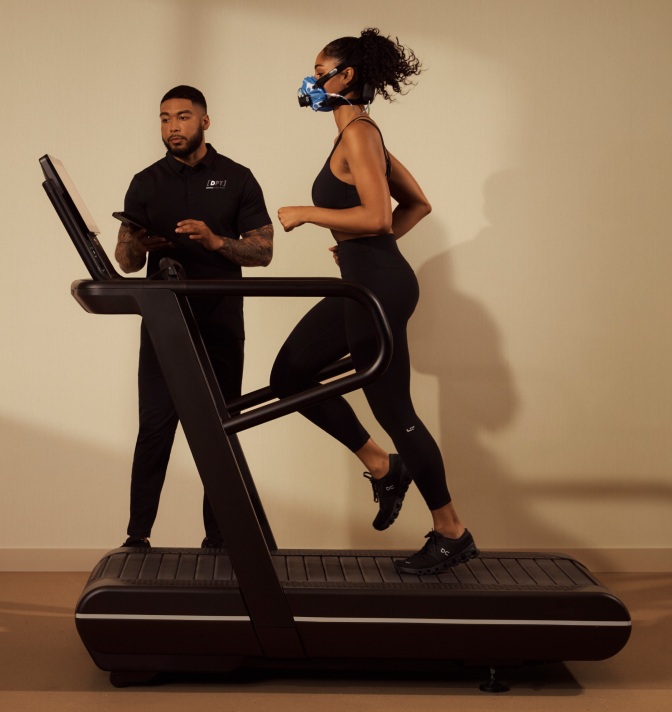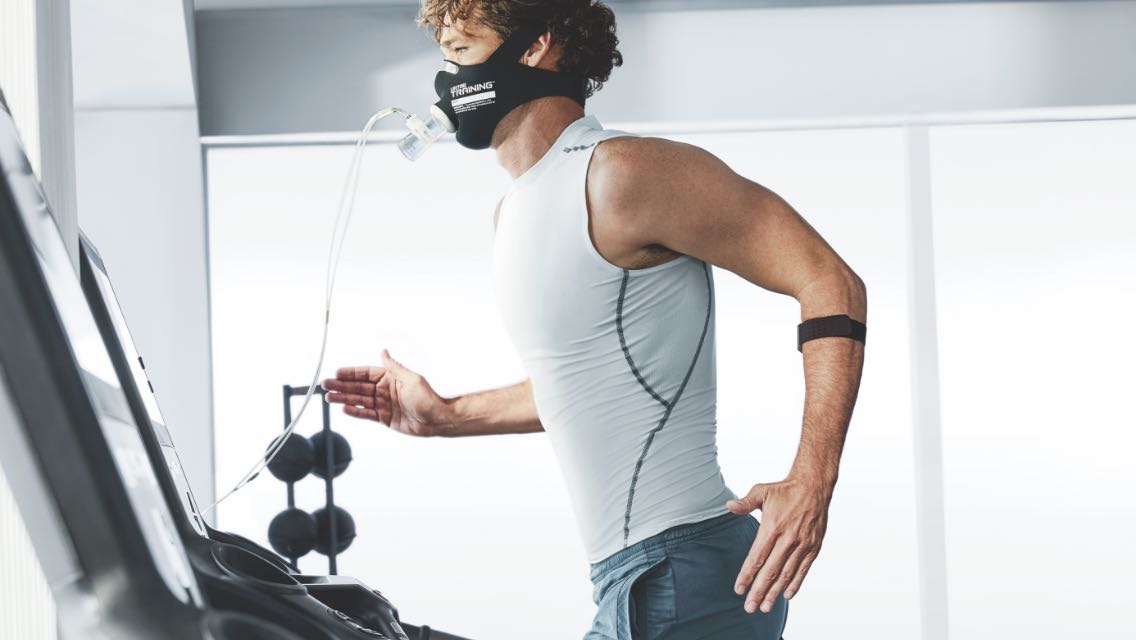




Have you ever seen someone at Life Time sprinting on a treadmill while wearing a mask over their nose and mouth? Were they sweating beads as a trainer stood nearby monitoring some charts on a device? If your answers are yes, then you know what the experience of an Active Metabolic Assessment looks like.
Whenever I saw this, I would think, Wow, they must be a hard-core athlete. I didn’t know exactly what they were doing or why they were doing it — until recently, when I tried it myself. Now I know the individuals I saw performing the test could have been athletes of any fitness level. The common thread between them was likely the desire to train smarter.
As a distance runner, I’ve always had a pretty good idea of what my recovery pace feels like, what my race pace feels like, and when I’m pushing myself too hard. I’ve known how this feels solely by looking at my mile pace and from years of running experience. But I’ve never known why my body feels better or worse at different paces.
I learned that if I could determine my exact heart-rate zones, I could go off more than feeling in my training — I would know exactly what pace to run or exercise at to be most effective, depending on the goal I wanted to accomplish. The Active Metabolic Assessment provides this data, along with other helpful insights like VO2 max, aerobic base, and anaerobic threshold. I thought, let’s give this a try!
An Honest Recount of My Experience
I reached out to Aaron Hlavacek, a Dynamic Personal Trainer at Life Time in Chanhassen, Minn., and scheduled an Active Metabolic Assessment. After booking, I received an email with a few pre-appointment instructions: Avoid strenuous exercise for at least 24 hours prior; avoid alcohol the night before; and eat and drink normally prior to the test.
On assessment day, Hlavacek asked for my height and age and measured my weight. He asked about my current fitness, and, specifically, if I had experience with running; this was to gauge where to start the warm-up and assessment.
He explained it’s ideal for the test to take about 10 to 20 minutes, so it’s important to start at a pace that’s not too slow or too fast. That time range is the sweet spot: If the test takes less time, the initial speed was likely too fast, and client runs out of steam too early; if the test takes more time and they start too slow, you run the risk of the client being fatigued by the time they reach their max sprinting speed. Both scenarios can result in a poor snapshot of results.
Hlavacek then had me strap a heart-rate monitor around my chest and helped adjust a silicone mask properly on my face and around my head so it fit snug. The mask was wireless and connected to his iPad via Bluetooth.
Talking would be difficult once the mask was on, so he explained that if I ever needed to stop, I could step on the sides of the treadmill. He also explained how to communicate with him throughout the test: I would use my fingers to indicate how I was feeling on a scale of one to 10 and use a thumbs-up as the signal to keep increasing the pace.
I felt comfortable with the directions provided before stepping on the treadmill. Talking through it all gave me confidence.
Hlavacek had me walk at first before bumping up the pace to 5 miles per hour to initiate a light jog warmup. After a few minutes at this light pace, he asked if I was ready to start the first level. I gave him a thumbs up.
He increased the speed, and I started running at this pace that I would stay at for one minute. As we approached the 60-second mark, he asked how hard it felt on a scale of one to 10, and I held up my score with fingers. He bumped up the speed by 0.5 mph.
We continued this cadence — one minute at a pace, followed by a check in on how I was feeling, before bumping it up 0.5 mph — for a few more increases until I was sprinting so fast, I could feel I was nearing my max.
Hlavacek encouraged me to keep going but also gave me permission to end the test at any moment I wanted or needed to. The longer I went, however, the better data we would receive. When I felt I couldn’t keep going anymore, I gave him the thumbs down, and he slowed the treadmill for my cool-down.
After five minutes of walking, I took off the mask and heart-rate monitor and joined Hlavacek at his computer to review my results.
Although wearing the mask for this test wasn’t the most comfortable, it wasn’t as bad as I thought it might be. I could breathe through my nose and mouth and never felt short of breath; however, it did feel a little intrusive, and I was ready to remove the mask after I was done.
Analyzing the Data
To be honest, I had no idea where my numbers would be. I had been running consistently since I was in high school, having completed several races, including two marathons. I maintained endurance running until last year, when I was pregnant and then recovering postpartum. I’m 10 months postpartum now and have just recently started running and exercising more regularly again.
Initially, I had the misconception that I needed to wait to take the AMA until I was in better shape. But I learned that by taking this test now, it would help me achieve even better results as I’d be equipped with the data to better tailor my exercise plan.
My VO2 max score was 42.4, which was evaluated against people of similar age, sex, and weight. The test shows where your score places you on a scale from “very poor” to “excellent”; my score puts me in the “good” range, but right on the cusp of excellent, Hlavacek explained. “A score of 43 would be considered ‘excellent,’” he said. This number is important as a higher VO2 max correlates with a lower risk of all-cause mortality.

“Your VO2 is a measure of how much volume of oxygen you get in during an intense workout; the higher your VO2 is, essentially the more oxygen you have,” Hlavacek explained. “If you and somebody with a lower VO2 max both go for a run at 6 mph, that run is going to feel different for both of you. Although it’s the same intensity, it’s going to feel easier for you because you have more oxygen working for you.”
Hlavacek explained that because VO2 is a measure of how well my body generates oxygen, taking deep breaths when training won’t impact my VO2 max score (it could, however, lower my heart rate).
I also learned the exact beats-per-minute ranges for my zones 1, 2, 3, 4, and 5, along with how many calories per minute and per hour I’m burning within each zone.
Additionally, the results show the percentages of the calories I’m burning that are fat or carbohydrates within the zones. Everyone’s heart-rate zones are different, which is why it can be helpful to learn your personal numbers and data.
| Zone 1 | Very light activity — ideal for warm-up and recovery. In this zone you should be able to speak easily. | 93.0–153.3 beats per minute | 1.0 –4.9 calories per min 60–293 calories per hour15.5% fat / 84.5% carbs |
| Zone 2 | Light activity — ideal for building aerobic base. This zone is suitable for longer training sessions. | 153.3–166.0 beats per minute | 4.9–6.5 calories per min 293–390 calories per hour15.9% fat / 84.1% carbs |
| Zone 3 | Moderately intense activity — training starts to feel harder here. This zone effectively improves aerobic capacity. | 166.0–175.9 beats per minute | 6.5 –8.4 calories per min 390–504 calories per hour1.8% fat / 98.2% carbs |
| Zone 4 | High intensity — suitable for intense interval or performance training. Improves speed and performance. | 175.9–187.1 beats per minute | 8.4–9.7 calories per min 504–582 calories per hour0.0% fat / 100.0% carbs |
| Zone 5 | Maximal effort — for short, intense intervals. This zone is mostly used for peak training or tests. | 187.1–197.0 beats per minute | 9.7–11.4 calories per min 582–685 calories per hour0.0% fat / 100.0% carbs |
Hlavacek explained that my heart-rate zone numbers show I’m in “great shape,” but ideally, we’d aim to improve my efficiency in each of the zones. Since I’ve been more sedentary over the past year, I was somewhat surprised to learn that my numbers were as positive as they were.
“This data reflects the history you have as runner,” Hlavacek explained. “People don’t easily or quickly lose all of the fitness capacity they’ve built up.” Now that I know my specific heart-rate zones, I’m able to reference them for targeted training.
The results also showed several other data points that reflect my fitness status and that can help inform my training plan, including my heart-rate recovery (how quickly my heart rate returns to normal after exercise); fat-burning maximum (the intensity at which I burn the greatest amount of fat); respiratory exchange ratio (how my body’s energy sources and metabolic processes adapt to different physical loads); and metabolic flexibility (my body’s ability to efficiently adapt metabolism to different energy demands and sources).
An Informed Plan Forward
Other than wanting to get back to regular movement, I didn’t have a concrete fitness goal in mind when I went into the test. Now I can clearly see how knowing this information can help me adjust my training for different goals.
For example, if I wanted to strive for marathon training again, I would look to spend a lot of my training time in zones 4 and 5 with the goal of bringing my VO2 score up. I would also aim to strength train in these zones.
If I wanted to see results in aesthetics, I would spend more time in zone 2 because that’s where I’m going to burn more fat than carbohydrates.
Hlavacek recommends using some form of wearable technology, like a watch or ring, while exercising to monitor your heart rate so you know which zones you’re in.
After meeting with Hlavacek, I was inspired to take inventory of my equipment and gear. I recently invested in a new pair of running shoes, and I started researching a new Apple Watch. Mine is more than 10 years old and doesn’t properly connect to my iPhone anymore. After I upgrade my wearable tech, I’ll have a better idea of my heart rate when I go out for runs and can strategically stay in desired zones.
I’ve thought about signing up for a race this upcoming summer, probably one that’s between a 5K and half marathon distance. I’d like to create a training plan for that, and this data can help direct me.
I’m glad I took the time to complete this test and meet with a Dynamic Personal Trainer to understand my results. I feel like it set the perfect groundwork for getting back into running and taking my training one step further. This test truly can be useful for fitness newbies, elite athletes, and everyone in between.
To learn more or to sign up for an Active Metabolic Assessment, you can do so in the Life Time app or by talking to a Dynamic Personal Trainer at your local Life Time athletic country club.