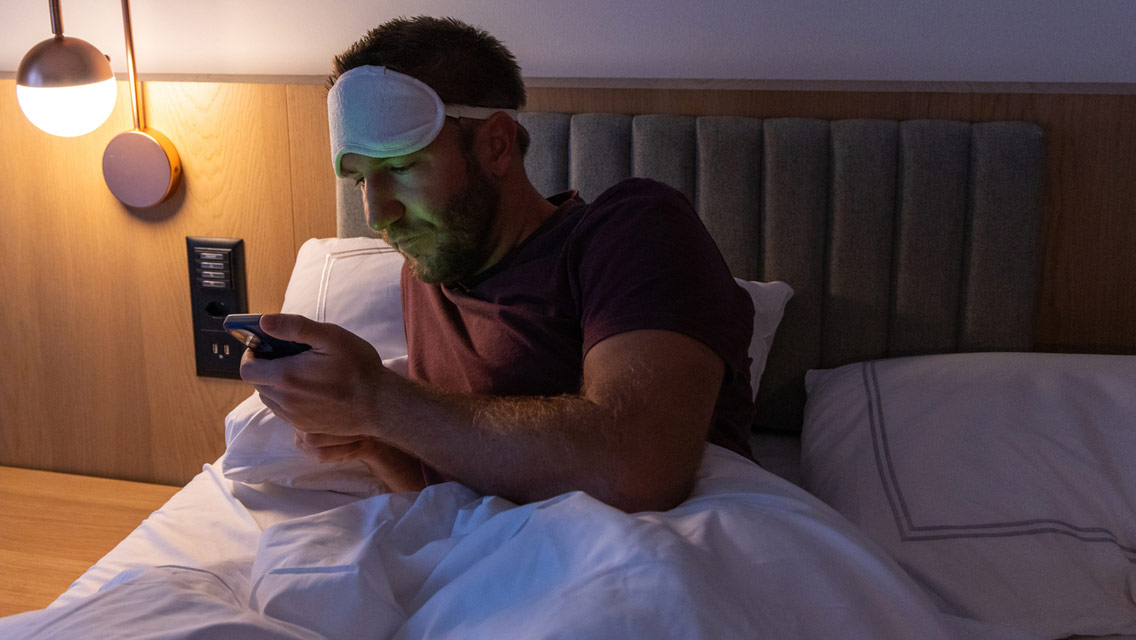




Many of us have woken up feeling an ache, pain, or tightness that wasn’t there when we laid down the night before. We might initially chalk it up to yesterday’s workout or a single night of sleeping in a strange position. But if you notice the discomfort becoming a more frequent presence in the mornings, it may be time to address how you’re physically positioned while you’re asleep — it can have long-term effects on how you feel, function, and perform.
“One of the most common complaints I hear from patients is that they’ve slept wrong, and it’s led to discomfort throughout their day,” says Patric Fun, DS, chiropractor at LifeClinic in Garland, Texas. “The mechanics of your sleep posture, which is typically a sustained position held for many hours, can have a ripple effect, affecting how you feel during the day as well as your performance. If you notice pain when you wake up and it gets better as the day goes on, that’s a sign that it could be a sleep-position-related issue.”
Seemingly minor shifts can make a big difference, whether it’s the thickness of your pillow or which direction you’re rotating your head, according to Fun. And while your sleep posture isn’t something you can necessarily control throughout the night, there are habits you can integrate to help you achieve better mechanical alignment — which can mean less pain and discomfort the next day.
“We need to ask ourselves, ‘How can I make the position I fall asleep in more optimal for my body, so that things don’t hurt when I wake up?’” says Fun.
Whether you’re a back, side or stomach sleeper, Fun has some ideas for getting yourself into a more optimal position.
How to Optimize Common Sleeping Positions
Back Sleepers
Sleeping on your back can allow for a neutral spine curve, Fun says, which can be especially helpful if you’re experiencing back pain. If you’re typically a back sleeper, Fun offers the following tips for better alignment if you’re experiencing aches and pains.
Try putting a pillow under your knees.
“When you’re sleeping on your back, you want to make sure you don’t have too much extension of the lower back,” he notes. This can be alleviated by placing a pillow underneath your knees, which can help take the pressure off your back.”
The desirable height of the pillow will vary depending on your build, but rather than focusing on how high or low your knees are, Fun suggests gauging the positioning by how the pressure on your back feels; if it’s alleviated, you’ve likely achieved a more neutral spinal alignment position.
Consider placing a rolled towel beneath your neck.
If you’re experiencing neck pain, your pillow may be too thick, and substituting your pillow with a rolled-up towel can help mitigate the issue. “For my patients who are back sleepers who are experiencing neck pain, it’s often because their chin is tucked down due to a thicker pillow pushing their head forward,” he says.
“You also want your head in the middle of the pillow, not at the edge of it. If your pillow doesn’t support the curve and length of your neck, forgo the pillow and use a towel underneath your neck (or a travel neck pillow like those used on airplanes). This can help support a more optimal spine curve and relieve morning pain,” Fun says. “Try the towel trick on its own first to see if that brings relief to your neck pain. Then, you can see whether it’s worth going shopping for a thinner pillow.”
Side Sleepers
Side sleeping is one of the most common sleep positions, and if you’re a side sleeper experiencing sleep-related pain, you are likely favoring one side, according to Fun. “If your bottom shoulder is more rolled toward your back, you may experience pain on that shoulder and along your shoulder blade region. If your top shoulder is more rolled forward, you may experience pain in that area, with the top shoulder being a common ache point.
“The types of aches can vary,” he continues, “but with side sleeping, there can be more misalignment depending on how rolled over you are.”
Consider these tips to achieve a more neutral spinal alignment.
Place a pillow between your knees.
“Having a thicker pillow between your knees can help take the pressure off your back, keep your hips aligned, and even prevent tossing and turning as you stay more comfortable throughout the night,” says Fun. “Hugging a pillow to your chest can also help position your upper arm just a little more forward, so your shoulder blades are in a more neutral position.”
To prevent any hunching, make sure you’re pulling the pillow into your body like it’s a wall to prevent curling into a ball, he adds, which can help keep your shoulders more stacked instead of rolling more onto either your back or front. “It’s very important to keep things in extension, rather than sleeping in a flexion or fetal position,” he notes. “Most of our daily activities, like looking at our phones or computer, have us looking down, which can lead to a rounded back.”
Make sure your pillow is the right thickness.
Pillow thickness is integral for alignment when you’re sleeping on your side, Fun says. “You want to make sure your pillow is at a height that allows your neck to be in straight alignment with your spine when you’re lying down on your side,” says Fun. “Many people who sleep on their side tend to tuck their chin down, which can lead to sleep apnea or neck pain.”
Stomach Sleepers
Compared to sleeping on your back or side, sleeping on your stomach is generally less recommended, especially if you experience neck or back pain. “Sleeping on your stomach can put more pressure on the spine and the hips,” Fun says. “And with any kind of twisting motion — such as sleeping with one leg hitched up or over, which is common — you’re unable to maintain a neutral spine. And because this position requires your head to be turned one way or the other, it can also potentially lead to over-rotation.”
But if sleeping on your stomach is truly what feels most comfortable to you, Fun recommends sleeping with a thinner pillow (or even no pillow at all). This can take pressure off the neck and prevent spinal misalignment.
Approaching Better Sleep Holistically
Before you go upgrading your pillows or mattress, Fun recommends examining your sleep posture as a more cost-effective path to addressing sleep-related aches and pains. If you’ve slept poorly for years, it is possible to retrain your body into healthier sleep positions, but Fun advises approaching the change gradually. “The hardest part is people trying to change too many things at once,” he says. “It’s all dependent on your unique needs. Identify what’s causing your pain or issues and try one small change at a time. A chiropractor can also help you pinpoint changes that may be most meaningful.”
Your sleep posture is, of course, just one facet of experiencing optimal rest. Fun says proper sleep habits (a consistent bedtime, turning off devices an hour before bed, and performing light stretches) can help lead to higher quality sleep. (Learn more: “Top 10 Sleep Mistakes — and Tips to Fix Them.”)
If you’ve detected any pain and soreness due to poor sleep posture or have trouble sleeping due to pain, a chiropractor can help treat muscle tension and pain and make recommendations for better sleep ergonomics. “If there is any persisting pain that wakes you up at night, that’s usually a red flag to get checked out by a professional” says Fun.
“From a chiropractic standpoint, we’re looking at your spinal alignment and muscle tissue, and what is either causing your sleep quality to worsen or prevent you from sleeping. This entails a head-to-toe examination to pinpoint the root issue of the dysfunction. From there, your care plan is tailored to your specific needs and goals.
“Chiropractic care can help give you the tools to help you feel less sleep-related discomfort, as well as address any other mobility or musculoskeletal issues you may have,” he adds. “Less muscle tension and pain from sleep can lead to a better performance the next day.” (Learn more: “Can Chiropractic Care Help You Sleep Better?”)