

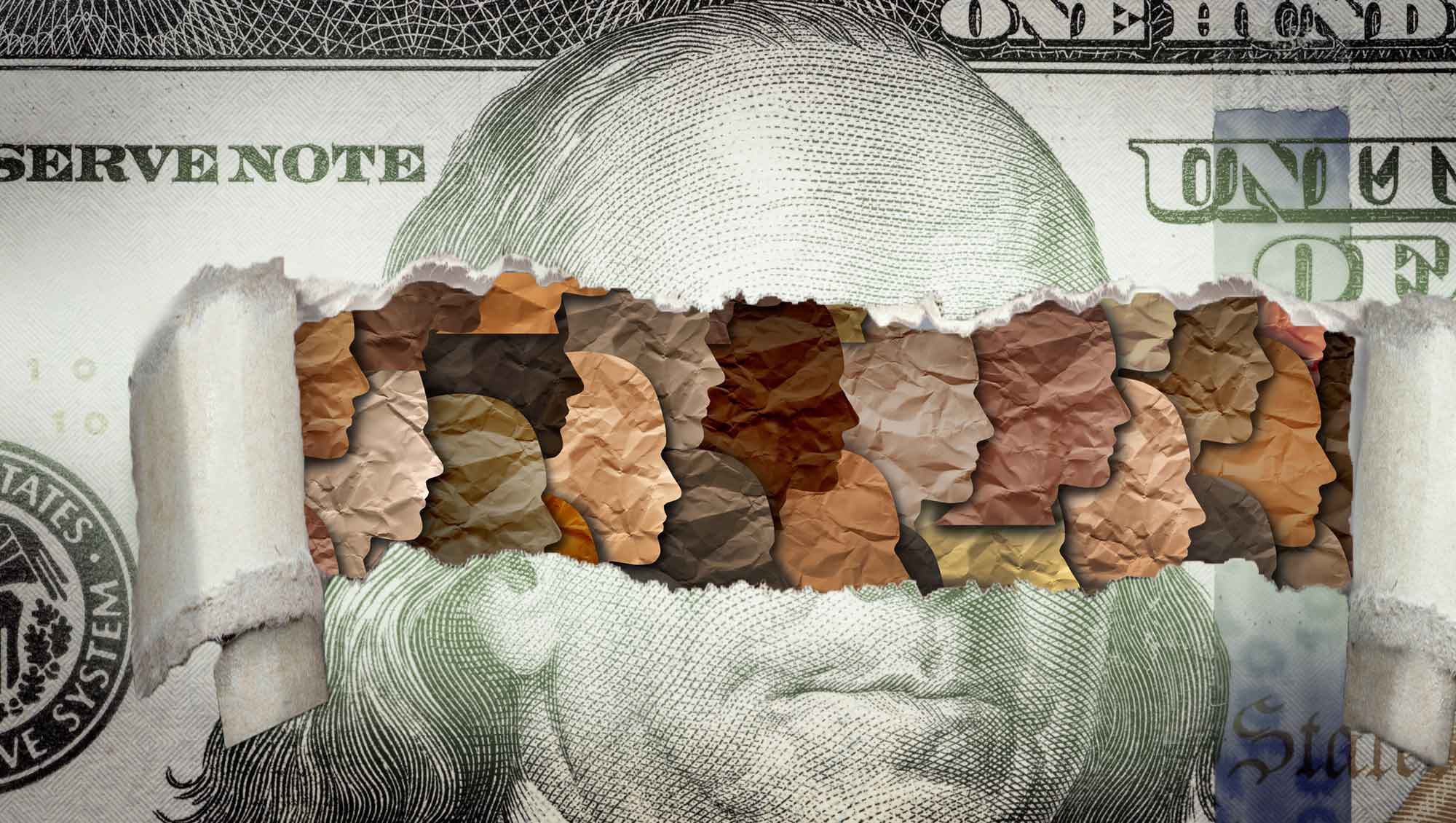
Wealth inequity in the United States has increased dramatically since the 1980s. The top 1 percent of Americans hold some $55 trillion in assets, which is roughly equal to the combined wealth of the bottom 90 percent of the U.S. population, according to the Federal Reserve. On top of that, the racial wealth divide persists, with white families in 2023 holding about 84 percent of America’s wealth while representing just 66 percent of households.
Edgar Villanueva is on a mission to rebalance the books. His goal is to address those marked inequities by redistributing money to historically underresourced communities. A New Yorker and an enrolled member of the Lumbee Tribe of North Carolina, he literally wrote the book on the topic: Decolonizing Wealth: Indigenous Wisdom to Heal Divides and Restore Balance.
To catalyze these efforts, Villanueva founded the Decolonizing Wealth Project (DWP) in 2018. The organization helped spark the reparative-philanthropy movement, which addresses the psychological, relational, and spiritual dimensions of wealth. Since launching, the DWP has influenced more than $1 billion of giving toward BIPOC-led social change. In 2025, Villanueva set an even loftier goal with his 10-year Moonshot strategy, aimed at unlocking $1 trillion by 2035.
Exactly how does Villanueva hope to achieve that? Through a three-pronged approach: transforming the philanthropic and social finance sectors; shifting conversations about wealth and giving through storytelling; and growing Liberated Capital, a collective-giving community he founded in 2019. Liberated Capital’s pooled giving has resulted in more than $30 million distributed toward community-led economic solidarity, climate justice, land-back projects, youth mental health, and racial-healing efforts.
“It’s important to understand that there’s always something you can do to make a difference — to use your time, money, and resources,” says Villanueva, who was named to the TIME100 Climate 2025 List. “You don’t need to have a lot of wealth or be an expert on social justice. You just have to come with an open heart and a willingness to grow.”
Below, Villanueva shares how we can all be a part of the movement to decolonize wealth.
Experience Life | From your perspective, what does it mean to decolonize wealth?
Edgar Villanueva | To decolonize wealth is to have an understanding of the harmful history of wealth accumulation in the United States — and beyond — and actively work to bring healing and repair from the harms. In this country, it’s largely tied to our history of colonization — the unceded land gained from the removal of Native Americans and the uncompensated, forced labor of enslaved Black people, a foundational driver of the modern global economy [that generated] vast wealth that fueled the industrialization and financial systems of the Western world.
The dynamics of scarcity, greed, and fear led to the creation of economic policies and systems that have exacerbated the wealth gap, fueled the climate crisis, and deepened the wounds of separation and division between people. At the 250th anniversary of our country, we find ourselves far removed from taking any responsibility for our history and the many communities still struggling with poverty and poor health as a result. And the pain is widespread; we are tired and are earning less, and we have less time for one another. The vast majority of wealth is controlled by a few, and their excessive wealth grows at the expense of the rest of us.
People and organizations with wealth can experience healing by doing the necessary work of acknowledging the truth about history, how we either benefited or suffered because of it, and work to repair our relationship to money,
DWP is guided by ancient Indigenous worldviews regarding resources, people, and land. We believe that money can be used to heal when it’s deployed to help those who have been harmed the most. And the healing doesn’t just flow one way. People and organizations with wealth can experience healing by doing the necessary work of acknowledging the truth about history, how we either benefited or suffered because of it, and work to repair our relationship to money, people, and land. We believe that we can transform wealth into collective well-being through this process of healing and repair. This is called reparative philanthropy.
DWP is not explicitly antiwealth; we are pro–community wealth. Wealth should not be controlled and hoarded by a few but should be used to ensure that we are all thriving. In 2024, the 19 richest U.S. households alone saw their wealth increase by $1 trillion; the federal minimum wage is equivalent to just over $15,000 a year. I think it’s fair to say the system is out of balance. When those living at the margins suffer, we all suffer. Yet when those communities are included and invested in, everyone benefits. This is about healthier economies and a healthier planet. This is about centering relationships and people over profit. Our work is about ensuring everyone can thrive.
Reparative philanthropy addresses the psychological, relational, and spiritual dimensions of wealth. Through experiences, advising, and resources, our donor clients become agents of transformation as they learn how to shift wealth away from harm and toward shared thriving. Our Liberated Capital giving community is the practical application of our work for the general population. It’s a multiracial, intergenerational, cross-wealth space where our 700-plus members connect, learn, give, and heal together.
EL | How does philanthropy need to shift to better support reparative giving?
EV | Donors and philanthropic institutions need to get back to the basics. The word “philanthropy” means “love of humankind.” Love of people. People who have been harmed by wealth, including by philanthropy. And philanthropy mirrors these colonial dynamics. Endowments are growing bigger while nonprofits are starving for resources, as public and private giving has been cut or stalled. Repair begins with examining the origins of wealth in a family or institution and asking who was harmed in the accumulation of the wealth that philanthropy grows and protects.
Wealthy donors and philanthropic institutions now have $1.8 trillion growing in endowments and private accounts. Reparative giving requires that we be in tune with our hearts and spirits more than our heads. We need to reconnect with the sacred inherent in every person and make decisions from a place of love, not fear or obligation. What would happen if money flowed to places of need freely? What would happen if the impact on communities was valued more than the rate of return on the endowment? Our Moonshot is a 10-year strategy to unlock $1 trillion in repair through transforming the hearts of people, shifting their giving practices towards repair, and awakening their spirits to the divine collective to see how money can be medicine — to heal us all.
EL | How can we overcome some of the common misconceptions about reparations?
EV | Reparations is love in action; it’s repair. When we truly love people, we want to apologize and make things right with our relationship. Yet there hasn’t been a formal apology in this country for the millions of Black people enslaved for labor and breeding for nearly 250 years. Reparations is not about taking from one group to give to another; that’s a scarcity mindset. Rather, it’s about healing the dark spot on the soul of our nation that still divides, and engaging in collective ownership and collective repair. If philanthropy is about love and care, then it must also be about repair.
Reparations is love in action; it’s repair.
Our recent research on collective care shows that 82 percent of Americans believe they care for others without an expectation of anything in return. We actually have a caring, giving culture. In fact, we could say that it’s un-American not to care about one another. Yet we struggle with this form of care. We seem to be afraid of facing the truth — or worse, we believe we know enough and should just move on. The point isn’t to blame or shame but to acknowledge and repair the harm the best we can.
I’ll add that it’s important to remember it took a great many people of all faiths, races, and economic positions to achieve the progress we have seen toward fairness and dignity in this country. That’s not to say we don’t have areas of improvement, because we definitely do. However, we can and should be proud of our wins as readily as we admit our failures. So much of this is about our hearts and our spirits. The spirit of America needs healing — reparative actions like land return, fair tax policies, and reparations can and should be part of that healing process.
EL | Can you provide an overview of the Seven Steps to Healing?
EV | I first shared the Seven Steps to Healing in my book, Decolonizing Wealth. The steps are rooted in an Indigenous worldview and guide us through a nonlinear experience to acknowledge and grieve the truth about how money has harmed — and then work to be in the right relationship.
On a personal level, it’s understanding your own history and how that overlaps with American history. For instance, did your family benefit from the atrocities in our history? Did your family benefit from generational wealth that was handed down? Inviting people into this process is not about shame; it’s about understanding the history that you embody and how that relates to money. That can be hard to process because we don’t often talk about money in our families, but bringing light to that also brings about healing, liberation, and joy.
You may not be wealthy, but we all make decisions about money every single day, and you can make choices about how you use your money that are in service to fairness and dignity. For example, what are the values of your bank? Is your bank investing in industries that are harming our communities and our planet? It takes effort to do the work of equity, but it’s worth it, and all those decisions really add up to help move resources to communities that haven’t historically had the same opportunities. There’s something very spiritual and emotional about seeing each other for who we are as human beings and understanding that we are all together in this thing called life.
EL | What does wealth distribution through an Indigenous worldview look like?
EV | I dream of a day where race or ethnicity cannot be used as a data point to predict the outcomes of someone’s life and, instead, where everybody will have the same opportunities to build wealth. Where we’ve shifted away from this individualistic way of being — putting borders and fences around things — to really understanding a cooperative way to exist.
But that’s not anything new. If you go back far enough, these were practices in all our communities. We were more tribal in nature. We had ways of taking care of each other and taking responsibility for each other, especially for our young people.
We need to remember our original instructions and work hard to embody those principles, because our societies have moved away from those practices. If we can accept abundance, mutual relations, and understanding that we’re all relatives, then we will make very different decisions with our money.






Comments (1)
What a load of crap.