

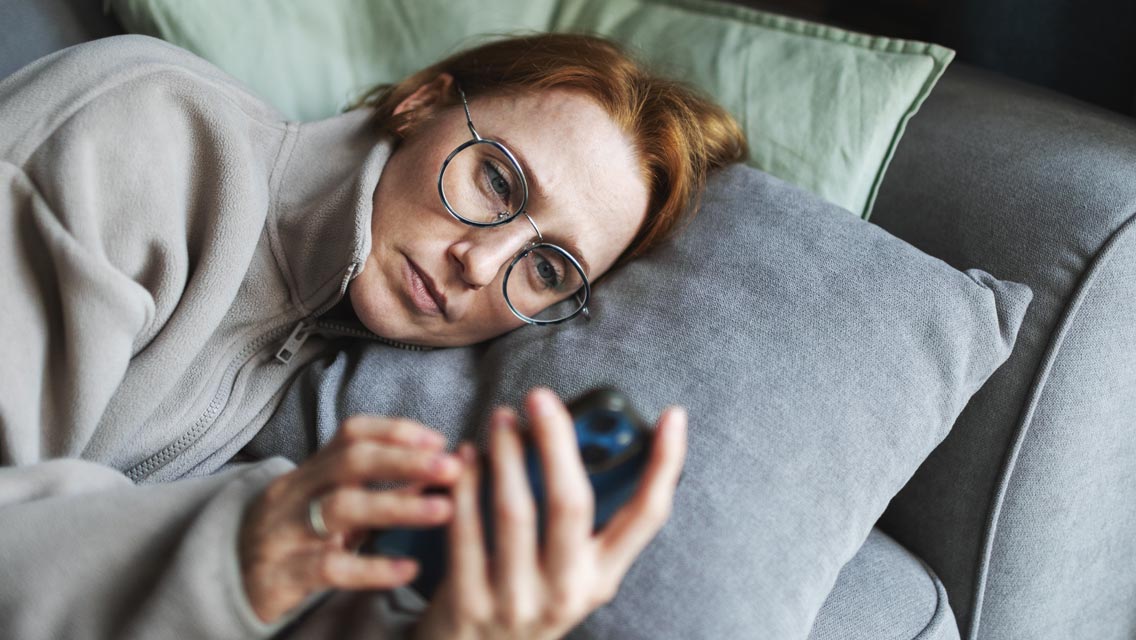
Fifteen-year-old Ellie likes things to be in order — her closet, her makeup tray, everything around her. “I’m obsessed with having it organized exactly right,” she says.
As Ellie’s obsession with order began to preoccupy her, she went online to learn more about it. She typed her symptoms into a web search, and the results were a revelation: Her symptoms matched the description for obsessive-compulsive disorder. But this information didn’t come from a clinic’s website or a medical expert.
“I learned what I have from this TikToker,” Ellie says. “She and I have the same issues, but she does a better job explaining it than I can.”
Ellie is a composite character, reflecting the stories of an array of young clients that therapist Jennifer Kokes, LPCC, works with. Kokes says that these clients are coming to therapy with a preconceived idea of their diagnosis. Their source: something they saw online.
A Growing Trend
Brent Haagenson, PsyD, LP, a clinical psychologist who provides psychological evaluations for kids, teens, and adults, is witnessing the same trend. Previously, most of Haagenson’s patients were referred by a third party, such as a teacher or social-service provider. Now, he sees more self-referrals — “people who come into my office saying, ‘I saw this online and I think I have it.’”
Self-diagnosing — believing one has a condition or disorder without having received a professional diagnosis — has long been common in medicine. Numerous websites enable diagnosis-seekers to confirm suspected ailments with a few clicks.
Now, self-diagnosing has come for mental health.
A 2025 study of 1,100 adult subjects found that 29 percent of them had self-diagnosed a mental health condition using online information. And this percentage is significantly higher in younger adults: Thirty-eight percent of Millennial and 50 percent of Gen Z respondents had used online information to self-diagnose a mental health condition.
The increase in online mental health content does have some positive effects. The broad popularity of mental health videos on TikTok has fostered open discussion of issues once shrouded in shame and secrecy — including tics, panic attacks, mood swings, and other concerns. A 2022 analysis of 100 TikTok videos tagged with #mentalhealth found that they collectively garnered more than 1.3 billion views.
Some experts believe that the trend in online self-diagnosing is connected to a more accepting attitude toward mental health struggles. Oxford University psychologist Lucy Foulkes, PhD, author of Losing Our Minds: The Challenge of Defining Mental Illness, points to a broader push to normalize mental illness.
From celebrity-fronted PSAs to suicide-hotline billboards to news articles on the global “anxiety epidemic,” we’re hearing a lot about mental health. “Broadly, all of this is a good thing,” Foulkes said in a lecture at the Royal Institution in London. “There’s been an overall net gain. If all of this means that someone who’s suffering now has the language and the framework to understand what’s happening to them, and it means they can come forward and get help, then all of this is worthwhile.
“I really believe all of that. But I also think, at the same time, this message is misfiring a little bit. I think there’s been some collateral damage and some side effects from the way we’re talking about mental health at the moment.”
“Inaccuracies and Half-Truths”
Open dialogue about mental health can reduce stigma and compel struggling individuals to seek help rather than suffer in silence. But this visibility can come with overgeneralizations — and the loss of important nuances between conditions.
Mental health diagnoses are complex and, in some ways, subjective. And that’s because mental health disorders are complex and subjective. They can’t be objectively measured like high cholesterol or low vitamin D.
Haagenson’s evaluation process illustrates how much work goes into getting an accurate mental health diagnosis. He first meets with the patient in person to gather data about their symptoms and learn more about their personal history, home life, school life, and medical issues. Whenever possible, he gets information from parents, teachers, and others who might offer additional context. Then he administers psychological and neuropsychological tests, including cognitive and personality assessments. These often take hours to complete.
Haagenson’s years of clinical experience are another critical piece. “Vibe checks are part of the process too,” he says. “You use your intuition to support the clinical data.”
A recent study analyzing claims from TikTok videos about ADHD found that less than half of the advice aligned with diagnostic criteria. And not one of the content creators was a mental health professional with a doctorate-level degree.
Experts have revised and updated the Diagnostic and Statistical Manual of Mental Disorders (DSM) — the so-called bible of mental health professionals — every decade or so, often following debate or controversy. When the latest edition was released, in March 2022, members of the American Psychological Association openly criticized the proliferation of new disorders and the lack of scientific evidence supporting the edition’s updates.
“For all the awareness-raising — the fanfare and campaigns and hashtags — there’s still a lack of understanding of what disorders actually are, let alone why people get them or how we’re supposed to help,” Foulkes writes in Losing Our Minds. “The absence of knowledge about mental health creates a vacuum that is filled by inaccuracies and half-truths.”
For example, a recent study analyzing claims from TikTok videos about ADHD found that less than half of the advice aligned with diagnostic criteria. And not one of the content creators was a mental health professional with a doctorate-level degree.
What’s the Harm?
Alongside concerns about misguided advice and misinformation, social media–enabled self-diagnosing may lead to pathologizing normative experiences.
“Since we’ve started talking publicly about mental health, the language people are using to describe common, transient negative feelings has become caught up in the language we should be reserving for mental illness,” writes Foulkes.
Mental illness exists on a spectrum. Foulkes believes that when disorders are claimed too indiscriminately, it minimizes the severe end and magnifies the milder side.
“If you allow everyone to describe everything as a mental health problem or a mental disorder, these terms lose value for the people who really need them,” Foulkes argues.
Take depression. When severe, it can be debilitating. Someone may struggle to get out of bed, pay the bills, or maintain basic hygiene. A diagnosis like major depressive disorder can enable access to much-needed accommodations and benefits. Conflating normal sadness with severe depression risks muddying the waters.
“If you allow everyone to describe everything as a mental health problem or a mental disorder, these terms lose value for the people who really need them,” Foulkes argues.
Overidentifying with a diagnosis can also lead someone to believe it explains the entirety of their being. This can foster a loss of agency and a sense of helplessness — when the point of a diagnosis is to help determine treatment.
“A label should never be the end goal,” says Haagenson. “It’s really just the beginning because it allows us to begin answering the more important question: What are we going to do about it?”
And What Are the Benefits?
A self-diagnosis may not be accurate, but it can be helpful in getting someone like Ellie closer to the truth. In Kokes’s composite example, Ellie became convinced that she had OCD. But a trained therapist like Kokes can recognize signs that something else may be going on. For example, perhaps Ellie’s fixation on order began after she, a historically straight-A student, got her first C in math. Then she started having trouble sleeping and was tense and irritable throughout the day. Counting, organizing, and ordering helped take her mind off things.
People with OCD often experience overwhelming fear of what might go wrong if they don’t perform their compulsive rituals. For Ellie, maybe it just felt good to have a sense of control. And while she did tend to ruminate, her thoughts didn’t reflect the obsessive patterns characteristic of OCD.
“Because she’d learned about the disorder, she was hyper-attuned to anything that seemed to suggest she had it,” Kokes suggests. Without realizing it, Ellie had been searching for — and even subconsciously exaggerating — signs of OCD. This is confirmation bias.
In cases like this, Kokes notes that anxiety is a more likely explanation. It provides a better template for the treatment. A more accurate diagnosis can help someone like Ellie connect with relevant and resonant content on social media, which can help them realize they’re not alone.
Often, that’s what many of us are hoping for all along.
While self-diagnosing mental health issues has its pitfalls, neither Kokes nor Haagenson considers self-diagnosing entirely bad. “This is not necessarily a bad thing — although it is a paradigm shift,” Haagenson says.
“The exposure sheds light on things we used to ignore,” he explains. He recalls seeing an ad on prime-time television for a medication treating schizophrenia, a disorder that’s long been misunderstood and stigmatized, if it’s discussed at all. “We’re talking about stuff we never used to talk about.”
“I love that so much information is out there,” echoes Kokes. “Whatever clients bring to me, even if it’s not entirely accurate, it shows they’re paying attention to what’s bothering them.”
She finds that many of her clients learn helpful coping strategies through their online research, and most welcome more nuanced discussions about mental health and the limitations of diagnoses.
“I always remind my clients that people are individuals, not a collection of symptoms,” she says. “A diagnosis can never capture the full extent of who you are.”
How to Identify a Mental Health Expert
Seeking mental health advice from someone online? Consider these questions before accepting their guidance.
Does the presenter have formal training or credentials? Mental health professionals undergo years of education, supervision, and hands-on training. Licensed practitioners also need to meet annual continuing-education requirements to stay on top of new research in the field. An influencer or celebrity can bring visibility to an issue, but they’re likely not the right source for expertise.
Do they cite quality research? What studies or references, if any, do they cite? If they’re sharing their own story, do they make it clear that their experience may not reflect everyone else’s? Look for data and nuance, not generalizations.
Are they selling something? Before taking someone’s advice, consider why they might be sharing it. If they’re sponsored by a brand or promoting a product, they’re probably more interested in attention than education.
Are they trying too hard to get your attention? Too-good-to-be-true claims (“This one trick will change your life”) and highly charged language (“toxic,” “miraculous,” “infuriating”) generate clicks but don’t bode well for credibility.







Comments (0)