


Your “healthspan” is the period of life you spend in good health, free from chronic disease and disabilities associated with aging.
One way to set goals around healthspan is by looking at fitness indicators for longevity. For example, grip strength correlates with your risk of falling and your risk of chronic disease, says Jennifer Miller, PhD, CSCS, an assistant professor of kinesiology at St. Olaf College and a Life Time Alpha and GTX instructor.
While these fitness indicators are commonly associated with aging, it’s never too early to start paying attention to them.
“What you’re doing in your 20s and 30s really [becomes what you build upon] when you’re 55 and 65,” Miller says. “We start to see changes every 10 years or so as we get older, so who you want to be in 10 years really depends on what you’re doing in the years prior.”
Grip-Strength Goal:
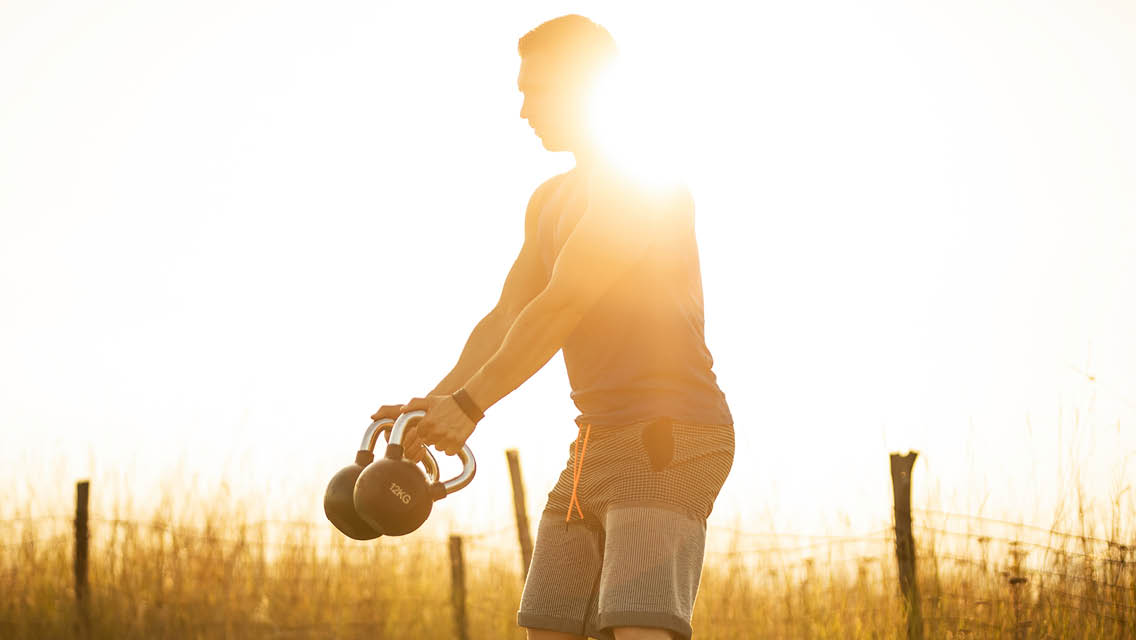
At age 65 and older, men need around 60 to 70 pounds of grip strength (the standard associated with lower mortality risk); women need about 35 to 45 pounds. Improve your grip strength with the farmer’s hold and carry.
- Baseline goal: Hold two kettlebells totaling 28 kilograms or about 60 pounds (men) or 17 kg or about 35 pounds (women) for 30 to 60 seconds.
- Advanced goal: Walk with two kettlebells totaling 50 to 100 percent of your body weight for 30 to 60 seconds.
Muscular-Endurance Goal:
For functional independence, older adults need enough strength and endurance to sit down and stand up from a chair 11 or 12 times in 30 seconds.
- Baseline goal: Sit and stand 18 times in one minute.
- Advanced goal: Sit and stand 33 times in 30 seconds.
(The ability to get up off the floor with minimal support is a marker of longevity. Practice the moves at “6 Exercises to Help You Get Down on the Floor — and Up off the Floor — With Ease” to improve flexibility, balance, motor coordination, and muscle power.)
Speed-Walking Goal:
Research shows that gait-movement patterns — such as a step length greater than 25 inches — predict lower chances of injury and better longevity outcomes in older adults. VO₂ max is associated with longevity and lower mortality risk. Speed walking can help improve both markers.
- Baseline goal: Run or speed walk one mile without stopping.
- Advanced goal: Speed walk a mile in under 13 minutes. Miller notes that it should take no more than three minutes for your heart rate to return to within 20 to 30 beats of your resting heart rate.
Lower-Body Strength and Balance Goal:
This compound exercise helps keep you mobile: Go from sitting to standing, then walk or run a short distance and return to your starting position.
- Baseline goal: Get up from a chair, walk 10 feet, and come back in 13.5 seconds.
- Advanced goal: Get up from the ground without using your knees, hands, or anything else for support, run 25 yards and back, and return to seated. Bonus: Do this while wearing a weighted vest (see “The Benefits of Adding a Weighted Vest to Your Fitness Routine” for more).
Your Next Fitness Adventure
Whether you’re looking to break out of a workout rut or pursue a new goal, you’ll find expert insights and inspiration in “What’s Your Next Fitness Adventure?,” from which this article was excerpted.

Comments (0)