



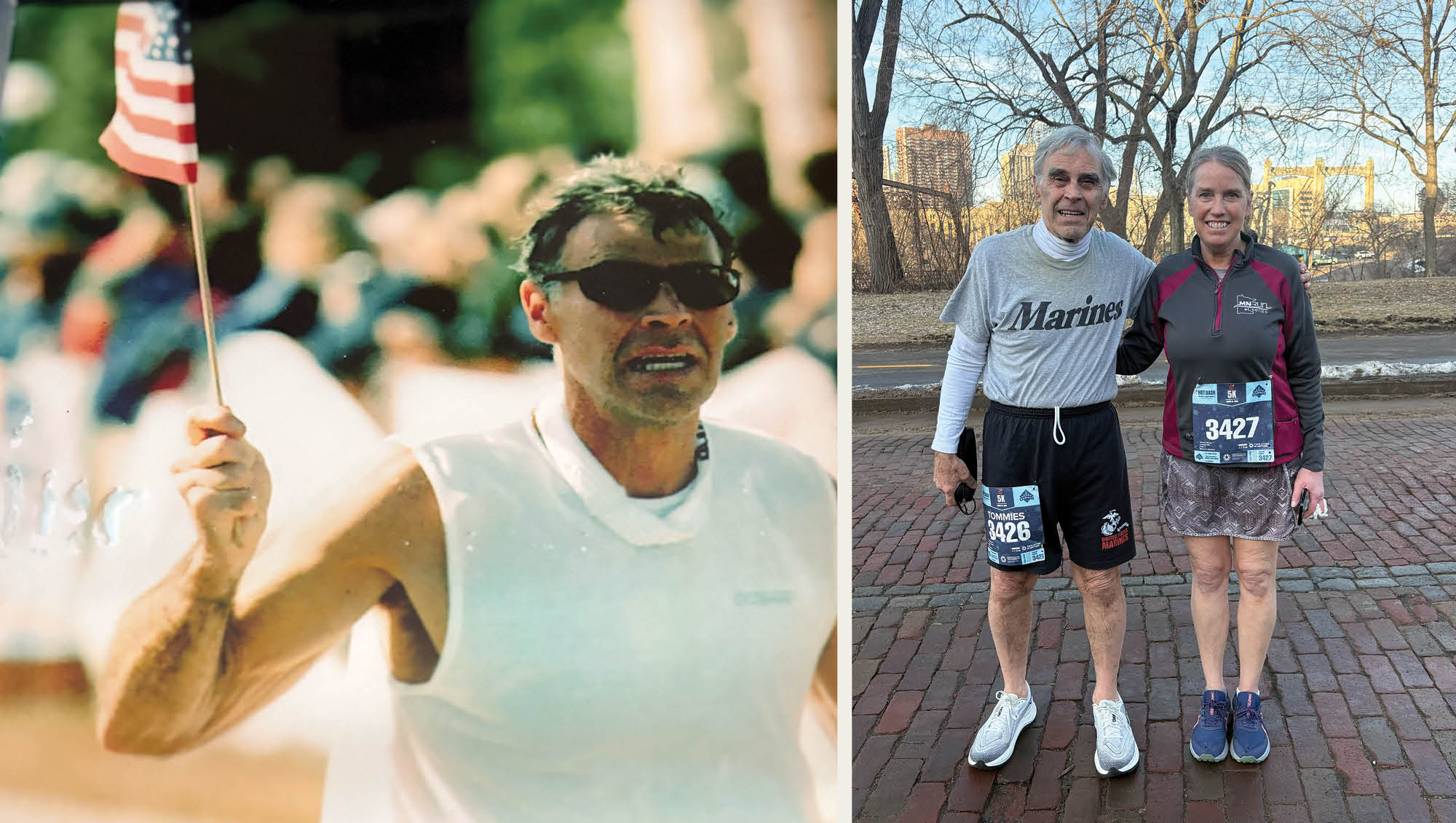
A few days into 2026, I ended my workout in the Life Time sauna beside a few other morning regulars. While sweating in the dry heat, we compared our annual “report cards,” which reflect the number of times we visited the club during the previous year. My number, 345, was the highest in the group.
Until then, no one had asked me how old I was. But now they were curious. When I told them I had just turned 80, they were surprised. I was significantly older than anyone else in the sauna.
Despite my age, I’ve never had a hip or knee replacement or spent a night in the hospital. Not many of my friends can say that. And even though I have a family history of heart problems, I continue to live free of major cardiac issues. As far as I’m concerned, that good health comes down to my commitment to working out almost daily for most of my life — a habit I developed at a young age.
Takeoff
I’ve been passionate about fitness and flying for almost my entire life. I grew up in Osseo, Minn., and played football, basketball, and baseball in high school. A helicopter ride I took when I was 10 sparked a dream of becoming a pilot. From then on, I asked my mom to pack carrots in my lunch to help my vision.
After graduating from the University of St. Thomas in 1967, I enlisted in the Marine Corps. A competitive athlete at heart, I relished the physical challenges of boot camp and was eventually sent to Pensacola, Fla., to join the aviation program. I had the opportunity to land jets on World War II–era aircraft carriers — one of the most thrilling things I’ve ever done.
I was released from active duty in 1971 after being stationed in Japan, and I began flying corporate aircraft for 3M and eventually for commercial airlines. After flying fighter planes at more than twice the speed of sound, it was like going from driving a Corvette to steering a cement truck. But I still enjoyed my career.

Deeper Motivation
I’ve had plenty of incentive to stay active. As a member of the Marine Corps Reserve, I took an annual physical-fitness test until I retired from the Reserve in 1992. Additionally, the FAA required pilots to pass a medical screening every six months — and when I started flying commercially, pilots who needed medication for hypertension or diabetes weren’t allowed to fly.
My primary motivation for staying fit, however, was more personal: Shortly after I joined the Marines, my mom died from heart disease at the age of 59. The loss was a tough reminder that fitness is more than a pastime; it’s a health investment.
After returning home from active duty in 1971, I directed my competitive energy toward a new goal: running marathons. I’d been told that cardio workouts were best for heart health, and I wasn’t about to take any chances with mine. I ran my first race, the Marine Corps Marathon, in 1978, and I competed in many others in the years that followed, including the Boston Marathon in 1992.
During this time, I also frequented my local YMCA to lift weights. A physical therapist told me my legs and back were relatively weak compared with my chest, which was hard for a runner like me to accept. But she was onto something, because once I began exercising to strengthen my back, legs, and hips, I suffered fewer injuries. Even so, running remained my priority. Logging 60 or so miles a week left little time for other workouts.
I ran my last marathon in 2004, just before I reached the airline’s mandatory retirement age. With more free time, I decided to prioritize strength training. I alternated between upper-body weights one day and lower-body weights and cardio the next. I now also include balance work and stretching, but I most look forward to lifting.
Shared Passion
My fitness journey hasn’t been a solo affair. While training for marathons in the ’70s, I ran with my Siberian husky, Tanya, a few times a week. Whenever she heard me get her leash, she would run in circles and jump up and down. Her excitement inspired me: I don’t think she wanted to run for anything other than the pure joy of moving.
When she died in 1984 at the age of 13, the vet said that all the running she’d done had helped her live such a long life. I hoped that one day I’d be able to say the same.
My sweetheart, Sue, has always been supportive. We’ve been married more than 58 years now, and fitness has long been part of our relationship. In fact, it was Sue who clued me in to a new Life Time club in Eagan, Minn., in 1994. Construction hadn’t even begun, but we joined as members at a trailer on the property. We have since changed clubs after moving, but having a place to work out has always been a priority for us.
We raised our two daughters to also be active: For close to 20 years, I ran the Key West half-marathon with my youngest daughter, Chrissy.
Running is still something I enjoy, so I often sign up for races with Chrissy or one of my four grandsons. They all understand the thrill of the finish line — whether it’s a 5K or half-marathon — as much as I do.
Carrying On
My longtime commitment to fitness has done more than keep me in good physical condition. In 1996, after three of my five sisters suffered cardiac events within a six-week time frame, I visited a cardiologist for a checkup. A calcium scan showed some blockage in my arteries, so I started taking a statin. But I know it could have been much worse.
At my last cardiology checkup, just before my 80th birthday, my doctor said that I have the physical heart of a 65-year-old. He recommended I keep doing what I’m doing, which is an easy prescription for me to follow because I enjoy it so much. After so many years, movement isn’t a choice for me — it’s part of who I am.
Bill’s Top 3 Takeaways
1. Commit. “Know that there is a difference between being interested in something and being committed to it,” Bill advises. Commitment has more staying power.
2. Track progress with a fitness journal. “You will discover that some of your best workouts will be on days that you really did not want to get up and go to the club.”
3. Trust the process. “Long-term results will follow if you just keep showing up,” he says.
My Turnaround
For more real-life success stories of people who have embraced healthy behaviors and changed their lives, visit our My Turnaround department.
This article originally appeared as “Heart of an Athlete.”



Comments (0)