



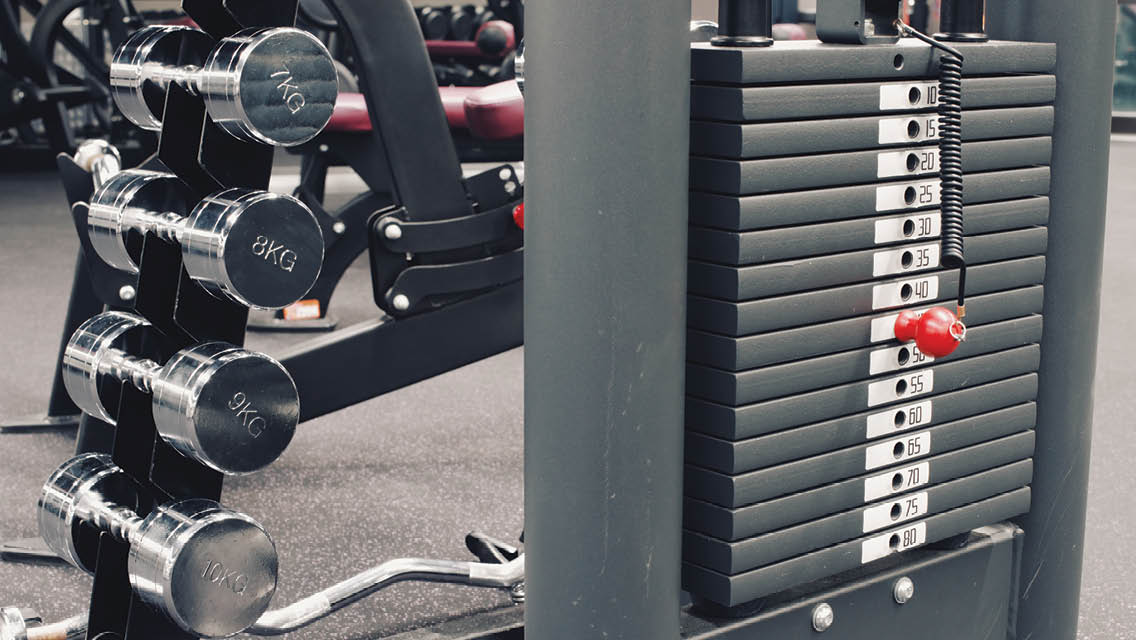
The common belief that weight machines are safer than free weights is a misconception. In fact, both machines and free weights have benefits and drawbacks that vary from person to person. Moreover, all forms of strength training — machines, barbells, dumbbells, body weight, bands, kettlebells, and others — are largely effective and safe.
Pitting machines against free weights overlooks a more important safety concern: The risks incurred by not strength training far outstrip any risks posed by the modality you might choose.
“Eighty to 90 percent of people already don’t meet the recommended amount of muscle-strengthening activity,” says Austin Current, NSCA-CSCS, author of Science of Strength Training.
People who don’t strength train risk losing muscle mass, dropping bone density, becoming frailer, losing mobility, changing metabolically, developing cardiovascular issues, and compromising their mental health. Regular strength work — regardless of the equipment — is a great line of defense against these whole-body risks.
So why does the false dichotomy persist? Mostly, it’s a matter of perception.
Weight machines seem like the perfect solution for beginners and anyone with an aversion to lifting weights. Most machines feel smooth, stable, and safe from the first rep. It’s easy to feel the muscles working. You’re seated in a padded chair, moving a padded lever arm, using weights that move along an enclosed track.
This can initially feel like a far safer bet than handling barbells, dumbbells, and other free weights, which, as the name suggests, are free to move anywhere — including off the rack and onto your big toe.
But first impressions can be deceiving. In the long term, says John Rusin, DPT, a strength-and-conditioning coach, injury-prevention specialist, and founder of the Pain-Free Performance Specialist Certification program, “free weights are probably safer than machines.”
Machines Versus Free Weights
Research suggests that the most serious, acute injuries tend to occur in home gyms when, for example, a lifter bench-presses a barbell without a spotter. But these injuries are preventable (don’t bench-press without a spotter) and rare.
Far more common among regular lifters are long-term, repetitive-use injuries that may not warrant a trip to urgent care but can nevertheless erode your capacity to move freely over time. This type of injury — undramatic but debilitating — is much more likely to result from using machines than free weights, says Rusin.
Machines, he explains, are designed to keep you safe while you’re using them but “not necessarily to keep your joints healthy in the long term.” Consequently, he adds, “they often create more chronic joint stress.”
The adjustable seats, lever arms, and angles of motion on strength machines are designed to accommodate the average user. If you’re a little taller or shorter, or have different proportions than average, machines might not fit you.
The adjustable seats, lever arms, and angles of motion on strength machines are designed to accommodate the average user. If you’re a little taller or shorter, or have different proportions than average, machines might not fit you. Using them may put undue pressure on your joints, resulting in pain and possibly injury over time.
Even if you’re an average-size lifter, the path of your arms and legs is still determined by the machine: Your wrists, hips, spine, and ankles may all be locked into place, preventing subtle adjustments that could make the movements more comfortable and guard against repetitive-use strain.
Then there’s the issue of usability. Machines appear simple and intuitive, says Rusin, and people may not bother adjusting seat height or backrest angle — they jump on the machine as is, further inviting strain.
Free weights avoid many of these shortcomings; a 5-foot gymnast and a 7-foot NBA player can both perform dumbbell presses or lunges or rows with the same tools — no adjustments necessary. And each lifter can modify each exercise in the way that feels best for them.
Again, “consistent muscle strengthening is the priority,” says Current. Whether you use machines or free weights — or, more likely, a combination of different tools — take the time to learn proper setup and form. Enlist the help of a trainer or coach, and use the type of resistance that makes you feel comfortable, so you can work hard while managing joint pain or discomfort throughout your workout.
Aim for a routine that makes you feel better, not worse.
Want More Thoughtful Health Insights?
Add Experience Life as a preferred source on Google.
This article originally appeared as “The Great Weight Debate” in the November/December 2026 issue of Experience Life.





Comments (0)