


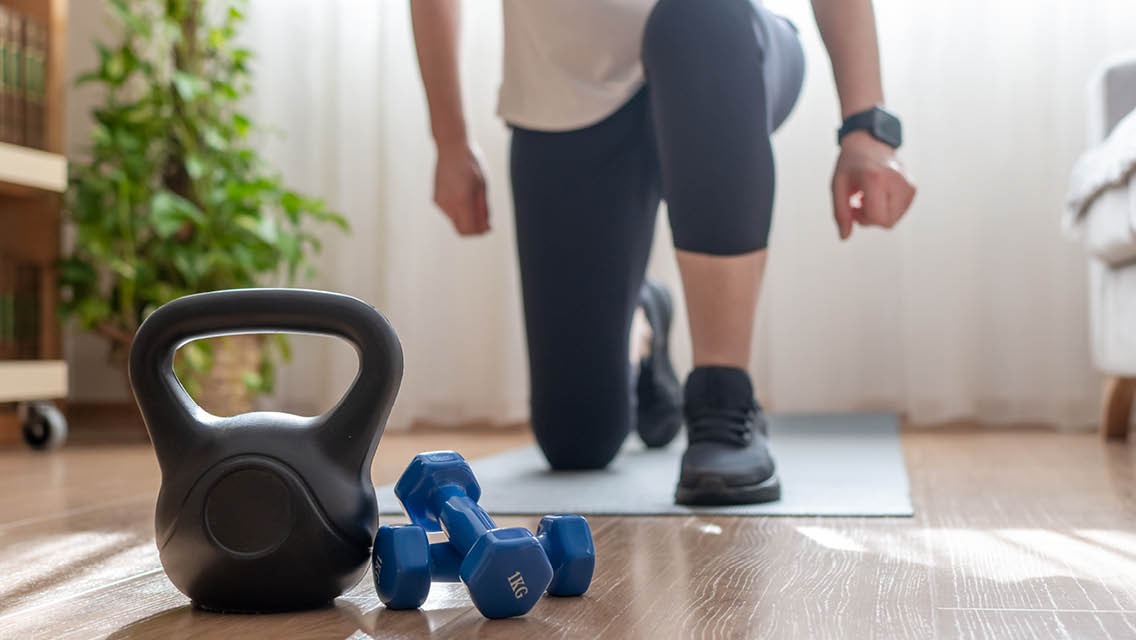
The goal with longevity is not simply to lengthen your lifespan but also to prolong your healthspan — that is, how long you remain mobile, functional, and in good health. Research shows that strength, balance, and coordination tests can help assess how your body is aging and reveal opportunities to shore up your fitness for the years to come.
Start with three simple, science-backed assessments.
(01)
SINGLE-LEG BALANCE
What it shows: Research has found that poor one-legged balance is a reliable indicator of age-related decline in muscle strength and nervous-system coordination. “The ability to stabilize your body on one leg is involved in so many movements, including stepping, lunging, and reaching up to grab something,” explains Christine Cernera, CPT, a personal trainer specializing in senior fitness. “As we get older, we naturally lose muscle mass and our reaction times slow. That’s why intentionally practicing balance, along with strength training, becomes increasingly important for maintaining stability and reducing fall risk.”
About one in four U.S. adults age 65 and older reports falling each year, and falls are the leading cause of injury-related death among seniors.
How to test: Stand on one leg and hold the pose for as long as you can. Switch legs and repeat. Aim for at least 30 seconds per side.
How to improve: For a full-body balance workout, visit “How to Build Your Balance.”
(02)
SIT–STAND
What it shows: Your ability to sit down and rise back up shows three important components of aging with good function. First, it indicates your general mobility and your ability to move your limbs through their range of motion. Second, it indicates coordination, or your ability to balance and move in space. And, finally, it’s indicative of your physical strength, because you leverage your body using muscular power and force to push off the floor.
“We need to practice getting down to get up,” says Jayme Zylstra, a yoga instructor, group fitness coach, and digital performer for ARORA at Life Time who specializes in working with older adults. “When we lose this skill, our world shrinks. A simple fall becomes a crisis, and getting stuck on the floor is a scary, heartbreaking blow to a person’s autonomy. Treat this simple movement as a daily independence check.”
How to test: Start by testing your ability to sit and rise from a chair. Without using your hands, sit down on a chair and stand back up as many times as you can in 30 seconds. If you’re between the ages of 60 and 64 and perform fewer than 14 sit–stands (men) or 12 sit–stands (women), you are at an increased risk of falling, according to the National Center for Injury Prevention and Control at the CDC. The standard decreases with age. At 70, the baseline goal is 12 reps for men and 10 reps for women; by 80, the goal is 10 and nine reps; and by 90, it’s seven and four reps.
The next-level test is your ability to sit and rise from the floor without assistance, which is associated with lower mortality risk. Aim to complete one rep without the aid of your hands, knees, forearms, or other tools. This is a tough challenge for most people, so view the result as an opportunity for improvement.
How to improve: For exercise ideas to help you get down on the floor and back up with ease, visit “6 Exercises to Help You Get Down on the Floor — and Up off the Floor — With Ease.”
.
(03)
GRIP STRENGTH
What it shows: For decades, studies have linked greater grip strength to reduced mortality risk and a lower likelihood of developing heart disease. We know grip strength is important for daily tasks like opening jars or carrying groceries. As an assessment, it indicates your overall muscular strength and function, bone mineral density, fracture and fall risk, nutrition status, and cognition.
How to test: Grip strength can be measured with a tool called a hand dynamometer, but not everyone has access to one. Instead, suggests healthy-aging specialist Amy Peters, CSCS, test yourself with a heavy farmer’s carry or a dead hang. To perform the carry, grasp weights in both hands (kettlebells, dumbbells, sandbags, and a trap bar are all good options) and see how long you can hold on while walking. Aim to carry at least half your body weight in your hands for 30 to 60 seconds. (For more detailed instructions, see “How to Do a Kettlebell Carry.“)
Alternatively, do a dead hang: Grasp a pull-up bar with both hands and hang as long as you can with both feet off the ground. Aim for 30 to 60 seconds. (See “The Benefits of the Dead Hang” for more.)
How to improve: “I’ve seen people go and focus on improving grip strength specifically, but this misses the point,” says Peters. “Grip strength is the result of performing activities that require strength.” For a full-body grip-strength workout, visit “The Grip-Strength Workout.”
Stay Healthy for the Long Haul
Add Experience Life as a preferred source on Google.







Comments (0)