



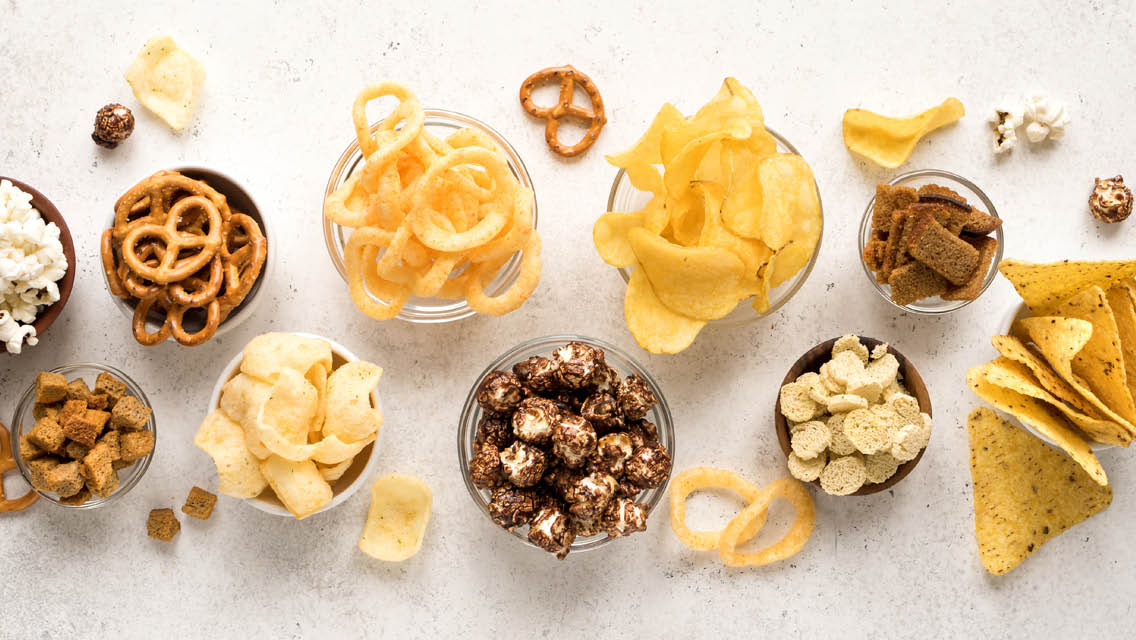
There’s a good reason you can’t eat just one potato chip.
No addictive drug ignites the reward circuitry in our brains as quickly and intensely as our favorite foods, explains Pulitzer Prize–winning journalist Michael Moss. And Big Food has made a science of this, hooking Americans on the “bliss point” of sugar, “flavor burst” of salt, and “mouthfeel” of fat, to use industry parlance. The result, he says, is a love affair with fast food and processed food that has become an addiction.
In his latest book, Hooked: Food, Free Will, and How the Food Giants Exploit Our Addictions, Moss compares food cravings with compulsions for nicotine and heroin. The reason we can’t stop at just one potato chip is because those food addictions are even stronger — and Big Food knows it. In fact, their business model craftily caters to “craveability,” “snackability,” and “more-ishness.”
“One hallmark of addiction is the speed with which substances hit the brain, and this puts the term ‘fast food’ in a new light,” he writes. “Measured in milliseconds, and the power to addict, nothing is faster than processed food in rousing the brain.”
We spoke with Moss about his research.
Experience Life | You write that Big Food is fighting to maximize its “share of stomach” — industry slang for market share — by hooking Americans on sugar, salt, and fat, leading to food addictions. What are the bottom-line effects?
Michael Moss | The trouble Big Food causes us lands on a spectrum. Some people experience cravings that cause them to lose control, as in binge eating. For others, it’s a more subtle loss of control that sneaks up on them and leads to overeating day after day.
A crude, albeit stunning, measure of this is the clinical obesity rate that shot past 42 percent even before the pandemic. Still others are just feeling the loss of the ritual and beauty of home-cooked meals shared with family and friends that we lost when we fell so hard for convenience foods.
EL | You compare food addiction to nicotine addiction. Most Americans no longer smoke cigarettes: What would it take to wean us off fast foods and processed foods?
MM | There is some guidance to be drawn from other addictive substances, experts tell me, whether cigarettes, alcohol, drugs, or things like smartphones. For some people, abstinence — avoiding the foods that cause them to lose control — is a reasonable strategy. Others can head off a craving by anticipating it: For example, get up and stretch, call a friend, try eating something better, like a handful of nuts.
And more long term, changing how we value food rather than letting the companies tell us what to value in food. For example, looking at pastries and thinking not just how yummy they’ll taste, but how they may affect your heart two years hence.
EL | Can you explain Big Food’s seemingly contrary motives starting in the 1970s of buying up diet companies and health-food makers?
MM | These are just additional revenue streams to the companies. Their involvement in the dieting industry has tapered off in the last few years as more people grow disillusioned with even the best methods aimed at helping one to lose weight.
The newest strategy by Big Food is to “help us” deal with our overeating of its products by changing the formulas to add some “anticraving elements” like protein or more fiber to its products. But I refer to this as “health washing” because these fixes don’t really change the nature of their products that are otherwise still loaded with salt, sugar, and fat.






Comments (0)