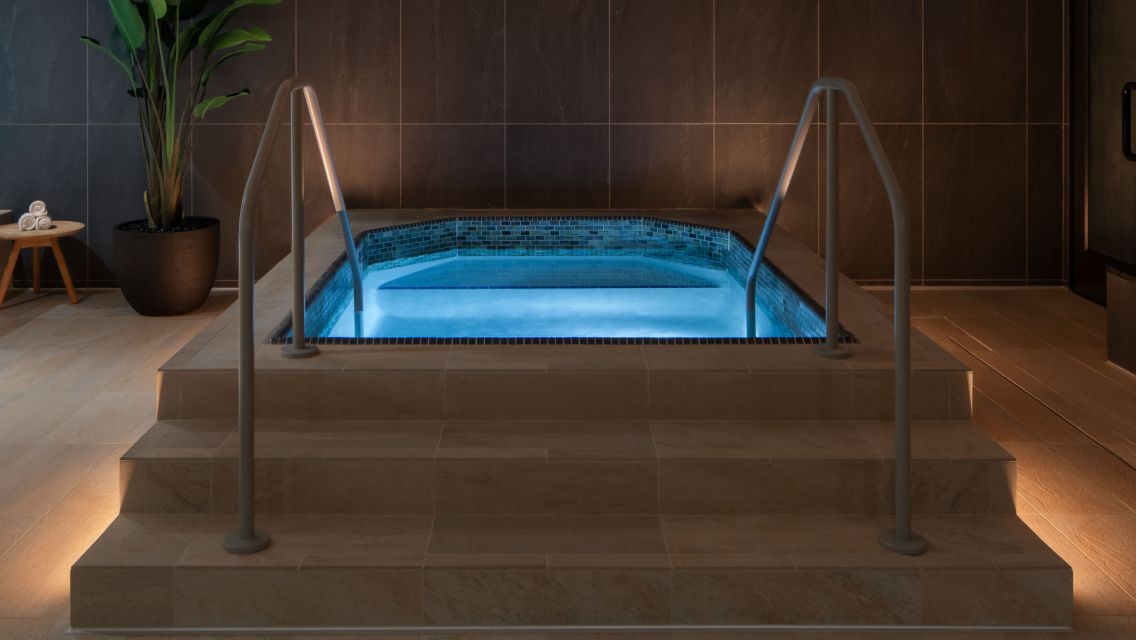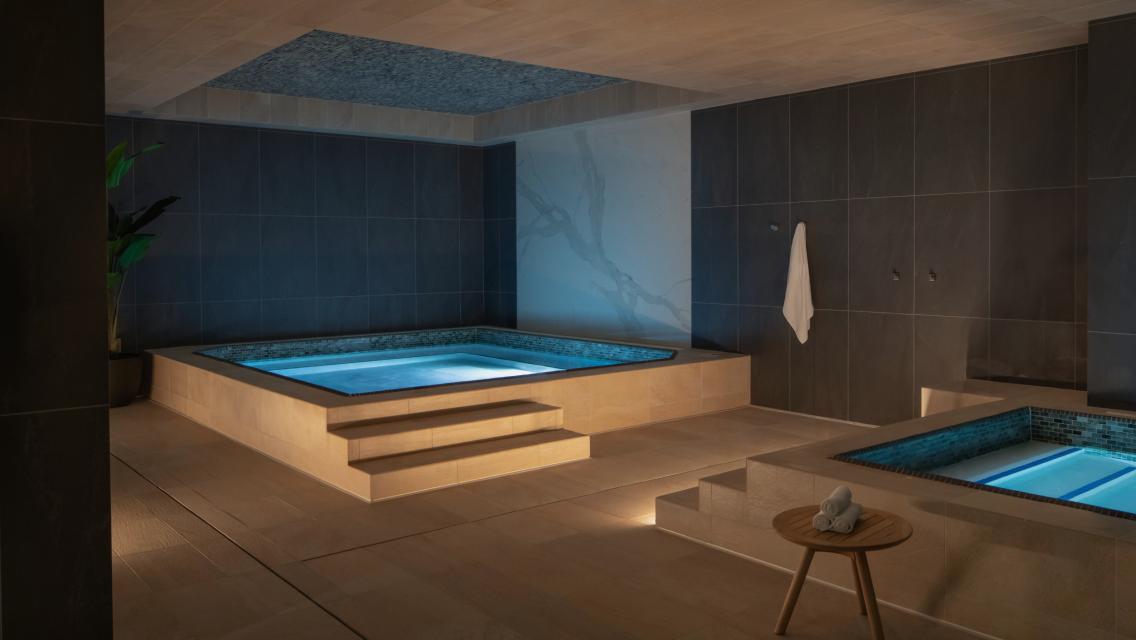



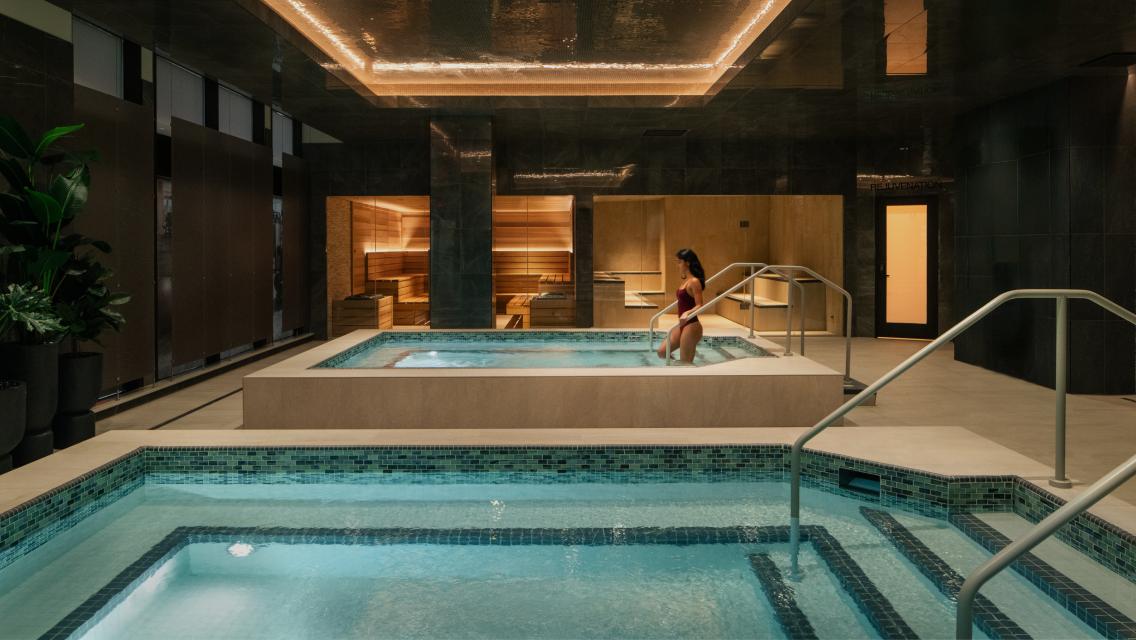
Picture the end of a demanding workout or a long, nonstop day: Your muscles are spent, your mind is full, and all you want are a few moments to exhale. You step away from the noise and pace of it all and into a quiet space built entirely for you to slow down. The air shifts. Warmth settles into your body. For a few unhurried minutes, recovery becomes something you can feel.
That’s the experience many Life Time athletic country clubs offer in their hydrotherapy suites, which feature a cold plunge, whirlpool, steam room, and sauna. Each recovery amenity brings together relaxation, recovery, rejuvenation, and community.
“There’s a lot of research to back up the healing power of each of these modalities as well as using them for contrast therapy, or alternating between hot and cold,” says Danny King, master trainer and director of performance and recovery at Life Time. “At Life Time, we’re leaning into this area of the club to improve the experience for our members, so they can more easily recover from their workouts and relax.”
Learn from Life Time leaders about how the hydrotherapy suite became what it is today, how it will continue to evolve, and the ways you can use it for your own recovery and relaxation efforts.
The Evolution of the Hydrotherapy Suite
Until recently, most Life Time locker rooms were designed with only a steam room and a sauna. But as time passed and destinations expanded more widely across the country, the company took note of emerging trends and how members preferred to use these spaces.
“The next addition was the whirlpool, and then as the cold plunge grew in popularity, we integrated that over time,” says Matt Brinza, vice president of architecture and engineering at Life Time. “It was a natural evolution. We saw that members weren’t just visiting these spaces — they were dwelling in them and spending a lot of time there. They were also socializing in them. Instead of happy hours, many of our members do ‘recovery hours.’ People come to our clubs looking for connection, and this space is one opportunity for that, in addition to being a natural add-on to a fitness routine.”
This prompted Life Time leaders to look at the hydrotherapy space through a social wellness lens. “Men and women, whether partners or friends, were using spaces throughout the club together,” explains Brinza. “But the one place they couldn’t do that was the hydrotherapy suite, since it was split between the men’s and women’s locker rooms.”
To further promote community, Life Time’s newest clubs now feature coed hydrotherapy suites. “We’ve evolved the current generation of all our ground-up prototypes to include the coed wet suite for all new clubs starting in 2027.”
You can currently find coed hydrotherapy suites at Life Time Prudential Center in Boston, Mass.; Life Time Sky (Manhattan) and Life Time Bryant Park (arriving December 2026) in New York City; Life Time Atlantic Avenue and Life Time Brooklyn Tower (arriving December 2026) in Brooklyn, N.Y.; and Life Time Scottsdale Fashion Square in Arizona.
Even if your club doesn’t have a full coed hydrotherapy suite, most Life Time locations still offer some or all of these amenities — sauna, steam room, whirlpool, and cold plunge. In some clubs, they’re in the men’s and women’s locker rooms; in others, they’re in a coed wet suite with only select therapies.
What’s Inside the Hydrotherapy Suite
The hydrotherapy suite has four main amenities: a sauna, steam room, whirlpool, and cold plunge. King explains the benefits of each for recovery and performance.
Sauna
Life Time typically sets its saunas to around 180 degrees F with dry heat. “Sitting in the heat pulls blood away from your core to your extremities, and your body needs to work extra hard to cool itself down,” explains King. “So, you get the benefit of sweating, which can provide a metabolic boost.”
King suggests using the sauna as a postworkout recovery tool: “With passive heat, your body pumps blood to help loosen those worked muscles,” he says. (Learn more: “Expert Answers: How Long Should I Stay in the Sauna?”)
Steam Room
Life Time’s steam rooms run at around 115 degrees F and use wet heat. “Where the steam room can really shine is if you’re having respiratory issues,” says King. “For example, when my allergies are acting up, I sit in the steam room and find it helps clear some of that congestion.”
In a steam room, you don’t sweat as much as in a sauna because moisture is already on your skin. However, like the sauna, the steam room still supports muscle recovery by promoting blood flow and circulation, also making it a good postworkout tool, according to King.
The steam room can also benefit hair health. Steam helps restore moisture to your hair by opening the hair cuticles, allowing moisture to penetrate the hair shaft. Steam can also open the scalp’s pores, allowing for better cleansing of impurities, and improve the scalp’s blood flow, which promotes hair growth.
Whirlpool
According to King, the whirlpool doesn’t get enough credit, given the ample research on passive heat. “It’s an underappreciated tool in the hydrotherapy space,” he says. “If you’re stiff and sore, the whirlpool can stimulate blood flow and help your muscles loosen to release some of that soreness.”
The whirlpool is a helpful tool for postworkout recovery, though it can be just as beneficial if you simply want to relax. The temperature of Life Time’s whirlpools is usually set around 104 degrees F. “If you’re looking to destress, you can hang in there and let your body go,” King says.
Cold Plunge
A cold plunge can reduce soreness, improve muscle recovery, and lower inflammation, according to King.
“It’s also the most physically uncomfortable,” he adds. “You’ll likely spend the least amount of time here, though I recommend staying in long enough to get past the initial shock, which is usually around 30 seconds. From there, the ideal duration is between two and five minutes.”
Most Life Time clubs set their cold plunge temperatures between 50 and 56 degrees F. You can work the cold plunge into your routine in many ways, such as using it as a morning energy boost to start your day. (“Learn more: “Expert Answers: How Do I Use a Cold Plunge?”)
How to Use the Hydrotherapy Suite
The best approach for making the most of hydrotherapy depends on your needs and goals — though there really isn’t a wrong way to go about it, according to King. “If you’re completely new, the easiest place to start is jumping into the whirlpool for 10 minutes after your workout. It’s a great way to destress, bringing your body from sympathetic (active state) to parasympathetic (resting state), and it’s a good introduction to the suite,” he says.
If you want to use more than one tool, build it into your routine. “Contrast therapy is very popular for recovery days,” says King. “Also known as hot and cold therapy, it involves exposing the body to alternating hot and cold temperatures (in a sauna and cold plunge, for example), which can increase blood flow and aid in muscle rejuvenation.”
A contrast therapy routine might start with heat, whether in the sauna, steam room, or whirlpool; a short 10-minute rest; a transition to the cold plunge; then another rest. You can then repeat that for up to three more cycles. (“Learn more: “Expert Answers: How Do I Perform Contrast Therapy for Improved Recovery?”)
“Our hydrotherapy suite is just another avenue of wellness we give our members,” King says. “It’s a great example of how Life Time is more than just a place to work out. If you only exercise a few times a week, for example, you can still make use of your membership in other ways on your off days.”