



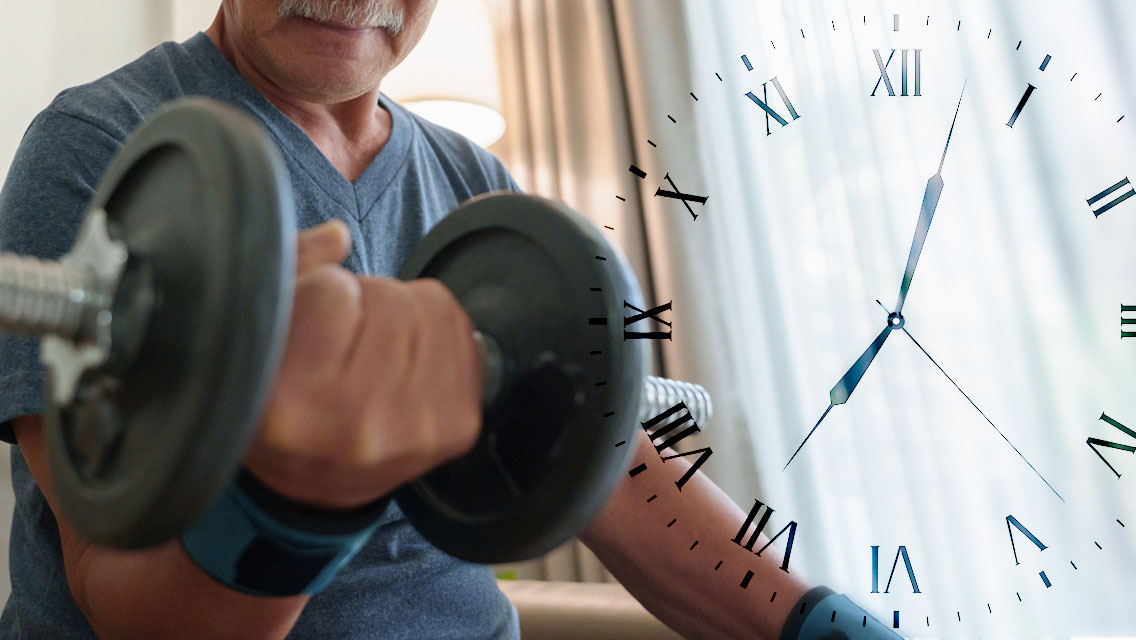
It’s a sad fact of later life that our muscles tend to betray us. By some estimates, as many as 50 percent of U.S. adults in their 80s contend with sarcopenia, a level of muscle loss that can raise the risks of frailty, falls, and fractures.
I’ve always assumed that it’s a lack of physical activity — strength training, in particular — that mostly contributes to muscle loss as we age, but researchers at China’s Sichuan University are pointing to a disruption of circadian rhythms — the body’s internal clock — as a prime culprit. When our sleep–wake cycle becomes disjointed for an extended period due to medications, illness, schedule changes, or other factors, the results can produce a wasting away of muscle mass.
That’s because the body’s internal timepiece plays such a key role in the development and maintenance of muscle, explains Tiantian Wang, PhD, coauthor of a recent systematic review of studies on the topic. “The circadian clock regulates many essential processes in muscle cells, from protein metabolism to mitochondrial function, immune responses, and cell repair,” Wang notes. “Understanding how these rhythms impact muscle health is crucial for developing new therapies for sarcopenia.”
Scanning the scientific literature, Wang’s team revealed some intriguing insights. Some studies have shown that targeting so-called clock proteins with specific molecular compounds may be able to adjust a disrupted circadian rhythm, though results have been mixed. More practical approaches, such as meal timing — and, yes, exercise — have shown some promise.
One 2023 study reviewing the meal schedules of older adults found that a longer eating window — earlier breakfasts and later evening meals — tended to produce greater muscle mass among study participants. And Wang cites research suggesting that the timing of our physical activity may nudge our circadian rhythms in a healthier direction.
Turns out that my assumptions about the influence of exercise on sarcopenia aren’t misguided. But it’s not simply due to some direct connection between hoisting weights and building biceps; physical activity is simply another factor that affects our circadian rhythms, which regulate all those biological mechanisms that affect our musculature.
Morning workouts, for instance, have been shown to “accelerate phase advances,” shifting the body’s internal clock toward an earlier period in the day. But there’s also some evidence suggesting that our muscles perform more effectively in the late afternoon than in the morning, so we may need to wait for more research before we can draw any real conclusions beyond the generally salutary effects of moving our bodies.
And Wang understands that pursuing such remedies presents a real challenge for an aging population. “Timed exercise and dietary interventions require significant adherence and lifestyle modifications, which can be difficult for elderly individuals with physical limitations or chronic comorbidities,” Wang writes in the Chinese Medical Journal. “Furthermore, the effectiveness of these interventions may vary depending on individual factors, such as chronotype, health status, and baseline muscle function.”
Still, we need to do what we can to keep our circadian rhythms functioning smoothly, because their impaired operation may have consequences beyond a drooping triceps, Wang notes. Lower levels of muscle-protein synthesis, impaired mitochondrial performance, cell senescence, and chronic inflammation can combine with other factors to cause more-serious health issues, including cancer and cognitive dysfunction.
“Impaired muscle function and reduced muscle mass may indicate not only muscle contraction issues but also systemic metabolic abnormalities and chronic inflammation throughout the body (known as inflammaging),” Wang writes.
That may be enough incentive for some of us to focus time and energy adjusting our sleep schedule or maybe even taking a closer look at our mealtimes. I’m just pleased to know that I wasn’t completely wrong about lifting weights.





Comments (0)