



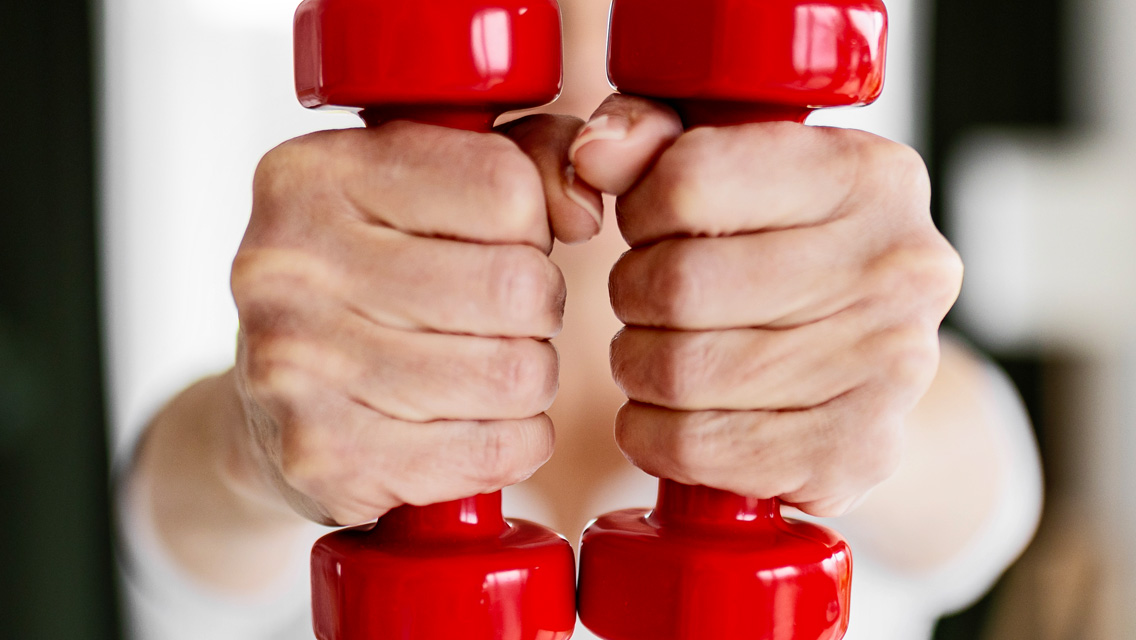
There’s a gym outside Detroit where seniors gather on a regular basis to lift very heavy objects. For $500 a month, they get a couple personal training sessions each week and access to barbells, dumbbells, and squat racks that challenge their strength. This is not an oasis for casual fans of 5-pound biceps curls, though. Here, you lift as much as you can. And then you lift some more.
“The basic program is built around four lifts: the bench press, squat, deadlift, and overhead press — supplemented with cardio,” reports Chris Cohen in The New York Times. “And while the program provides extensive adjustments for older bodies, it focuses on relatively high weight, low repetitions, and progressive overload, or structuring a training plan to consistently add difficulty.”
This approach is not for everyone.
Building and maintaining strength has long been a prescription for countering the loss of muscle mass that begins in our 30s and accelerates as we reach senior status. The aging body produces less protein, which helps grow and repair muscles, while declining levels of testosterone and insulin-like growth factor add to the problem. Unchecked, these conditions can lead to sarcopenia, characterized by muscle weakness, poor balance, and a lack of physical stamina.
This is all pretty well understood by physicians; what’s less clear is just how much strength training is required to prevent the condition. While the government’s recommendation for aerobic activity is quite specific (at least 150 minutes per week), it’s less prescriptive on building muscle, suggesting only that we lift a couple of times each week and focus on all major muscle groups.
By some estimates, only 16 percent of older adults manage to meet those vague government guidelines. So I was intrigued by recent research that offers more concrete advice for seniors hoping to rebuild their sagging musculature. And here’s the bonus: The results of these studies vary enough to inspire both committed exercisers and their less ambitious peers.
Any amount of strength training is, of course, better than none, but Edward Giovannucci, DSc, MD, and his team of Harvard researchers set out to determine just how much time in the weight room is optimal for a longer healthspan.
As Gretchen Reynolds reports in The Washington Post, they delved into 30 years of data on the physical activity and mortality rate of nearly 150,000 men and women. Their findings, published earlier this month in the British Journal of Sports Medicine, suggest that participants reaped the most health benefits by lifting 90 to 119 minutes per week. Those who adhered to that schedule were 13 percent less likely than participants who spent less time lifting to die prematurely from any cause and 19 percent less likely to die from heart disease. They were also 27 percent less likely to succumb to a neurological disease.
“Given its large sample size and long-term follow-up period, with repeated measures of resistance-training behaviors, the findings are convincing,” David Scott, PhD, an exercise scientist at Australia’s Deakin University, who was not involved in the study, tells the Post.
Convincing or otherwise, Giovannucci’s study may not be enough to inspire those seniors unwilling to commit a couple of hours a week to bench presses and deadlifts. Government statistics suggest this reluctance is especially common among older women. So, why not lean into evidence showing that lifting for less than 10 minutes a day can deliver health benefits?
That little nugget of inspiration, published in February, reflected the strength-training habits of more than 5,000 women between the ages of 63 and 99. Using data from an eight-year health study, researchers tracked participants’ moderate-to-vigorous physical activity (MVPA) and measured its effect on grip strength and chair stands as well as mortality risk. The results, notes lead study author Michael LaMonte, PhD, MPH, a research professor at the University at Buffalo — SUNY, suggest that aerobic activity is not the only way to enhance health and longevity.
“Even when the study sample was restricted to women with very little MVPA (less than 10 minutes per day) there was an association between strength and mortality,” he writes in JAMA Network Open. “The significantly lower mortality risk associated with greater grip strength in participants whose physical activity was below guideline recommended levels (less than 150 minutes per week) and in those who used a walking device is important because some older women may not be able to engage in regular aerobic activity but still might enhance health and longevity through maintenance of muscular strength levels.”
Ten minutes of daily lifting too much of a commitment? How about four? That’s what Penn State researchers calculated was needed to increase quality of life for seniors, in a study published in early June.
“The human body is designed to improve very quickly,” explains lead study author Christopher Sciamanna, MD, MPH. “And just a few repetitions of an exercise performed regularly can lead to huge improvements. Exercise is about forward thinking — think about what you want to be able to do and train for it.”
Sciamanna’s team recruited 97 older adults who reported exercising 18 minutes per week on average prior to the study. The participants were randomly assigned to two groups: One performed a daily exercise program involving two sets of four exercises — pushups, chair stands, two-arm rows, and stair stepping — each of which they performed for 30 seconds, followed by a 30-second rest, and another 30-second set. Those assigned to the control group maintained their normal exercise regimen.
At the end of the 12-week study, the results of which were published in the journal PLOS One, the program exercisers outperformed the control group on three functional movements: 30-second chair stand, one-legged stand time, and sit-to-stand time. The results, Sciamanna argues, relate directly to an older adult’s quality of life.
“These indicators predict your future ability to go into a nursing home [and] your future likelihood of falling and of developing difficulty walking,” he says. “They give you a sense of whether or not you’re going to be able to be active in the future.”
And those are worthy goals, whether you’re lifting a little or a whole lot.





Comments (0)