



Being wary about exercise after a heart attack is understandable. You may wonder if another cardiac event is imminent and worry about the slightest twinge or flutter. As a result, you might hesitate to do exactly what you need to do to get better — namely, get your heart rate up.
“People are frequently terrified,” says integrative cardiologist Mimi Guarneri, MD, FACC, author of The Heart Speaks: A Cardiologist Reveals the Secret Language of Healing. “They don’t know what just hit them. Some people go home without a foundational understanding of any of it.”
That’s why the first thing to do after a heart attack is enroll in a cardiac rehabilitation program, says Guarneri. These roughly 12-week, 36-session programs — available in person or at home and typically covered by insurance — have been shown to reduce the risk of mortality or hospital readmission by more than 40 percent.
A cardiologist and a team of specialized trainers design your program based on your goals and current capacity, then guide you through the earliest phases of recovery. The program can help you return to — and potentially exceed — your pre-heart-attack fitness level.
“There are flavors of heart attack; it’s not just black and white,” says interventional and integrative cardiologist Sanjay Bhojraj, MD, FACC. “For some people, we may have to put in an artificial device, which is complicated; others come in on Tuesday, go home on Wednesday, and they’re in the gym a few days after discharge.”
Only the professionals can tell you where you fall on that spectrum, but wherever it is, you can expect to follow a few general guidelines.
A Slow and Steady Approach
Your first day in outpatient rehab — which should take place as soon as possible after you leave the hospital — begins with goal-setting: Are you hoping to resume your normal daily activities? Or are you shooting for something more rigorous, like surfing, tennis, or triathlons?
Any goal is fine, says Bhojraj. Just know that progress after a heart attack — as in any fitness program — requires patience, time, and effort.
“Once, a patient told me he was going for a short jog and ended up running 15 miles,” he recalls. “Our job is helping people find the middle path between being afraid to do anything and wanting to run an ultramarathon in a week.”
Once you know where you want to go, he says, “we can reverse engineer your training program from there.”
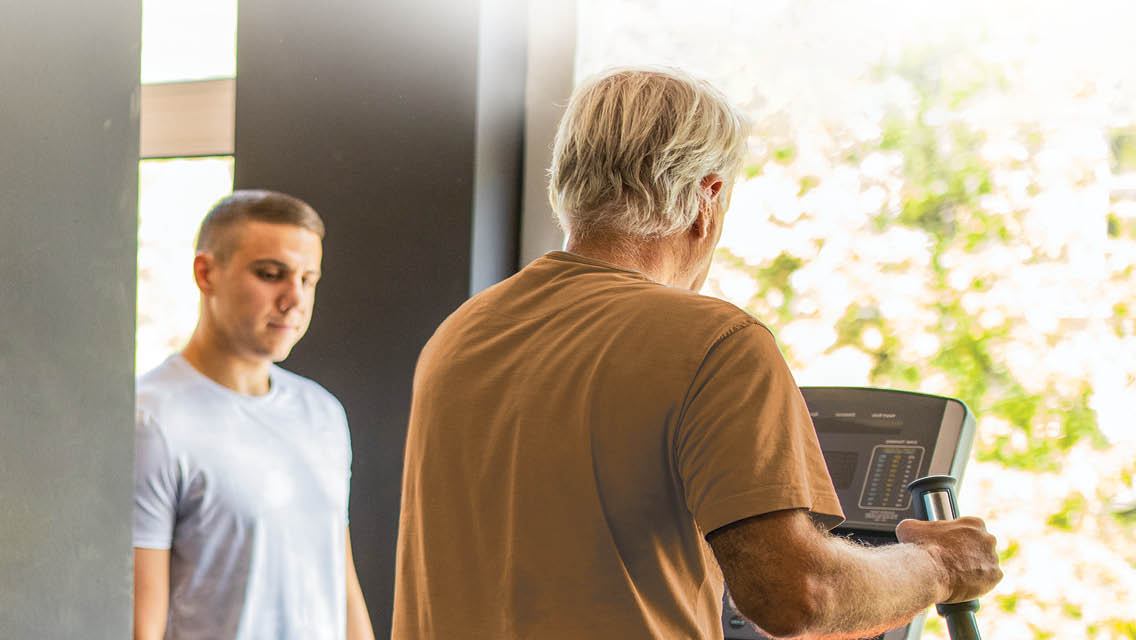
First steps for this phase of the program are just that: steps, usually on a treadmill, with a heart-rate monitor to ensure your safety. Walking — as well as cardiovascular activities like swimming or cycling — increases your heart rate, circulates blood, and decreases blood pressure and cardiovascular risk over time. Your coaches will keep the duration short and the intensity low and monitor your fatigue level and well-being throughout.
These early phases are safe. Bhojraj notes that in 15 years, he’s seen very few true cardiac events occur in a cardiac-rehab program. The primary intention is to help you feel confident exerting yourself again. “A lot of the early phase is psychological,” he says.
Strength training can complement the heart-building effects of aerobic exercise; it’s now a standard part of many rehab programs. As you curl and squat and press, your body releases nitric oxide. This relaxes the lining of your blood vessels, boosting what’s known as endothelial function, a key marker of vascular health. (Learn more about nitric oxide at “What You Need to Know About Nitrates.”)
Research also suggests that combining aerobic and strength work can be more effective for reducing blood sugar and lowering insulin resistance — other major risk factors for heart attacks — than either form of exercise alone.
As with cardio training, strength work in the early phases of cardiac rehab begins gently: lighter weights and higher reps, with a focus on form over exertion. If you’ve never lifted before, this low-stress approach will introduce your muscles to strength work without causing undue soreness. If you know your way around the gym, it’s a useful reminder of the basics of mechanics, form, and breath.
Train Smarter. Live Better.
Get More Insights.
Add Experience Life as a preferred source on Google.
Beyond the Body
Physical rehabilitation is only part of the process. “It’s emotional, mental, even spiritual,” says Guarneri. “All of those factors affect heart health.”
To that end, cardiac rehab often includes education on nutrition, stress management, and other lifestyle habits that influence long-term outcomes. Some programs offer classes in cooking, yoga, and meditation — all of which can empower you to take charge of your health. Practices like meditation can reduce the risk of cardiovascular events; one study found that people who meditated for 15 to 20 minutes twice a day over time cut their risk nearly in half. Quitting smoking and eating a plant-forward diet can further reduce risk, even in people with a genetic propensity for heart attacks.
“If you have good genes and a bad lifestyle, you do worse than someone with bad genes and a good lifestyle,” says Guarneri.
Finally, if your program takes place in a group setting, the most underrated perk of cardiac rehab might be the community you can build there. Social isolation and loneliness have been shown to increase the risk of heart attack by 29 percent and the risk of stroke by 32 percent.
In program counseling sessions, participants share stories, ongoing anxieties, and coping strategies, and they may benefit as much from the interaction as from the practical tips. Returning patients, back for a workup or a workout, often support newer ones.
“People go into a program, and all of a sudden they have 15 new friends,” Guarneri says.
Regaining Control
With these early steps — lighter workouts, lifestyle shifts, and psychological support — gradual improvement is the order of the day. Your doctor may have you on medications that reduce heart rate, so if you typically use a monitor to track your effort level, Bhojraj recommends reducing your estimated max heart rate and your training zones by 10 to 20 percent.
After two to four weeks of supervised training, Bhojraj has found, most people are able to start adding unsupervised workouts outside the program, increasing the intensity and duration of their sessions over time — just as you would in a normal fitness program.
“When people come out of the hospital, they feel like they have no power,” says Guarneri. “In cardiac rehab, you learn that the health of your heart is in your hands.”
This article originally appeared as “Back on the Beat” in the November/December 2026 issue of Experience Life.









Comments (0)