



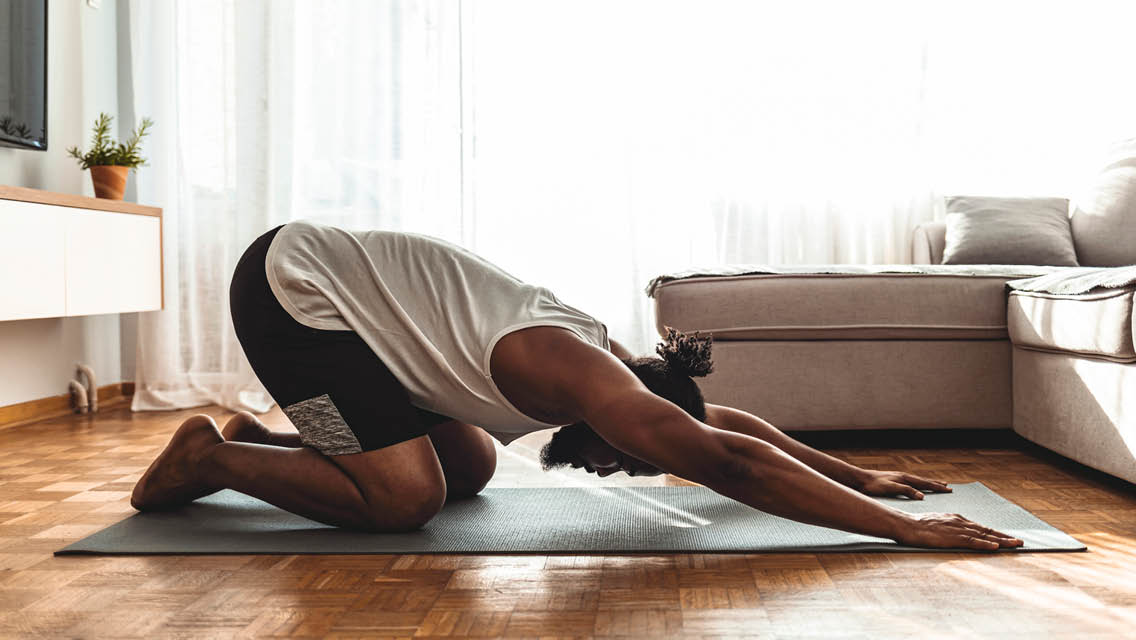
A standard approach to graded exercise — walking one mile one week, two the next, etc. — isn’t likely to work for people with long COVID. “Pushing through ‘the wall’ is more detrimental for them than allowing the body to rest,” says Nisha Viswanathan, MD. She charts a gradual, tiered exercise-recovery process:
1. Minimal movement, keeping the heart rate below 100 bpm
2. Slowly increasing the duration of gentle activity, keeping the heart rate low
3. Building toward brief bursts (five to 10 minutes) of movement with higher heart rates
| Do’s | Don’ts |
|---|---|
| Do keep movement minimal for two to four weeks following a COVID infection (or a period of lingering symptoms). “Give your body some time to let inflammation come down,” says Viswanathan. “If you have any crushing fatigue or shortness of breath, stop what you’re doing.”
Do ease back into movement slowly and gently, with five to 10 minutes at a time of stretching, light yoga, housework, or gardening. “The goal is that within an hour after that activity, you should not feel fatigued anymore,” she says. Do learn your body’s signals of an impending crash. Some people notice joint pain, headaches, or visual floaters when a crash is coming. Don’t push through these signs. Honor them, and slow down. |
Don’t do too much too soon. Pushing through pain or fatigue is likely to do more harm than good.
Don’t get discouraged by setbacks. Progress toward recovery may be marked by periods of relapse. “If at any point in the three steps we see fatigue coming back, then we know we need to dial it back,” explains Viswanathan. Progress isn’t always linear. But even when it’s two steps forward and one step back, focus on the forward motion. “I’ve seen a lot of improvement with this approach,” she says. |
How to Pace Yourself After COVID
Pacing was developed in the late 1980s as a tool for patients with chronic fatigue syndrome. Now, many long-COVID patients struggling with fatigue are finding it useful. The goal is to allow for as much activity as possible while limiting the frequency and severity of relapses.
People with severe fatigue usually have good and bad days. Good days present the temptation to accomplish as much as possible to make up for lost time, but this often backfires and leads to a crash.
Pacing takes a different approach. “When you have a good day, you do more things than on a bad day, but you don’t push yourself to the limit,” explains Leonard Calabrese, DO.
You calibrate an “energy envelope” for the day, allocate it carefully, and make sure you keep some in reserve. “It’s almost an art form,” he adds. This careful balance of activity and rest helps to manage a damaged aerobic energy system.
Pacing also requires a reappraisal of what constitutes activity. Anything that takes effort, whether mental, physical, or even postural (such as being upright), comes out of the day’s energy budget. Reading, talking on the phone, attending a Zoom meeting — these all count as activities.
“With pacing, I tell people to find ways to savor the good days and do things that bring joy,” says Calabrese. “If this is successful, the good days get more frequent and the bad days get less frequent and less severe.”
This was excerpted from “How Long COVID Affects Your Ability to Exercise” which was published in the December 2022 issue of Experience Life.




Comments (0)