


As we age, we naturally begin to lose muscle mass, which can lead to a higher risk of injury and other health concerns. Strength training can help counteract this decline and help our bodies preserve lean muscle, improve bone density, and enhance overall mobility.
“Strength training is great for improving mobility and balance, which can reduce the risk of falls,” says Kaylee Sternhagen, group instructor and coach at Life Time in Lakeville, Minn. “Maintaining muscle mass and bone density is crucial to reduce the risk of injury and prevent chronic diseases like arthritis, diabetes, heart disease, back pain, and several other issues.”
Because of the importance of regular strength training, Sternhagen recommends incorporating a class like ARORA Strength into your routine two to three times per week.
“ARORA Strength is for all levels and abilities,” she says. “In this class, you’ll see traditional exercises used to develop muscular endurance — no jumping or high-impact moves. We’ll guide you through all planes of motion, including squats, lunges, and push and pull movements, to work all parts of the body. Instructors will give options to modify and progress, helping you tailor the workout to meet your needs.”
To get an idea of what these exercises look like, we asked Sternhagen to demonstrate five moves you might see in an ARORA Strength class.
1. Deadlift
“The deadlift is a foundational strength-training exercise that targets the muscles along the backside of your body,” Sternhagen explains.
- Stand with feet hip width apart, toes pointing forward, and heels flat on the floor. Keep your back flat and engage your core.
- Softly bend your knees as you hinge forward with your hips. Trace the front of your legs with a barbell or dumbbells at a weight that feels challenging to you. You can also choose to use no weights. Pretend you are shaving the front of your legs and keep your back flat.
- Reach all the way down to your knees, or if your hamstrings and glutes are strong enough, you may even go down to your shins or ankles. Remember to keep a flat back and engage your abdominals.
- Rise up slowly, keeping a straight spine and squeezing your glutes. Gently press your pelvis into a neutral position as you stand tall. As you repeat these moves, you will find you can increase your range of motion.
2. Squat
“This fundamental exercise primarily works the lower body while also engaging your core,” says Sternhagen. “It targets key muscles in the quads, glutes, and hamstrings.”
- Stand with your feet about hip width apart. Keep your core engaged and your chest open without flaring your rib cage. Optional: Hold dumbbells at your sides or up by your shoulders.
- Lower into a squat: Brace your core, and, with control, bend your knees and hips to squat down until your thighs are about parallel to the ground. Keep your knees right over your toes throughout the movement. If it’s challenging to keep your toes pointed forward, you can open them slightly, but make sure your knees stay in line with your feet.
- As you rise, squeeze your glutes and feel as though your feet are firmly rooted into the floor.
- Once you reach the top of your squat, stand tall with proper posture; repeat.
3. Reverse Lunge
“The reverse lunge is a highly effective lower-body exercise that challenges your balance while strengthening the legs and core,” says Sternhagen.
- Stand with your feet right under your hips and your toes pointing forward. Optional: Hold dumbbells at your sides or up by your shoulders.
- Step one foot directly behind you, keeping your back heel off the floor. The farther back you step, the more challenging the movement will be.
- Lower down into a lunge position. You can increase the bend in your front knee, but keep your chest lifted without arching your back.
- Rise back up, step your back foot forward, and stand tall. Repeat on the other side.
- For more balance and stability support, feel free to hold onto a wall, chair, or body bar.
4. Shoulder Press
“This powerful upper-body exercise mainly targets the shoulders while strengthening muscles that are crucial for everyday pushing and lifting motions,” says Sternhagen.
- Stand with your feet about hip width apart. Though this move targets the upper body, make sure to keep your lower body engaged by squeezing your core and glutes; avoid locking your knees.
- Rack dumbbells at your shoulders. Optional: Use a towel or bodyweight if dumbbells don’t work for you.
- Press the dumbbells overhead while keeping your torso still.
- Bring the dumbbells back down to the front of your shoulders and let your elbows return to your waistline. Repeat.
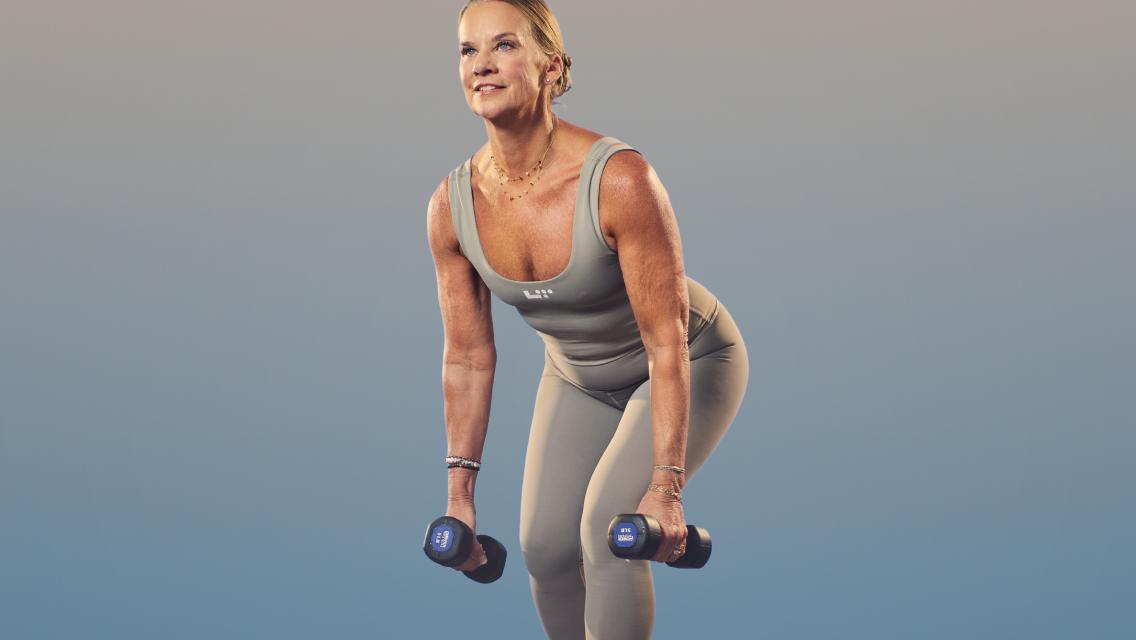
5. Bent-Over Row
“This move focuses on the ‘pulling’ muscles of the upper body, which is key for building strength in your back and supporting functional movement,” says Sternhagen.
- Holding dumbbells in both hands, stand with your feet hip width apart. Bend your knees and hinge forward from your hips, not your waist; keep your back flat, engage your core, and squeeze your glutes.
- Draw your shoulders down and away from your ears as your elbows bend and go straight back behind you. Squeeze your shoulder blades together the whole time.
- Extend your arms straight but don’t lock your elbows; repeat.
- Your instructor might tell you to turn your palms in or palms up depending on the part of your arms and back you are targeting.