


Understanding Cholesterol (Performance & Longevity Series)
Take a closer look at what advanced lipid profiles can tell us, what really influences cholesterol levels, how cholesterol affects long-term health, and what you can do to support healthy levels.


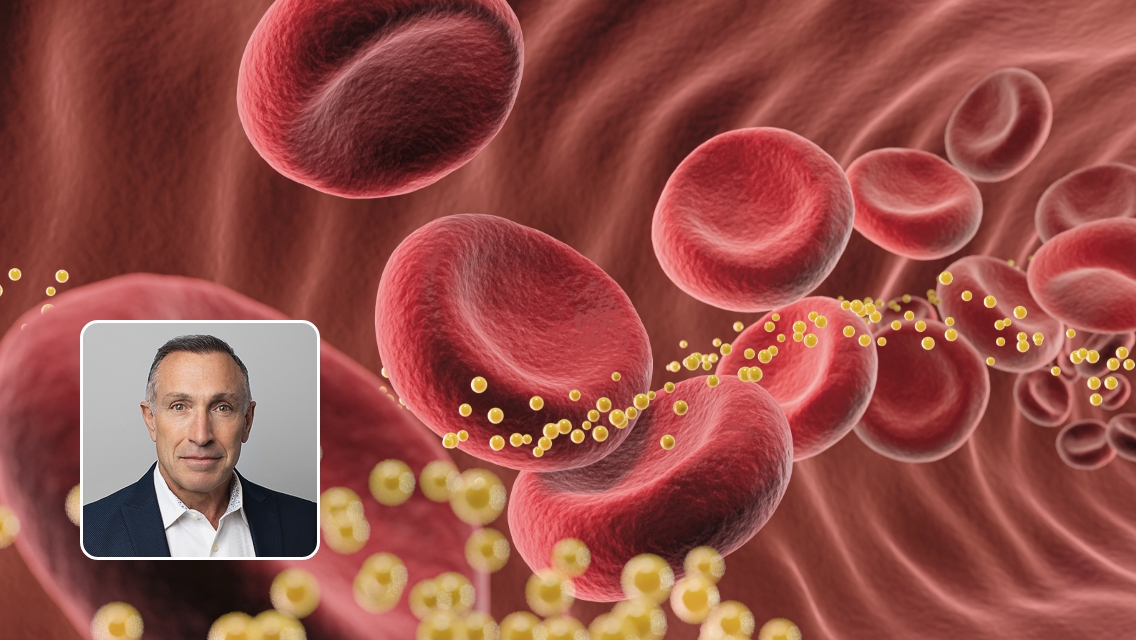

For decades, the conversation around cholesterol has been oversimplified, leaving many people confused. While cholesterol plays essential roles in the body, problems can arise when levels get too high or the wrong types dominate. The story is far more nuanced and complex than simply “good” versus “bad.”
In this episode, Jim LaValle, RPh, CCN, explains what advanced lipid profiles can reveal, what influences cholesterol levels, how cholesterol affects long-term health, and what you can do to support healthy levels.
This episode of Life Time Talks is part of our series on Performance and Longevity with MIORA.
Jim LaValle, RPh, CCN, is a clinical pharmacist, the cochair of the American Academy of Anti-Aging Medicine, the chair of the International Peptide Society, and the chief science officer for Life Time.
In this episode, LaValle explores how advanced testing can tell us more about cholesterol and its connection to overall health, what influences cholesterol levels, and what you can do to support yours. His insights include the following:
- Viewing high cholesterol as the villain of heart disease is an incomplete perspective. More advanced testing is necessary, as basic cholesterol tests (total cholesterol, LDL, HDL, triglycerides) don’t provide enough detail for accurate risk assessment or a true understanding of your heart health.
- Cholesterol is necessary for many biological processes, such as making sex hormones, repairing cell membranes, and supporting brain health. Issues occur when you make too much of the wrong kinds of cholesterol, or when the lipoproteins that carry it are problematic. Simply put, we need cholesterol, but we don’t need too much, and we don’t need the bad kind.
- The particle size and density of LDL (referred to as “bad cholesterol”) matter more than total LDL amount. Large, fluffy LDL particles can be protective as they can’t penetrate artery walls as easily as small, dense LDL particles. The same is true for the particle size and density of HDL (referred to as “good cholesterol”): If they’re large and fluffy, they can be protective; but if they’re small, they’re not as helpful.
- It’s important to understand your triglyceride-to-HDL ratio. The lower your triglycerides and the higher your HDLs, the better. LaValle notes a ratio of 1:1 or 2:1 as being excellent.
- Advanced lipid profiling should be part of standard bloodwork, according to LaValle. This is especially important for women approaching or past menopause because of the connection between hormonal shifts and heart disease risk.
- Advanced lipid markers to evaluate include apolipoprotein B (ApoB), apolipoprotein A (ApoA), lipid particle size, lipoprotein(a) (Lp(a)), and lipoprotein-associated phospholipase A2 (Lp-PLA2). Additional markers can be helpful depending on your situation.
- Genetics can influence cholesterol levels. Other influences include:
- Glucose and insulin disturbances: Higher glucose leads to higher insulin, which leads to more bad-actor lipids.
- Cortisol and stress: Cortisol triggers more cholesterol production.
- Environmental burdens: Lead, mercury, and arsenic exposure can all negatively affect lipid profiles.
- Overtraining: Exercise that’s too intense can raise cortisol and disrupt glucose, creating lipid issues.
- Sleep apnea: Disturbed sleep triggers inflammatory chemistry.
- Medications: Certain medications can alter cholesterol levels.
- Hormonal changes: Healthy hormone function, especially sex hormone function, is important for regulating lipids.
- Sugar and refined carbs are more often the culprit of cholesterol issues than dietary fat. The amount of saturated fat you can tolerate depends on your genetics and lipid response.
- A modified low-carb, low-allergen, anti-inflammatory diet can support healthy cholesterol levels. This includes consuming carbohydrates to your level of activity measured against your blood sugar levels. It also includes eating enough protein and plenty of vegetables and fiber.
- Certain supplements can support cholesterol levels, including aged garlic extract, omega-3s, and red yeast rice.
Transcript: Understanding Cholesterol (Performance & Longevity Series)
Jamie Martin
Welcome back to Life Time Talks. I’m Jamie Martin here with Jim LaValle, my friend and colleague and the chief science officer at Life Time. We are talking about a topic that we’ve all been hearing about for years. More than that, we’re talking cholesterol, because we know that it has a role in our health and well-being.
So, Jim, we know that for decades the conversation has been going on about this. In some cases, it’s been oversimplified, and many people are just confused about what all these numbers related to their cholesterol mean, which ones matter, and different things we want to talk about too in terms of, like, what about the size of cholesterol and all these different pieces?
So we’re gonna delve into it here for a little bit today. So let’s start with the obvious question. For years, many people have been told that high cholesterol is the villain in heart disease. Is that a complete view of cholesterol?
Jim LaValle
No, it’s not. It’s just, this is the story of the good, the bad, and the ugly. You need cholesterol. You can’t make sex hormones without cholesterol. You need cholesterol to repair your cell membranes. The brain needs cholesterol. There’s a reason your body makes it.
The problem is either you’re making too much of the wrong kind, which can happen due to other situations, I know we’re gonna get into that, or it’s the type of cholesterol and what it’s made of, the lipoproteins that you look for that also create issues. So cholesterol is essential. We need it. We don’t need too much, and we don’t need the bad kind.
And then we have to understand that, so I’ve lived through four decades of listening about cholesterol now. And so it was the bad guy, remember it was the bad guy and, “Hey, you know, get all the fat out of your diet.” And then it was, “Well, it’s bad, but gee, we’re starting to look at these advanced lab patterns where we’re looking at all the different kinds of cholesterol, like an NMR lipo profile.” That was kind of the big thing. And now we’re realizing that we need it, but at the same time, if the patterns of them are wrong, that’s where it really gets into trouble.
And I was just at a conference and it was funny, I was talking to a cardiologist, he’s one of my instructors in my courses, and we were like, “Yeah, a straight cholesterol, like cholesterol, LDL, HDL, triglyceride, that just isn’t gonna cut it.”
Jamie Martin
We need more detail then.
Jim LaValle
We need more detail. And if we don’t get that detail, we really wanna get a full picture of where am I at with my heart health.
Jamie Martin
So what impacts does cholesterol have on our body, and how does it affect our disease risk and long-term health?
Jim LaValle
So the first step is it promotes our health if it’s being used as a building block, which I just mentioned. Where the risks occur is if you’re making, let’s just call them bad actor lipids. I know we’re gonna get into them specifically, but if we’re making the bad actor lipids, they’re more prone to penetrate the inner lining of the artery called the endothelium. It’s actually currently being more called the glycocalyx.
So that’s one. So it deposits and now your immune system looks at it and goes, you don’t belong there. Let’s attack it. And then we create streak cells and foam cells and we make hardened plaque. And then we can also make vulnerable plaque. It also turns out that these LDL particles that are circulating could damage other tissues. So for example, there’s an association with high LDL and kidney issues, kidney disease. And when we lower those LDLs, gee, that’s good for the kidneys. There’s less oxidative stress.
You can think of dementia, anywhere where arteries are plaquing and inflamed and we’re reducing blood flow, that can be an issue. But the biggest story, of course, is heart disease is still our number one killer. It’s not only cholesterol, because there are people that have zero plaque in their arteries and they have a heart attack. And that’s not rare. It’s 30 to 40 percent of heart attacks. So we just have to be realistic that it’s not the total villain. And at the same time, we should be paying attention to it.
And what’s confusing it is that if I hear of a study in Europe on cholesterol, and it’s like, they have this level of cholesterol and their heart disease levels are lower. But what is their bad actor cholesterol profile like compare with us in the US who don’t have the same quality of food? We eat more sugars, we have more stress, we have less sleep, like all those factors. So you gotta compare apples to apples. And so therefore for us in the US, getting those lipids down a bit tends to be a little more beneficial. And that’s why the focus is there.
Jamie Martin
Got it. You mentioned LDL already, kind of the bad actor lipids. LDL has often been characterized as the bad cholesterol and HDL is the good cholesterol and all of those Cs, but it’s more complicated than that. Explain why the size and density of LDL particles is important and how you can compare that to total volume.
Jim LaValle
Yeah, and HDLs as well. So for both, it’s interesting if you make small particles, meaning they’re tiny. So if you think of a bucket, I got a bucket here. And I’m gonna drop LDL particles in it. The more LDL particles I can drop in that bucket, the smaller they are. So how I explain this to people is if you think of the inner lining of your artery, that endothelium or glycocalyx as a tennis net.
And I am gonna throw a softball through a tennis net. It’s not gonna go. Unless it’s Nolan Ryan throwing it a hundred miles an hour or something, like somebody that can really wail that ball. It’s probably not gonna break the net, it’s not gonna go in, and you don’t have a trouble. That is a large, fluffy LDL cholesterol pattern that is protective against heart disease. So no, all LDL are not bad.
The size of the particle, pattern A, pattern B, that’s the part. Your pattern A, big and fluffy, your pattern B, too tiny. So if I try to throw a baseball through a tennis net, some get through, some don’t. If I try to throw BBs,
Jamie Martin
I was gonna say like ping pong ball, BB, something like that. They’re going through.
Jim LaValle
They’re going through. And so the smaller the particle, the more risk you have. And that activation, you can see that because there’s an enzyme called myeloperoxidase that you can measure. The higher that goes, the more the chances are that you’re starting to attack that deposited cholesterol. It’s an enzyme that says, hey, we got to get to work.
HDLs, same way. We hear HDL is the protective cholesterol. And it’s true, if it’s large and fluffy. There’s good correlation to HDL cholesterol being very protective. If they’re small, they don’t do much.
You hear of your triglyceride. So we do a typical test, triglyceride to HDL ratio. So the more you can have lower triglycerides and higher HDLs, like if it could approach one to one, it’s amazing. If it’s two to one, it’s amazing. So a 90 triglyceride and an 80 HDL and they’re healthy, good, fluffy HDLs, that’s a really cool ratio that says your risk of future heart disease is smaller.
So those are the two big things. The other side is that at least in the integrative space, when your HDLs get too high, they’re trying to protect. And typically you look for environmental or what’s called the exposome exposure in an individual. Once those HDLs get up over a hundred. So in general, we want women over 50 on their HDLs, men over 40 in their HDLs.
The other one is on LDLs. Really in the literature now it’s you don’t want it over a hundred. I actually think, if it’s good fluffy HDLs, I’m not too worried about it if it’s 120 or 130 if they’re big and fluffy and protective, sure. Especially if my HDLs are good and my trigs are low. But if it gets into the 160, 180, LDL only, I think you gotta start to pay attention about that. Why are you making those bad actor lipids?
Jamie Martin
Talk a little bit about a couple of the markers, like ApoB. We hear a little bit about it. How does that metric give us an even clearer picture of true risk for heart issues?
Jim LaValle
So you look at what’s called an advanced lipid profile. And an advanced lipid profile for me is what everybody should get. If they don’t have any other kind of comorbidity, like they’re not insulin resistant, they don’t have low thyroid, because those are two big risk factors. They don’t have high cortisol. It was in the Wall Street Journal 30 years ago that stress, cortisol causes hyperlipidemia. And yet we’re still shocked. I mean on the front page, it’s like wow, okay.
So the point being is it matters, especially when women are approaching menopause. Because more women will die of heart disease postmenopause than men will. So it’s important. So you’ve got apolipoprotein B. Apolipoprotein B is an inflammatory lipoprotein. That’s a fraction that you can measure when you’re looking at cholesterol. And the higher the apolipoprotein B, it creates more risk. So ideally you would be under 90. I like to see it under 80. So I’m not like at 90. And then that means you’re normal, but you’re right at the edge of the normal. So I like to see it there, but you also look at APOA and APOB as a ratio. APOA is a more friendly lipoprotein that can be protective.
And then you have other fractions. You can also measure your lipid particle size. So in that advanced lipid panel, you may get an apolipoprotein B. You can get an LDLP, so LDL particle size. And that’s just giving you a number of, is it a thousand? And I’ve seen it as high as 2,500. So if it’s under a thousand, that means you got big fluffy cholesterol you’re putting in that bucket and you can only get a thousand of them in there, or 1,100 in there. If you’re getting 2,500 in there, that’s that ping pong ball BB thing. There’s a lot of bad actor LDL, small particle.
Then there’s other fractions like lipoprotein little A. And lipoprotein little A is interesting because it’s kind of got a unique structure that it actually can be independently damaging. So lipoprotein little A is an independent risk factor for future, not just heart disease risk, but acute myocardial infarction risk. So if that gets up over, 125 is typically the high end of normal. You get into the two hundreds on that, it’s bad. There’s some genetics to that. And people that are insulin resistant and people with diabetes tend to drive that number up. That’s why people with diabetes, all people with diabetes have heart disease developing somewhere because of that baseline chemistry. They make more LPA. So it’s this lipoprotein that’s specially structured that can create inflammatory chemistry.
Jamie Martin
Okay. So, and I’m not gonna know which one this is, but I have heard and read a little bit about one of these factors. They’re like, okay, if I have an, is the LPA the one where it’s like, hey, you could be doing everything right, but if you have this, your risk is still up? Even if that’s the one, that’s what I thought.
Jim LaValle
That’s the one. Another interesting fact about LPA. And postmenopausal women especially. Yes.
Jamie Martin
Do I wanna know? I do want to know, but I’m done.
Jim LaValle
It’s a good one. When they get their estradiol replaced, a lot of times that LPA drops.
Jamie Martin
Well that’s, I mean, so again the case for like really good,
Jim LaValle
Your hormones. Getting a good assessment, a full picture of your health. That can really help that.
There’s a couple other markers that are important. One is LP-PLA2. And that’s another marker that just shows it’s basically a lipoprotein that’s carrying around oxidative compounds. So the higher the number that you’re making, the more oxidative compounds you’re carrying around. And oxidative stress is what damages the inner lining of the arteries. And so as you get under oxidative stress, you use up your glutathione and you use up your SOD, which are your antioxidant protection. And what happens is that you make more superoxide anions. Those are free radicals, superoxide free radicals. When you make enough of those, you trigger peroxynitrite free radicals. I know I’m going down a rabbit trail.
Jamie Martin
This whole,
Jim LaValle
And it’s a big deal. But I think you kinda gotta understand how’s this happening to me. And what happens is that that chain of free radicals triggers something called vascular adhesion molecule. Vascular adhesion molecule one, V-CAM one. Well, what’s that mean? It’s making that lining of the artery more sticky. So more attached, so the cholesterol can attach to it.
We all hear about alpha lipoic acid. Alpha-lipoic acid inhibits vascular adhesion molecule one. So it’s a nutrient that’s really valuable. And so it’s just understanding that, well, how did I end up getting in that situation? Heightened oxidative stress damages your lining because you’re triggering these molecules. And now all of a sudden it’s up.
Now let’s go another step further related to cholesterol. If you are gaining weight and you have a lot of visceral fat, you make something called angiotensin. It’s angiotensinogen, which when you make angiotensinogen, it makes you convert from angiotensin one to angiotensin two. Why is that important? Angiotensin two is what makes your vascular smooth muscle thicken. So your artery wall thickens, narrows,
Jamie Martin
To narrow the,
Jim LaValle
And they get less pliable. They get stiffer, and now you start to. And your blood pressure’s going up. And so you have to recognize that. And that’s one of the most common drugs given. The angiotensin blockade drugs, like losartan. A lot of people listening, they know somebody in their family on losartan. Guarantee it. Or lisinopril. And so understand that all this is playing together that kind of force this cholesterol into a bad place.
So there’s people that I’ve seen that’s like, hey, they’ve got higher lipids, but they’re not making bad actor lipids. And genetically they’re not predisposed, and therefore no risk is happening. Where I have people that look pretty darn healthy, but because of that genetic predisposition, and maybe because they’re under a lot of stress, they’re setting themselves up with a lot of bad actor lipids.
Jamie Martin
So that’s really the case for going more in depth with that advanced lipid profile, like really wanting to look at more numbers.
Jim LaValle
Yeah, I think you have to understand because you can even measure oxidized LDL. You can measure that myeloperoxidase in a translator profile. What’s oxidized LDL? Ox LDL is that LDL cholesterol that has been attacked by your immune system. And so basically if you’re in our immune talks, we talk about monocytes. When monocytes go up, they make macrophages. You make two kinds of macrophages. The one, macrophages one, is what goes and attacks that cholesterol. And that’s the pro-inflammatory macrophage.
Jamie Martin
And we don’t want that one. Again, interconnected systems.
Jim LaValle
And in fact, integrative cardiologists would say they feel more like gastroenterologists than cardiologists.
Jamie Martin
Because you gotta be thinking about that gut.
Jim LaValle
There’s a gut, brain, heart connection. Once again, body being a system of systems and understanding that these networks are always talking to each other. They’re either sending good information or maydays.
Jamie Martin
Okay, so to that point of these things being interconnected, let’s talk inflammation and C-reactive protein. How does systemic inflammation act as a trigger that could take harmless cholesterol and make it more problematic for our bodies?
Jim LaValle
So the first thing is that when you get signals of inflammation, you’re gonna make more cholesterol because you’re trying to repair damaged tissue. So that’s one. And inflammation signaling is supposed to be really good for us. But the problem is if it’s sustained inflammation signaling, it’s going to trigger more bad actor lipids, some of these lipoproteins. And it’s going to trigger more oxidative stress, which damages cholesterol. So inflammation is there.
And the thing is, sometimes your C-reactive protein, which I think is a really good marker, it’s just not the only marker. So sometimes people have a low CRP and they still have issues. But C-reactive protein, it’s a calculation of a family of cytokines. Just like basophils is another one. Basophils, if your basophil is over one, probably have heightened interleukin six floating in your bloodstream. So CRP, the high sensitivity C-reactive protein.
Now, I gotta give people a couple caveats on this. Don’t work out hard the night before your blood test. If you work out hard the night before your blood test, you will have an artificially inflated C-reactive protein. So you don’t wanna have a lot of alcohol, because that could affect liver enzymes as well as CRP. And if you’ve had a recent infection, like I was sick last week, I went and did my blood test for my annual physical, more than likely C-reactive protein, because it definitely shows up as elevating if you have an infection.
Jamie Martin
Got it. Okay. All right.
Jim LaValle
You know what I enjoy? I love it when you take a deep breath and you just go, I just wrote a lot of stuff. I really love that.
Jamie Martin
Well, and like, okay, this is the path now, how do I go from here? Where’s the next thing? So many things, so many ways we could go. Okay, we know that genetics can influence cholesterol. There’s that piece of it. But what are some of the other influences that will affect our cholesterol levels? What causes them to elevate?
Jim LaValle
Yeah, I mean one of the biggest ones is glucose and insulin disturbances.
Jamie Martin
I wonder how many times through this season we say glucose and insulin because it’s in everything.
Jim LaValle
If you remember right, I said it’s at the center of everything because it’s how your body makes energy. So when that’s disturbed, you’re sending out warning signals. And the warning signals are inflammatory signals, which then go down the road. So the higher the glucose, the more the insulin, the more you’ll make bad actor lipids. And that’s why when people go on GLP-1s, their lipid profile gets significantly better. Because you’ve controlled their glucose and insulin regulation, you’ve got mitochondrial function back, and now you’re remodeling your lipids in a good way. So that’s a big one.
The other one is cortisol. So cortisol also will trigger more cholesterol production. So those are two big physiologic ones.
Environmental burden could trigger that. So there’s plenty of studies that kind of look towards lead exposures, mercury exposures, arsenic exposures, and what that does potentially to lipid profiles. So that’s really important.
I would say that people that are overtrained, because their cortisol goes up, because their glucose is off, exercise as its own driver also can create those issues.
And obviously, another big one is apnea. So if you have disturbed sleep and you’re triggering all this inflammatory chemistry and your heart rate’s going up and your blood vessels are freaking out, you’re gonna make more cholesterol. And you see that, right? People with apnea, they gain weight for no apparent reason, their lipid profiles look bad, their glucose and insulin’s bad. So that’s really important.
And then you could see it go up. Certain medications could alter your cholesterol. And infections, maybe chronic infections, you’ll see disturbances in it when people get into more chronic infections. But those are the key things.
I mean, obviously when you lose hormones. Hormones are kind of important for regulating, especially sex hormones, for regulating your lipids. For example, men who have low testosterone are more prone towards cardiovascular disease. Because with low testosterone, you have all this other inflammatory chemistry that kind of spirals out of control. Women postmenopausal, where they no longer have estradiol to protect the inner lining of their arteries, also plays a very important role.
And then thyroid hormone. So thyroid hormone basically helps you to burn fats. And so when thyroid hormone hits your cell, here we go with more big words, carnitine palmitoyl transferase. So what’s that doing? That’s helping you carry fats to be burned. And you need carnitine. Carnitine transferase. So we think of these, well, how do we make these names up? It’s because it’s usually including one of the amino acids that you need in order to make that enzyme work.
Jamie Martin
The case for more amino acids, right?
Jim LaValle
Exactly. So low thyroid will end up creating higher lipid profiles as well. And then there’s the genetic hypercholesterolemia that can occur. I think that’s less common.
I also think that we’re maybe overmanaging and scaring people. We do know that if we lower cholesterol too much, there’s the literature related to statins. I’m not here to bash statins. If people have an existing coronary artery score, statins can help. But truthfully, a lot of the cardiologists are on to the next generation. They’re moving on to the more biologic version of the drug, which does a little bit better job of utilization of LDL, shaping of LDL, and lowering the total amount.
A lot of people know the big side effect related to statins. You’ve got about 20 percent of people who take it who will get myopathies. Their muscles get sore. Now they can’t work out. And working out really helps regulate your lipids. And then there’s the increased incidence potentially of Alzheimer’s and the increased incidence of diabetes that’s been associated with it. It makes sense, because if you lower your cholesterol a lot, you maybe don’t have as many building blocks in your brain. That’s not gonna help things. And if you’re lowering your mitochondrial capacity, that’s gonna affect your metabolic status.
Once again, it’s not about, hey, when I look at drug therapy. I think I probably look at it more neutrally than a lot of people in integrative medicine. A lot of people just kind of get out the thump and stick, or it’s bad, it’s bad, it’s bad. I don’t think that’s the case. I think a lot of times the nutrient depletions that occur when you take a drug actually contribute to why you see side effects. The obvious one everybody’s heard about is CoQ10. It also depletes carnitine. Carnitine’s needed for burning fat in our cell, with thyroid hormone activating it. Carnitine goes down, vitamin D goes down, selenium goes down, omega-3s go down. Omega-3s are highly cardioprotective.
Jamie Martin
Right, we need those healthy fats.
Jim LaValle
And they help us shape those lipid molecules. So we’ll make more HDL when we take omega-3s, when we take magnesium. I’m always very interested in drug nutrient depletion. Why aren’t you researching that the nutrient depletion is why that’s happening? And if you gave those nutrients, maybe you wouldn’t have as high a side effect profile.
Jamie Martin
Right. So quick question about statins, because I have been hearing more recently about some people who are going on statins proactively. They’re thinking, I have a risk of heart disease in my family based on these numbers that are trending this way, so I’m going the statin route. What are your thoughts on that, from a proactive standpoint where you have not been diagnosed with anything at this point?
Jim LaValle
Personally, I’m not a proactive statin person. From the clinical side, if you don’t have any evidence of a problem, don’t give a drug that has known side effects. And I’ll give you a good example of that, because it’s different when you take a drug in someone who has a condition versus when they’re well.
Remember when metformin was thought of as the ultimate anti-aging approach, where you should do this in the well population and it’s gonna be great? There was a very famous book that came out related to it by a very famous author. I’m not gonna say anything. But a few years later, he gets on social media and says, I’m no longer taking metformin, because it turns out that in a healthy population, when you take metformin, you can’t build muscle.
Jamie Martin
Right. So there’s the question of what the effects are.
Jim LaValle
It’s more about a drug that’s developed for an illness doesn’t mean it has the same effect if you’re well.
Jamie Martin
Well, this goes back to an earlier conversation we had. This kind of kicked off our whole season really, about performance aging and that gap between disease treatment versus keeping people well. There’s a little bit of a gap in there.
Jim LaValle
That’s exactly it. So now what’s one of the gaps we’re trying to bridge? We’ll use these meds that’ll keep you on the well side. But there isn’t a lot of research to that effect. Is it a fact that type 2 diabetics taking metformin have some benefits? Absolutely. But they have a condition. They’re on that disease state side. So I’m very careful about preventative medications. I just wanna understand it. I’m not against it. But that was one of the big primary drivers, and to be honest, I was saying it all along. It ended up coming true, which is good. I think we just have to be very careful.
Jamie Martin
Okay. I wanna get into a little bit about the misconceptions around dietary cholesterol and blood cholesterol, because there is confusion there as well. There was this whole push, and we talked about this in other episodes, to aggressively cut out saturated fats to protect yourself, to protect your heart. What do you say about that, on the dietary cholesterol side of things?
Jim LaValle
I think it depends. I think cholesterol was vilified when it clearly wasn’t the culprit. It was sugar and refined carbs. That was the big villain. We all know that now, so we can talk about it.
Jamie Martin
The actual villains, right?
Jim LaValle
And there is that population of people. I remember there was a PhD who came into our clinic and his lipids were horrible. He was somewhat ketogenic. He was drinking the real famous fat coffee, doing all this. We ran his ApoE gene steps and he was a three-four. And he’s taking in a ton of saturated fat a day. When we got him down to 20 grams of sat fat and got his stress under control, he literally said to me, I haven’t seen lipid numbers this good since I was going through medical school.
So I think you have to look at it this way: I’m eating this way in my life, I’m gonna do a lab. You do the lab, your lipids look great. Okay, keep doing what you’re doing. I do my lab, my lipids look like crap.
Jamie Martin
What am I gonna change?
Jim LaValle
What am I gonna change? What do I need to do? Am I eating too much sat fat? Am I eating too much sugar?
But I don’t think fat should be vilified, period, as dietary cholesterol. I can tell you right now, I’ve got people who come in to me, 45-year-old executives, and they say, I eat a steak every night. And they don’t have the genes for it. They’re not gonna develop a lot of cholesterol. In fact, I get jealous when I see it. I’m looking at them going, my gosh, you look at your advanced lipid profile, it’s perfect. And you’re eating horribly. Although that might catch up with them in other areas.
It’s that thought of, you really need to look at whether what I’m doing is good for that lipid profile. And when you’re thinking of your lipid profile, you want to be thinking about what my liver numbers look like, what my stress looks like, what my glucose and insulin look like. It’s the family. What we call triads in metabolic code assessment. It’s what triad of relational things are going on. In the case of lipids, it’s liver, because you produce a lot of cholesterol in the liver. It’s that liver, adrenal stress, immune.
Jamie Martin
How are they interacting?
Jim LaValle
How they’re interacting. Gut, immune, liver.
Jamie Martin
Okay. Did you wanna speak any more on the whole refined carbs and added sugars when it comes to heart health piece of it?
Jim LaValle
Yes, I do. I really do. Nobody should be eating a lot of refined carbs and sugar, ever, for any reason. It’s amazing to me that we haven’t done more to correct this. I don’t want to get to the point, you remember the show “Demolition Man” by any chance?
Jamie Martin
I don’t, but okay.
Jim LaValle
So Sylvester Stallone’s in “Demolition Man” and he’s in the future, and everybody is walking around and they only sing jingles from commercials, like Oscar Mayer. That’s all the music that’s going. But the point of it is, every restaurant you go into, everything is controlled. You can never have a piece of cake. I’m not that far. I think people should enjoy a birthday. I think they should have a holiday.
But holidays aren’t whole weeks, and they’re not whole months, and they’re not whole years.
Jamie Martin
Yeah. Days at a time.
Jim LaValle
So the point being, we haven’t as a society responsibly looked at our food and what we’re allowing to be present. Why do we have so many children with diabetes now? Why do we have children who already have plaque in their arteries in their teens? There are children who are now getting treated with statins in their teens. So that whole saturation of glucose and a bunch of refined carbs, it’s trouble.
So I guess every episode I wish I could say that, to be honest with you, Jamie, because I think it’s at the core of why we’re having issues.
Jamie Martin
We need to limit those just in general for our health and well-being.
Jim LaValle
You go to countries that eat smaller plates and don’t rely on that, where it’s more balanced, like the Mediterranean diet. And I’ll still push back a little bit and go, yeah, but we don’t live in the Mediterranean, so maybe environment has something to do with that. But it’s true, they’re eating whole foods, they’re not as processed, they’re not sprayed. That’s a core thing for why your cholesterol is gonna be going up.
Jamie Martin
Avoid those refined carbs and sugars. And probably the ultraprocessed foods too. Let’s just put that in there as well.
Jim LaValle
Yeah, you’re probably gonna say that every time.
Jamie Martin
Every time. So let’s get to that proactive side, the things that we can do. Is there a certain type of nutrition approach that you do recommend? You kind of already said it can depend, depending on your lipid profile. But just general types of foods we should be prioritizing.
Jim LaValle
What I’ve used in our clinics for literally the last 40 years is a modified low-carb, low-allergen, anti-inflammatory diet.
Jamie Martin
You said that super fast. You need to have an acronym for that.
Jim LaValle
Modified LCLAID.
Jamie Martin
That would be an initialism, and we can have that.
Jim LaValle
We could do that. Modified low-carb, low-allergen, anti-inflammatory diet. So I like that diet. We developed it with a team of dietitians. Not overdoing carbs, getting adequate protein, teaching how to eat plenty of vegetables. Carbohydrates matched to your level of activity measured against what your blood sugar is. Because we have genetic variance in how much carbohydrate we can take in too. There was that fascinating study where they gave an equal amount of a carbohydrate load and you saw what the tolerance was. That’s crazy.
Jamie Martin
Well, and that’s where things like CGMs can be helpful, right? Because how you react to a sweet potato might be different than me, depending on the person.
Jim LaValle
I think CGMs are critical for learning about cardiometabolic health, which is glucose, insulin, and lipids. And stress, let’s add that. But I think that diet-wise, more vegetables and fiber is really good to help control cholesterol. I like giving additional fiber. I love sun fiber. I’m a big guar gum fiber person because you can pour it in your water, you can pour it in your coffee, you can put it in your protein. It’s tasteless. It’s great. It binds up that extra cholesterol. I think it’s really good.
And then, depending on how you react, how much saturated fat can you tolerate? Learn it. I am an ApoE three-four. I am Italian. I loved charcuterie boards. I love dried Italian sausages that are made preservative-free. And who doesn’t love cheese?
Jamie Martin
No, that’s like one of my go-to snacks.
Jim LaValle
And I can’t have it. Because I watch it.
Jamie Martin
Because you’re careful with it.
Jim LaValle
I do. You’re correct. I do. That’s that holiday.
Jamie Martin
Special occasion. Yeah.
Jim LaValle
But I really think you wanna get to understanding that. I always tell people, you gotta learn how to eat vegetables. I like people trying to shoot for seven to nine servings of vegetables a day. The servings aren’t that big. Half a cup. And then three vegetables for every fruit. Because if you eat too much fruit, yeah, I eat fruit, I eat bananas and pineapple, and I also eat dates. High sugar still is always gonna lead to more lipids.
Jamie Martin
Right. So you kind of wanna have the veggies, which are really the fiber and all the other things, with that sugar.
Jim LaValle
Yeah, it’s berries, it’s apples, it’s pears. But just watch too much pineapple. And I’m not big on fruit juice. If you’re gonna drink it, I always tell people pour an ounce or two of fruit juice and fill the rest with either sparkling water or regular water. And then you have your cheat days. You’re gonna have days where you just have to say, hey, I enjoy this food. I recently had a birthday. My wife baked a carrot cake for me. I really like carrot cake. It was gluten-free, but it had natural sugars and it was delicious. And I enjoyed a nice big fat piece of carrot cake. And guess what? I had one piece of carrot cake. And we gave the rest of the cake away.
Jamie Martin
See, that’s the nice thing, right? But I think that is so important still with anything related to food: We still want food to be a pleasure. Celebrate food, and there’s ritual around it and all that. But the rituals don’t typically happen every day.
Jim LaValle
Right. When you’re talking about cardiovascular health and insulin and glucose regulation, I think people should take the time to learn how to cook with good food, because it doesn’t have to be bland. It doesn’t have to be non-engaging. My father was one of the most famous chefs in the world. I grew up around food. We love cooking food. But at the same time, you can make healthy foods wonderful.
Jamie Martin
Yes.
Jim LaValle
Absolutely. And it’s your responsibility to learn that. It really is a person’s responsibility. And I know that’s hard, but just remember you also probably have children in your home. They deserve to be eating healthier too.
Jamie Martin
Absolutely. Are there any other strategies to lower cholesterol levels we haven’t talked about? I think we covered most of them.
Jim LaValle
Yeah, if you’re wanting to take nutrients related to cholesterol, aged garlic extract, 1,200 to 2,400 milligrams a day, reduces cholesterol seven to 10 percent, significantly reduces oxidized LDL, significantly reduces apolipoprotein B, helps to manage LPA, has been shown to improve the endothelial connectivity in your tissues, and helps to reduce circulating inflammatory cytokines.
Jamie Martin
Seems like just a good one to take.
Jim LaValle
It reduces vulnerable plaque. It’s been shown in human studies to reduce the soft plaque, which is actually the more dangerous plaque. And when people with diabetes take it, they actually had a one-year study showing that it reduced their left ventricle size, which is a part of the heart disease phenomena. So yes, I think everybody should take aged garlic extract. There are amazing clinical trials related to that.
Obviously people take things like red yeast rice to just lower their cholesterol. Fish oils are good. But remember, you’ve got to get your blood sugar right. And you’ve got to get your stress hormones right. So these things are great. I’m a huge aged garlic extract fan because there are hundreds of publications on it, published in leading journals, as to what it does when it relates to lipids. It even helps with fatty liver. We now have a new term for that, but it helps to get the fat out of the liver, which is one of the key features that happen. When you’re making a lot of lipids and you’re hyperlipidemic, some of that fat’s going into the liver.
Jamie Martin
Yeah, it’s absolutely gonna go over there. Okay.
Jim LaValle
So those are the key ones. There are others. Niacin’s interesting, but if you’re using it at a higher dose, which a lot of docs will consider using to lower LPA, you get a 25 percent reduction typically. You just have to test your labs every four months when you’re doing high-dose niacin, because in some people it raises their bilirubin and creates some side effects when you take it at a real high dose.
Jamie Martin
So test more regularly with that one.
Jim LaValle
Yeah, but it’s a vitamin, right?
Jamie Martin
Right. Okay, last question. If you’ve been struggling with high cholesterol for years, is it possible to reverse damage or plaque buildup if you incorporate these changes? Can you go backwards?
Jim LaValle
So, toward health. The current thought is that hardened plaque is your body doing its job. Could you halt future hardened plaque? I think that’s a yes. Can you regress that plaque? We did a lot of coronary artery scans at our institute in Ohio. We were leading the country in the research. And yes, I’ve seen the hardened plaque numbers go down. But it’s not always easy.
The one that you have a lot of control over that’s really important is vulnerable plaque. It’s the soft plaque that can break off and lead to a stroke. And that is highly modifiable now, with agents like Repatha. I know a Harvard cardiologist, actually a heart transplant surgeon, who uses certain stem cells and exosomes and has seen reversal. So I think we’re on the verge of that maybe being more and more possible, that you’ll see significant hardened plaque reversal. But stopping it is the first part that’s most important.
Jamie Martin
So, in terms of the innovation space when it comes to cholesterol and new things that are coming, like looking at some of these stem cell approaches and exosomes and all of that, which we’ve covered in separate episodes.
Jim LaValle
Right. Exactly. There’s a lot going on in this space that I think gives people a lot of hope.
Jamie Martin
That’s good news. Jim, as always, you’re like an encyclopedia of knowledge here on the podcast. If people want to learn more and hear more from Jim, they can do that in the podcast at ExperienceLife.com. And to learn more about MIORA, which is doing great work in this space, it’s MIORA.lifetime.life. All right. Thanks, Jim.
Jim LaValle
It’s always fun.
More like this




We’d Love to Hear From You
Have thoughts you’d like to share or topic ideas for future episodes? Email us at lttalks@lt.life.
The information in this podcast is intended to provide broad understanding and knowledge of healthcare topics. This information is for educational purposes only and should not be considered complete and should not be used in place of advice from your physician or healthcare provider. We recommend you consult your physician or healthcare professional before beginning or altering your personal exercise, diet or supplementation program.
Life Time provides administrative, non-clinical support to MIORA as well as services and amenities related to general wellness and fitness; Life Time does not provide medical advice, diagnosis, treatment or care.
Advertisement