



For years, protein has dominated the nutrition conversation, with people closely tracking how many grams they need and consume each day. As of late, however, fiber has started to claim more of the spotlight. But rather than approaching it focused strictly on daily gram targets, many are embracing “fibermaxxing,” a wellness trend centered on packing more fiber into their diets in pursuit of better gut health, satiety, and overall well-being.
While experts welcome the focus on this often-overlooked nutrient and encourage efforts to increase daily fiber intake, a “maxxing” approach is not right for everyone and requires some nuance.
What is fibermaxxing?
Fibermaxxing is a social media trend focused on maximizing daily fiber intake. The motivation behind it is sound: Fiber offers numerous health benefits, and an estimated 90 percent of women and 97 percent of men fall short of the recommended daily consumption.
But why is this nutrient suddenly getting so much attention? According to Samantha McKinney, RD, CPT, director of LTH at Life Time, several factors are at play. “Fiber is in the spotlight for a combination of reasons,” she says. “First of all, gut health is becoming more mainstream across wellness content on social media. People are thinking more about gut health for overall health optimization. There’s attention on the rise of colon cancer, too.”
The rising popularity of GLP-1s is also making people think more about their fiber intake. “It’s well known that boosting your fiber while on a GLP-1 is crucial for satiety and maintaining health regularity like consistent bowel movements,” McKinney adds.
With the buzz comes increased awareness of the critical role fiber plays in many aspects of our health, including gut health, blood sugar, heart health, and appetite. McKinney believes the attention on fiber is a good thing — but she cautions that it can be taken too far.
“Focusing on fiber overall is a health-enhancing habit that most people can benefit from,” she notes. “However, there certainly are concerns with going too extreme. Optimal fiber intake depends on the individual, their overall diet, and their digestive health.”
How much fiber do I need?
Most people do not consume enough fiber, according to McKinney. “If you look at the baseline fiber intake of the majority of people, they need to at least double their intake for optimal well-being,” she says. “But it’s important that the increase is done slowly and over time.”
The USDA’s current recommendation is 25 grams of fiber daily for women and 38 grams daily for men. However, that’s a guideline many experts believe is too low for ideal health.
“When I work with clients, I recommend hitting 35 grams of fiber per day or 14 grams of fiber per 1,000 calories — whichever is greater,” says McKinney. For example, if your daily caloric needs are 3,000 calories, then you’d aim for at least 42 grams of fiber per day.
Increasing your fiber intake too quickly can be problematic, McKinney cautions. “Fiber feeds healthy bacteria, so increasing your intake too aggressively can cause all those bacterial colonies consuming the nutrient in your digestive tract to produce excess gas, which can temporarily and paradoxically lead to constipation, pain, and bloating.”
McKinney recommends gradually increasing your fiber intake by 5 grams daily above your baseline intake each week. “For example, if you’re consuming 15 grams per day on average now, aim for 20 grams daily for a week, then 25 grams the following week, and so on,” she says.
It’s also important to be mindful of where your fiber is from. As fiber gains popularity, more products are being marketed around it — something you might’ve noticed on grocery store shelves. Prebiotic sodas, for example, are becoming increasingly popular. But McKinney says it’s best to prioritize whole-food sources of fiber and be discerning about which fiber-boosted products actually offer meaningful benefits.
What are the benefits of optimizing your fiber intake?
Meeting your optimal fiber intake can provide a whole host of benefits for your body, including the following:
- Enhanced gut health and microbiome: “Fiber feeds healthy bacteria to drive a better balance of protective microbes,” says McKinney. “The more diverse and robust the microbiome, the better off our health is.”
- Improved energy with fewer cravings: Fiber is crucial for balancing your post-meal blood-sugar response: “This can help stabilize energy levels and prevent food cravings,” says McKinney.
- Regular, complete bowel movements: “Dietary insoluble and soluble fiber adds bulk and moisture to the stool and stimulates colonic motility,” says Chella Wahlin, MS, RD, registered dietitian for Life Time.
- Cholesterol support: “Adequate dietary fiber intake can help remove excess cholesterol from the bloodstream,” says Wahlin.
- A more regulated appetite: Whole foods that are high in fiber can help physically slow down how we eat, according to McKinney. “Fiber-rich whole foods give our appetite-regulating hormones a chance to kick in to help us stay better attuned to hunger and satiety signals,” she says. “The blood-sugar balancing effects alone can also stabilize our energy to keep us feeling satisfied for longer.”
- Supported mood: “There are some very interesting connections between digestive health and mental health,” notes McKinney, “with some health professions referring to the digestive tract as the ‘second brain.’”
- Improved natural detoxification: “Fiber helps with bile-acid binding, toxin binding, and short-chain fatty acid production to support the body’s natural detoxification process,” says Wahlin. “As fiber moves through the gut, it also translates to the final stage of the detoxification process, which is elimination through bowel movements.”
- Hormone support: “Through its contribution to supporting inflammation control, insulin regulation, and short-chain fatty acid production, fiber can play a positive role in hormonal regulation for many people,” says Wahlin.
To maximize the benefits of fiber intake, Wahlin emphasizes the importance of pairing it with adequate hydration. “When hydration is increased before fiber changes, it ensures the body has enough water to keep the fiber moving throughout the colon,” she says. “This will lower the risk of a roadblock that can lead to constipation-like side effects.”
5 Tips for Increasing Your Fiber Intake
Boosting your fiber intake doesn’t have to be complicated. McKinney provides tips for meeting your fiber goals safely and sustainably.
1. Think “additions” instead of “subtractions.”
Increasing your fiber intake can be as simple as adding to the meals and snacks you’re already eating. “Think about what naturally high-fiber foods you can add to your day and routine,” says McKinney. “Could you have your afternoon sweet treat be some fresh berries? Throw some chia seeds in your yogurt? Add some chickpeas to a salad?”
2. Don’t neglect often overlooked high-fiber foods.
There are underused fiber options that offer a lot of bang for your buck, says McKinney. “Chia seeds, avocados, blackberries, edamame, legumes, and artichokes are all fiber-rich, whole foods that can easily be incorporated into your diet,” she says. “Look for tiny ways to add some high-fiber variety, and the results really do add up.”
3. Diversify your fiber sources.
A common mistake when aiming to increase fiber is getting it from a limited number of sources, notes McKinney. “Fiber by itself is beneficial, but it’s even more beneficial to diversify your sources so you can also increase your variety of antioxidant and polyphenol intake.”
You also want to get a good mix of both soluble and insoluble fiber sources because of their different functions in the body, she says. “Insoluble fiber — from sources like whole grains, nuts, beans, and root veggies — absorbs fluids and adds bulk in the large intestine, making stools larger and easier to pass. Soluble fiber — from sources like avocados, apples, peas, and flaxseeds — collects bile molecules, metabolic waste products, hormones, and exogenous chemicals so they can be eliminated from the body.”
4. Don’t rely too much on fiber-boosted processed foods.
Whole-food sources are generally preferred because they contain diverse forms of fiber, as well as health-promoting phytonutrients and other bioavailable compounds.
Fiber-boosted processed foods may cause problematic symptoms in certain cases. “These fiber sources can contain inulin, chicory root fiber, or psyllium, which may trigger IBS-type symptoms,” says McKinney.
5. Consider a fiber supplement to boost your intake.
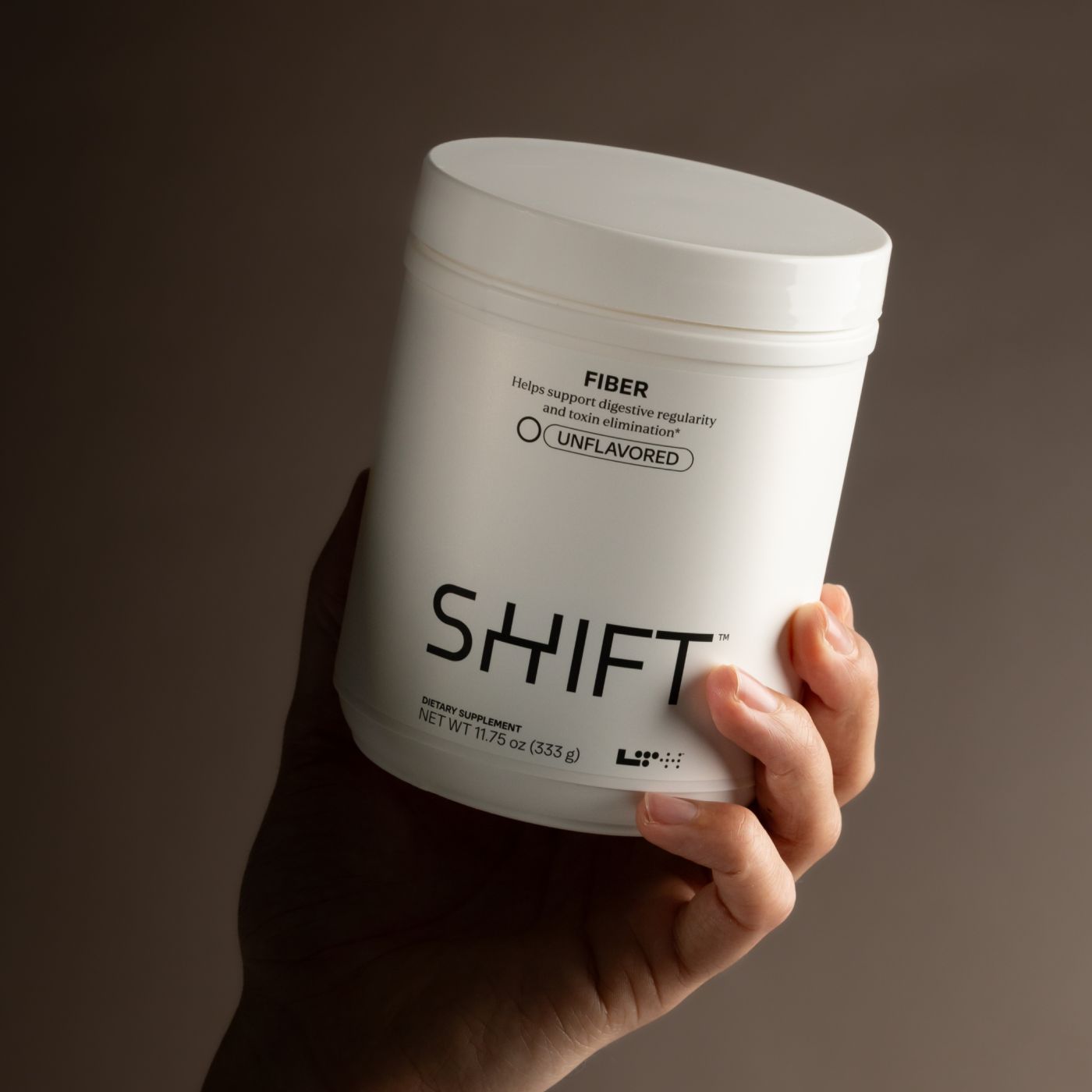
A fiber supplement is an easy way to increase your intake. “You can easily boost the content of what you’re already eating by adding fiber supplementation,” says McKinney. She recommends a third-party-tested option that doubles as a prebiotic, such as LTH Shift Fiber, which is formulated to support digestive regularity, natural detoxification, and balanced gut health.
“You can easily add this tasteless powder to smoothies, pancake or waffle mixes, yogurt, oatmeal, and even to dishes like meatballs or meatloaf before cooking,” she notes. “Some people even mix their fiber supplement with just water.”