



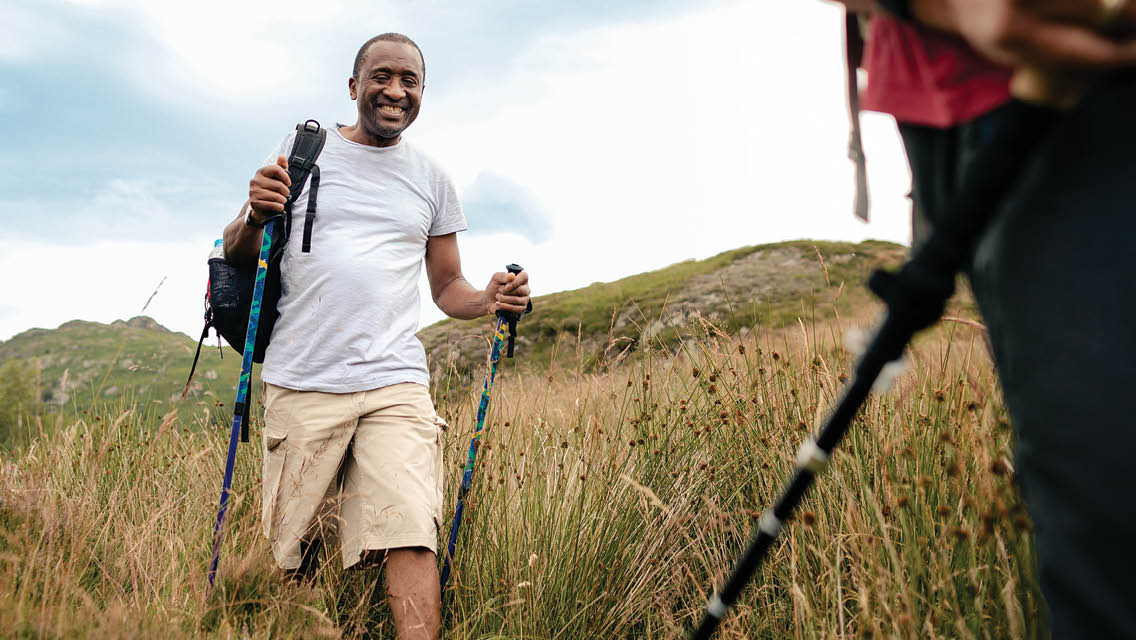
Walking is directly linked to increased longevity, and it’s a common method of exercise for the longest-living people. “If you look at the longevity of people who consistently incorporate walking into their routines, even without strength training, it’s a lot better than those who don’t walk,” says Jason Stella, NASM, PES, CES, Life Time national education manager.
In fact, Reynes contracts with a company for genetic testing to make recommendations for his patients and says exercise influences how we age at the genetic level.
“Walking should be ‘prescribed’ by every doctor for the primary and secondary prevention of dementia and cardiovascular disease,” says Carlos Reynes, MD, a functional-medicine specialist in Oak Park, Ill. He notes that a 2011 study from SAGE Journals points out that “Studies on people with moderate dementia have described numerous positive effects of physical exercise and walking programs: improvement in walking endurance, better urinary continence, enhanced communication, reduced depression, and an increase in activities of daily living.”
The brain-derived neurotrophic factor (BDNF) protein is called a “brain fertilizer” because it helps your brain make neural connections. Low levels of BDNF have been associated with depression, anxiety, poor memory, and brain degeneration.
“Walking should be ‘prescribed’ by every doctor for the primary and secondary prevention of dementia and cardiovascular disease.”
“We now know people can be strong or weak at making these connections,” explains Reynes. “We also know that exercise increases BDNF, and walking actually works better to create this chemical than some supplements out there.”
Research remains inconclusive on just how fast and how much you need to walk for your brain to benefit, but some studies have shown that pace and quantity influence aging. A 2019 Mayo Clinic study of 474,919 participants found a brisker walking pace to be associated with longer life expectancy.
A 2022 meta-analysis of 15 studies involving nearly 50,000 people on four continents found that taking more steps per day helps lower the risk of premature death. For adults 60 and older, however, this risk levels off at about 6,000 to 8,000 steps per day, meaning that more than that provides no additional benefit for longevity.
For adults younger than 60, the risk of premature death stabilized at about 8,000 to 10,000 steps per day. This study found no association of premature death with walking speed, however.
Reynes stresses that the most important thing is to make walking a consistent habit. “A lot of people get caught up in the idea of getting 10,000 steps and think, I can’t make it happen, so they give up. But even 4,000 steps a day has benefits. I tell people that whether they walk, lift weights, or do other exercises, the answer is always improving on your abilities — that’s what makes us optimal human beings.
“Once people start doing anything consistently, they’ll start feeling better and are going to want to do more of it.”








Comments (0)