


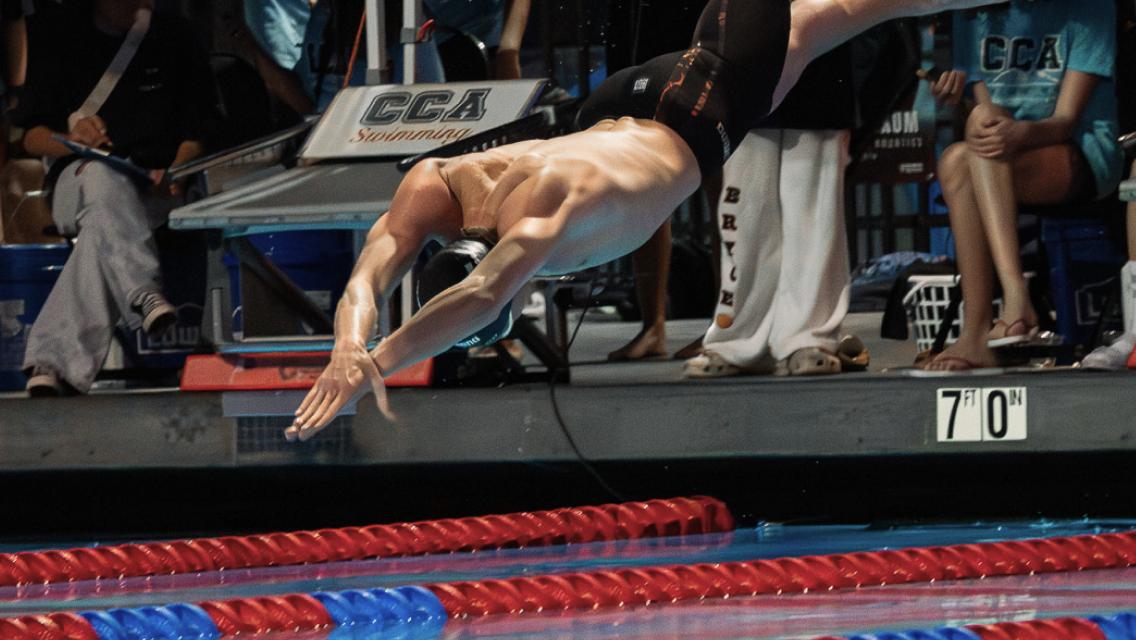
Hailing from Roseville, Calif., Jordan Ragland is one of the fastest junior swimmers in the nation. At just 18, he already has an impressive stack of accolades, including two junior titles in the 50-meter and 100-meter freestyle, and multiple age-group records.
He ranks No. 1 in his home state and sixth nationally for recruiting on Swimcloud; the metric is based on a swimmer’s fastest times and projects collegiate potential. Next year, Ragland is focused on making the NCAA swim team at the University of California, Berkeley.
But before becoming an elite swimmer, Ragland, like so many kids, loved playing in his family pool. “I have memories of being 6 years old swimming at my grandma’s house, and my aunt, who swam at Dartmouth, would put me on her shoulders and swim laps,” he says. “It created these core memories for me, and hearing about her experiences motivated me to pursue swimming.”
At 9, Ragland began steadily and diligently ramping up his training to be a competitive swimmer. What started as a love for the water has transformed into a disciplined training lifestyle — one that’s been shaped and elevated through his experiences on the swim team at Life Time.
“My training at Life Time Arden has built such a strong foundation for me,” says Ragland. “It’s given me a lot of confidence for this next step at [UC Berkeley], knowing that it’s going to be a lot more conditioning and technique work as well. I feel ready and prepared for the challenges to come.”
First Strokes Toward Excellence
When Ragland began swimming seriously, he trained at Arden Hills Athletic and Social Club, a fitness facility that is important to him personally and to the sport of swimming overall. “My aunts trained at this same facility years before me, so this place holds a lot of family history for me on top of the legendary swim history,” he says.
Life Time acquired the facility in May 2025, and it became Life Time Arden, where Ragland continued to train with the Life Time Swim programming.
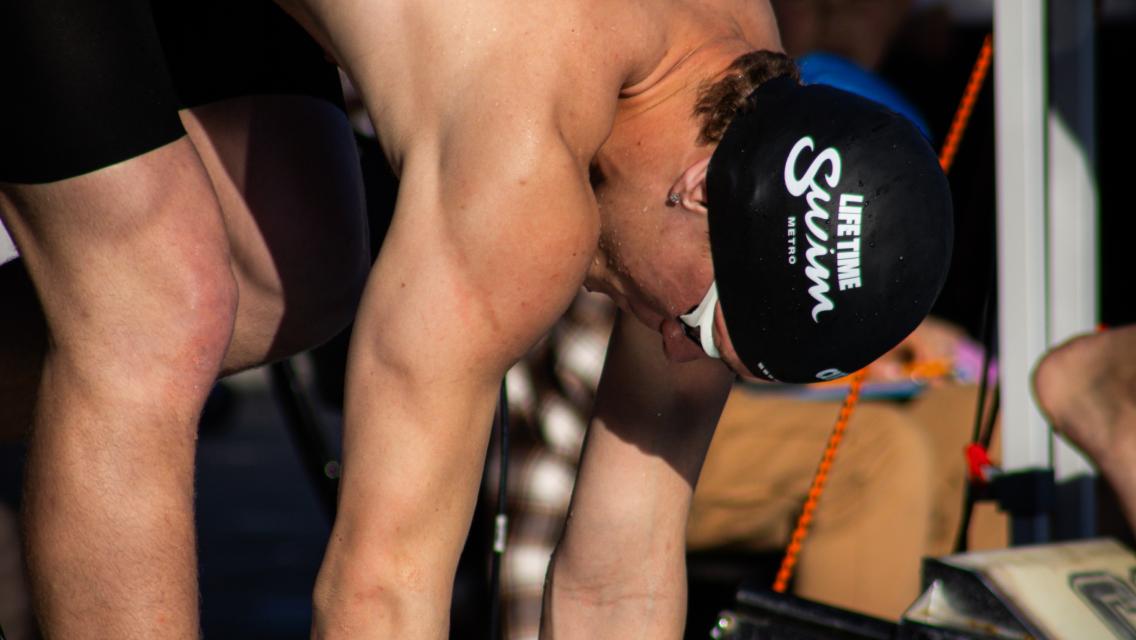
Ragland wasn’t always the strongest swimmer: “I always felt I was a little bit behind; I never really was the fastest kid.” And when college recruiting came into the picture — something he’s been dreaming about since he was 5 years old, he also wasn’t ranked very high at first.
“It’s hard to drop time, and that can get to you. But setting small goals, showing up every day, and staying disciplined — knowing the motivation won’t always be there, but I still need to be — has been key for me,” he says.
Ragland began approaching improvements one day at a time and remained focused on what he could control. “I got lucky with genetics, and my height is definitely a benefit,” he notes, but he credits the people he’s grown up with in the sport for shaping his mindset.
Coach Adric Jope, senior swim coach at Life Time Arden, has been a positive influence for Ragland since his early swim days. “Being coached by Adric has given me such a strong foothold in the sport when it comes to technique and getting all my strokes dialed in,” he says.
Ragland’s teammates are also an important fixture in his swimming career: “I’ve known them for so long, and they’re some of my best friends,” he says. “Just seeing them excel in the sport motivates me to be a better athlete and a leader.”
In December 2024, Ragland finally broke into the top rankings for college recruiting, and he’s been chipping away at his ranking ever since.
“Coach Adric has prioritized mindset since I was young,” he says. “This team has also always been about having fun, and that played a big role in how much I love the sport. We spend a lot of time in the pool — really a significant part of our childhoods — so if it’s not fun, it’s tough to maintain the level of commitment required to excel. Having fun has made me faster, but it also leads back to mindset. I am happy out there, and that makes me swim faster as well.”
Training for the Future
These days, Ragland’s race priorities are the 50-meter and 100-meter freestyle as well as the 100-meter backstroke. This means his training is more sprint- and strength-oriented.
Right now, a typical week of training at Life Time for Ragland consists of three two-hour morning practices and four two-hour afternoon practices throughout the week; he also has a three-hour practice on Saturdays. “It’s a lot of work,” he laughs, “but you get used to it.”
His focuses include advanced aerobic and anaerobic training, refining race tactics, training all four strokes, and maintaining a strong kick. While the bulk of Ragland’s training is in the water, he also devotes time on dryland to strength training, which is critical.
This usually looks like bodyweight and compound lifting, Ragland explains, with a concentration on leg, core, and chest strength, along with shoulder mobility. “I’m primarily focused on my legs for explosiveness,” he says. “This means a lot of high reps with heavy weights, and then a lot of explosive reps with resistance bands — just trying to build that power.”
Ragland is also intentional about recovery and rest. “I stretch and roll out almost every single day on my own for about 20 to 30 minutes right before bed,” he says. “After practice, as a team, we stretch for probably 10 to 15 minutes. And after harder workouts, we use the recovery tools at Life Time Arden.”
Ragland gravitates to the Normatec compression sleeves and the CryoLounge chairs in the LT Recovery zone. He also likes to use the sauna as a physical and mental reset.
“Intentional recovery gives me the confidence that I’m not going to get injured as easily, and it also helps my mental state,” he says. “It’s really hard to practice when you’re sore or when you don’t feel your best. Recovery allows me to push more when it comes to speed and technique during practice.”
Achieving Olympic Goals
When Ragland broke the 50- and 100-meter freestyle records previously held by Olympian Luca Urlando at a high-school sectionals race in December 2025, it was a defining moment. “Having my name on a few record boards and being in the caliber of my Olympian peers is a really cool feeling,” he says.
But there is one moment for him that ranks above the rest: For more than a year, he carried around a notecard with one goal on it: 1:02.19. “That was the Olympic trials cut for the 100-meter breaststroke in 2024,” he says. “And it was the time I wanted to personally make.”
In 2025, at the USA Swimming Futures Championship — an annual, national-level meet for rising swimmers — Ragland touched the wall in the 100-meter breaststroke at 1:02.12.
“It was such a relief to prove to myself that I could get that time and have that personal success,” he says. “I still carry that notecard in my swim bag.”
Next year, Ragland plans to bring the fundamentals from his training at Life Time to the UC Berkeley swim team. “Under Coach Adric’s coaching, we take our sport very seriously, but we’re able to balance the stress of meets and hard practices by letting loose too,” he says. “It’s always a fun practice at Life Time.”
He’s also looking forward to training with some of the best swimmers in the world at UC Berkeley, he adds, while keeping his Olympic aspirations front of mind. “Who’s to say what will happen in the next two years,” he says. “But I’m going to be doing everything I possibly can to be on that 2028 Olympic team.”
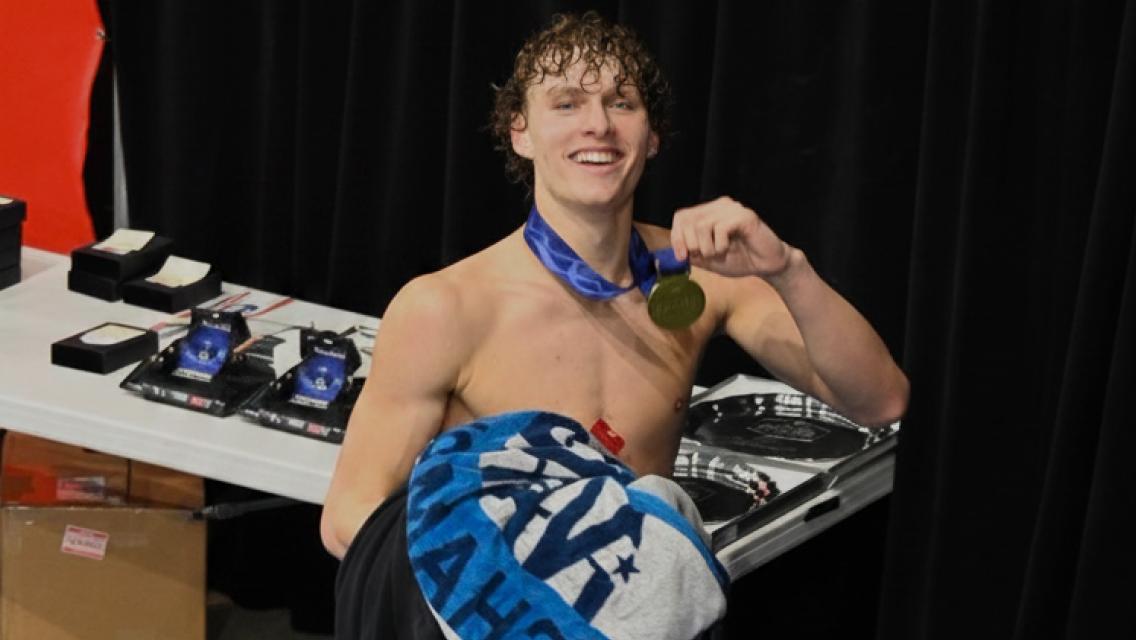
4 Benefits of Competitive Swimming at Life Time
The Life Time Swim competitive teams operate under USA Swimming, the national governing body for competitive swimming in the United States. “There is no higher level for junior competitive swimming in the [United States],” explains Alicia Kockler, senior vice president of Life Time Kids and Aquatics.
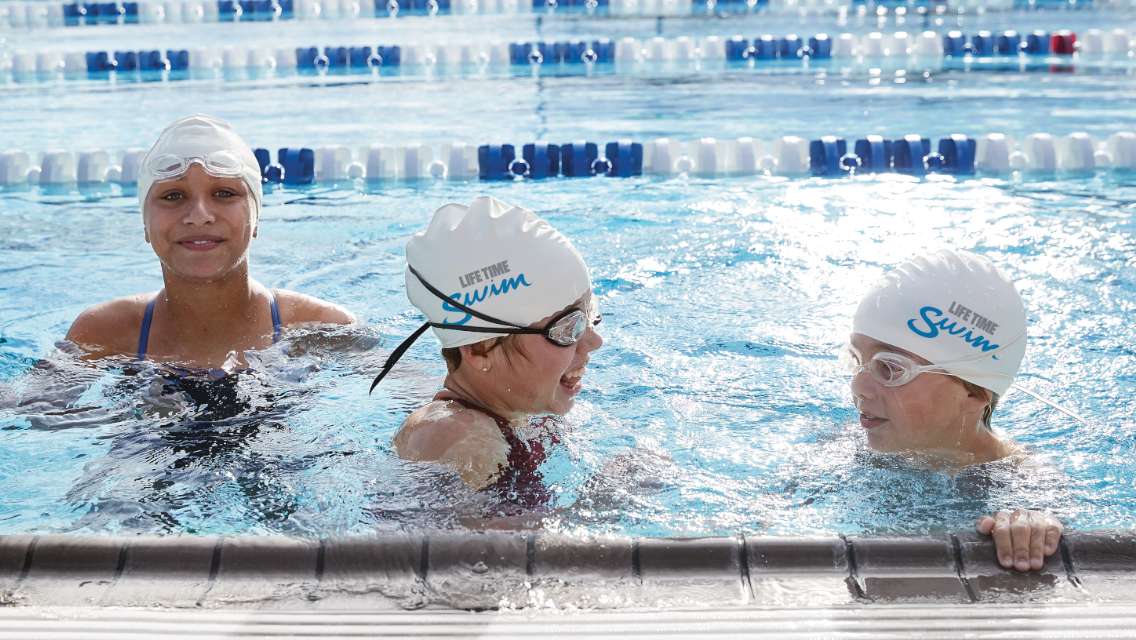
Swim teams range from summer recreational teams to highly competitive national-level options. Life Time’s competitive swim teams offer age-specific training — from ages 5 to 18 — that challenge and develop each swimmer, with elements like weekly practices, professional coaching, and regular meets. (Learn more: “What You Need to Know About Life Time’s Swim Team.”)
Here, Kockler and Jope break down the ways Life Time can transform younger swimmers into driven athletes.
1. Facilitating Athlete Progression
The best way to get kids started with Life Time Swim programming is swim lessons.
They learn swim fundamentals and can eventually transition onto the Developmental Swim Team — a team for kids exploring the possibility of a competitive swim team. “Here, they’ll refine their strokes and get to experience what it’s like to be on the swim team with a lower time commitment of 45 to 60 minutes, twice a week,” says Kockler.
If competition is of interest, kids can work their way up the Life Time Swim Team tiers: bronze (beginner level); silver and gold (intermediate levels); and finally, senior (advanced level). At the senior level, a swimmer trains approximately six days a week for two hours each practice.
There is also a college team, an advanced-level option for swimmers who train and swim with their college teams during the school year and then train with Life Time in the summer months.
“Life Time Swim Team programs are designed to allow athletes to progress throughout the teams as their skill level, dedication, and desire to achieve more grow,” says Jope. “We offer ‘progressive stimulus’ in our training so our athletes can continue to improve without hitting plateaus often experienced in the sport.”
2. An All-In-One Training Facility
Jope, who has been a swim coach for 17 years and has coached thousands of young athletes, says there are unique advantages to training his swimmers at a Life Time athletic country club.
“We have everything on site in a world-class facility — it’s a one-stop shop for any swimmer who wants to be elite,” he says. “At Life Time Arden, we have a 50-meter Olympic pool with 20 short-course lanes. We also have top-notch fitness and recovery spaces, where swimmers and athletes can hit the steam room, roll out their muscles, get stretched out on the massage tables — anything that they need as a high-level athlete. There are not really a lot of sites that offer what we have here.”
Kockler adds that Life Time swim teams aren’t at the mercy of other teams’ calendars, like those who practice at a local recreational center or a school district facility. “Our practice days and times remain consistent throughout the year,” she says.
And as a Life Time member, your benefits further compound: “Parents are also able to multitask while their kids swim,” she says. “Younger siblings can participate in swim lessons or spend time in our Kids Academy, while parents can get in a workout, do some work in our lounges, or enjoy a spa service.”
3. A Life Time Swim Team Network
A perk of Life Time Swim is that swimmers can experience the closeness of a small team and get access to a vast network of swimmers who practice at other local clubs.
“What makes our swim teams unique is the fact that we can have multiple clubs in the same area compete as one team at meets,” says Kockler. “Swimmers get the benefit of the feel of a smaller swim team during practices at their local club, but they also get to compete as one large team at meets when we combine multiple local clubs to form one team.”
4. Person First, Athlete Second
The essence of the Life Time Swim programming is to value the person who shows up, according to Jope. “We truly care about our athletes as people first,” he says. “This allows them to freely pursue their goals in the sport uninhibited from outside pressures.”
He adds: “What drives the culture of Life Time Swim is impressing upon the kids to have good character and be good people. That is something that builds upon itself — both in and out of the pool. As coaches, we aim to curate an environment where kids can feel accepted, safe, and happy to put in the work to chase their goals and dreams.”