



Backbends come in many forms: standing, kneeling, and lying down; mini-bends of the upper back; and deep, head-to-feet variations. They’re ubiquitous now in fitness circles, thanks to their popularity in many yoga classes.
When done right, backbends offer a powerful stretch through the front of the body, including the muscles of the chest, abs, hips, and thighs, as well as a controlled hyperextension of the spine. This can feel wonderful, offsetting the hunched posture many of us favor when facing our computers, smartphones, steering wheels, dinner plates — even during activities like running or bicycling.
With time and practice, backbending can help relieve tension and build mobility.
Trouble can arise, though, when we approach backbends with the intention of achieving something extreme. Pushing the spine beyond what can be safely controlled can be uncomfortable or painful.
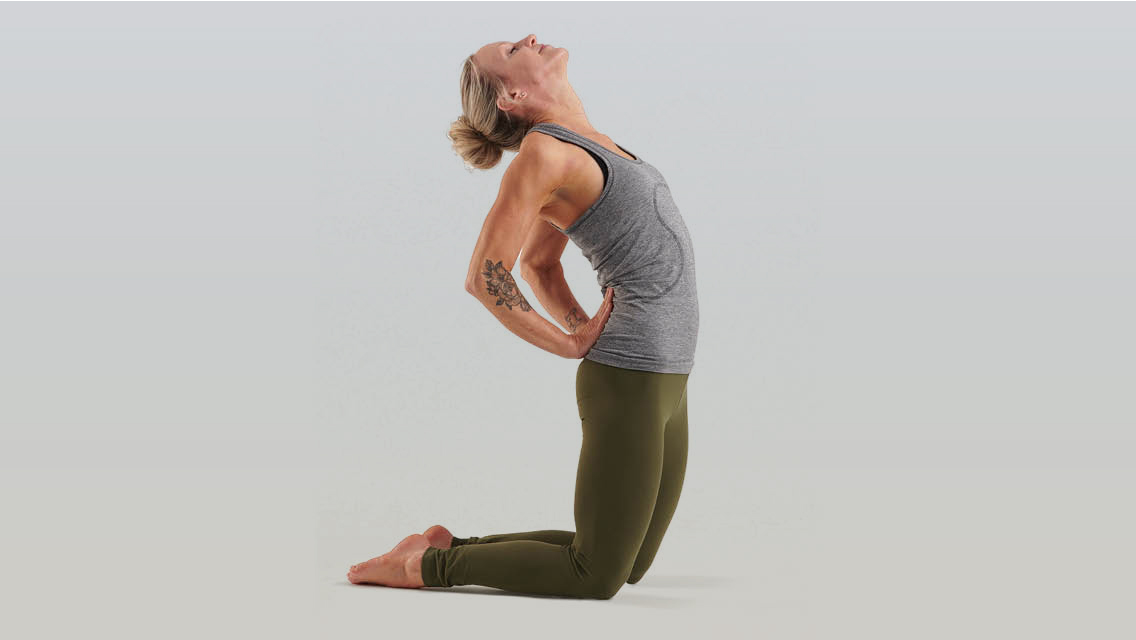
The variation pictured above is a way to practice spinal extension and front-body opening in a low, supported posture. It might be familiar to you as the setup to camel pose in yoga asana practice.
Think of this less as an end goal — a posture that needs to be achieved — and more as an exploration in stretching through the chest without crunching through the spine. The focus here is moving up and back with control and while breathing.
As you gain awareness of your spinal movement, you’ll be able to take the lessons to other backbend variations you enjoy.
-
Begin in a tall kneeling position with your knees and feet hip distance apart, toes pointing straight back, and hands placed on the small of your back.
-
Inhale and feel your chest lift, as if there were a string connecting your sternum to the ceiling.
-
Press down through your lower legs, draw your shoulder blades together, and lift your chest up. Shift your gaze up and back, without craning your neck. Move only as far as you can with control.
-
Hold for five to 10 breaths. On an inhale, return to the starting position, with control and leading from your chest.
Other alignment tips to keep in mind:
- Avoid leading this stretch with your head. Initiate the movement (and return to the start) from the sternum.
- Keep your upper body engaged throughout the movement with your chest reaching for the ceiling and shoulders drawing together and away from your ears.
- Don’t force your hips forward to deepen the stretch. Keep your pelvis neutral.
- Keep your thighs perpendicular to the floor throughout the movement.
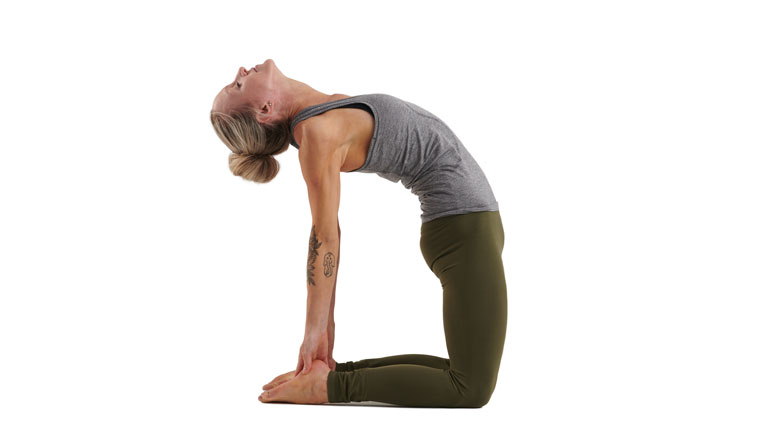
- In time, you may choose to increase the stretch by moving your hands from the small of your back to your heels (demonstrated in this photo) — but only do so if you can keep your pelvis positioned over your knees.
This article originally appeared as “The Kneeling Backbend” in the June 2021 issue of Experience Life.




Comments (0)